
Agents are expected to manage complex tasks like booking multi-layer travel itineraries to streamlining business processes which would previously need human intervention.
McKinsey & Company recently authored a case study on the rise of ‘Agents’ and its implications on workflow, productivity and the nature of generative AI. Generative AI (gen AI) systems, like large language models (LLMs), have gained attention for their ability to generate content, analyse data, and provide insights. But McKinsey’s latest findings suggest the next step for AI will be the emergence of “agentic” systems—digital agents capable of handling complex workflows autonomously. These AI agents are expected to manage tasks ranging from booking complex travel itineraries to streamlining business processes traditionally requiring human intervention.
According to McKinsey & Company, these agents have the potential to revolutionize business processes, cutting review times by up to 60% in tasks like credit-risk assessments and code modernization. Major tech players such as Google, Microsoft, and OpenAI are already investing heavily in this technology, aiming to unlock new levels of productivity and innovation.
Unlike chatbots, which are primarily knowledge-based, AI agents operate by moving from information to action. McKinsey highlights that the agents’ ability to complete multistep workflows will enable businesses to automate processes that previously required significant manual input.
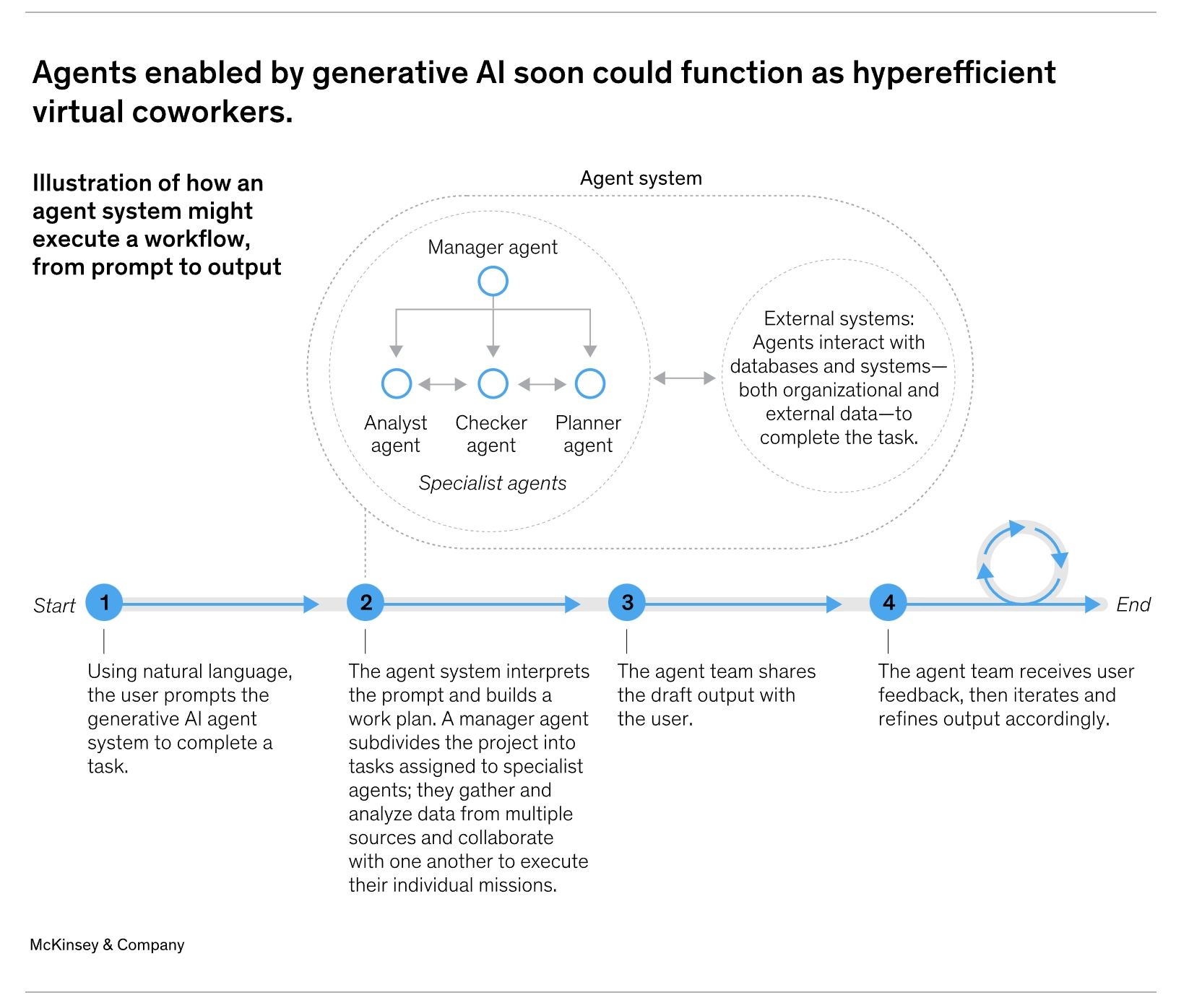
A new age of automation
McKinsey identifies three key ways AI agents can improve workflow automation:
- Handling complexity and multiplicity: Traditional rule-based automation systems often fail when faced with unpredictable inputs. However, AI agents adapt in real-time to a range of situations, which allows them to navigate complex workflows with multiple possible outcomes.
- Simplifying automation through natural language: Agentic systems can understand and act on instructions provided in natural language, making them more accessible to non-technical users. This reduces the need for manual coding, which in turn will help with lowering costs and speeding up deployment.
- Interfacing with existing tools: AI agents can integrate, almost seamlessly, with existing software, search for information, and communicate across digital ecosystems. This adaptability eliminates the need for extensive manual data integration, drastically reducing the time required to collate information from multiple sources.
Industry applications and real-world use cases
McKinsey’s study explores the potential applications of AI agents across various industries, offering three hypothetical use cases that could redefine how businesses operate.
- Loan underwriting: AI agents could streamline the labor-intensive process of credit-risk assessments by handling specialized tasks like document compilation, financial analysis, and final credit memo creation. This would reduce review cycle times by 20% to 60%.
- Code modernization: Legacy software poses risks and challenges for businesses. AI agents can analyze outdated code, document business logic, and translate it into modern systems, offering a scalable solution for enterprises undergoing digital transformations.
- Marketing campaigns: AI agents could revolutionize digital marketing by automating complex tasks such as campaign design, content creation, and market analysis. By integrating various software tools, agents could help marketing teams execute campaigns faster and more efficiently.
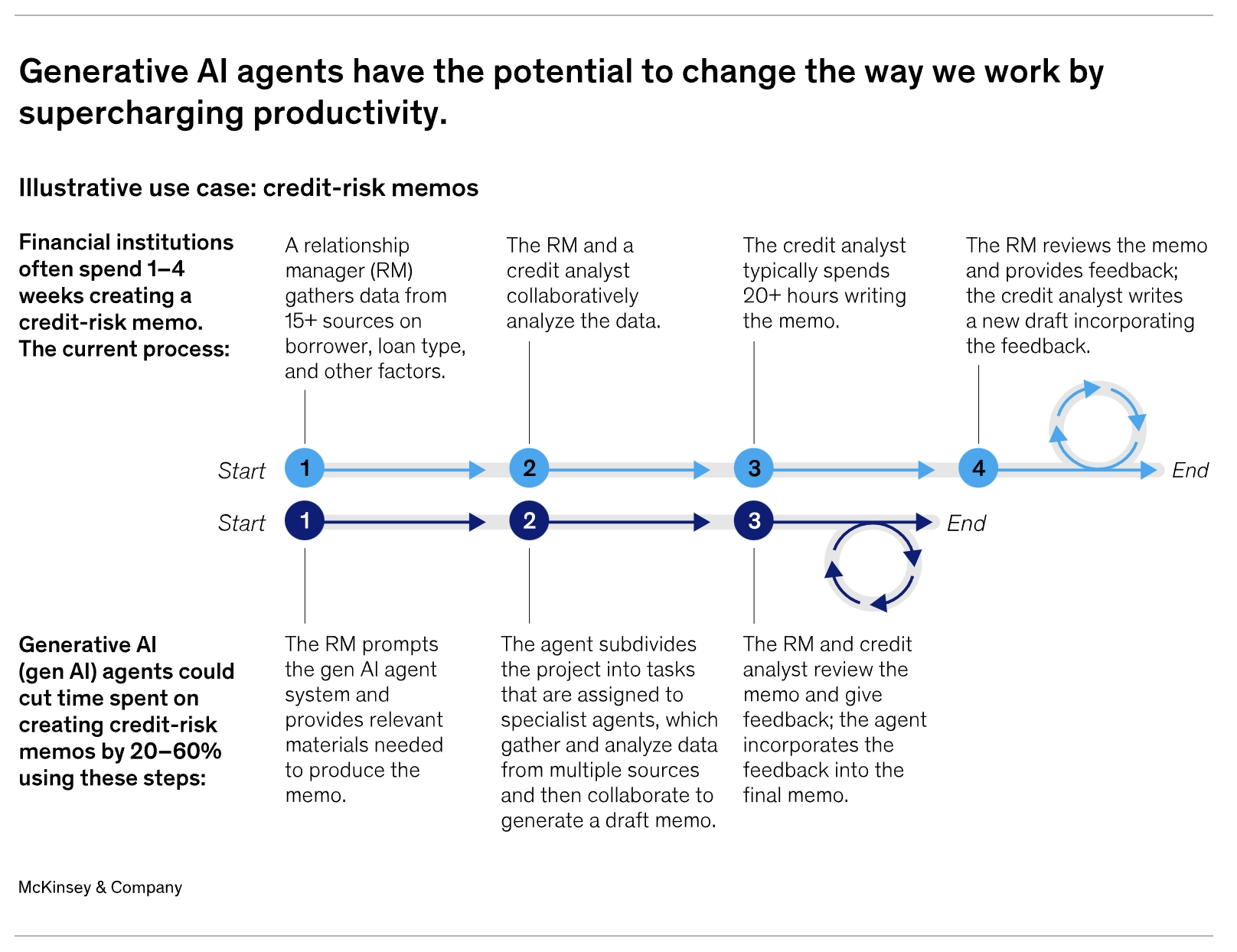
Preparing for the era of AI agents
While the technology is still evolving, McKinsey advises business leaders to begin exploring how AI agents could enhance their operations. McKinsey’s recent “State of AI” survey found that 72% of companies are already deploying AI solutions, with interest in gen AI rapidly increasing. Businesses should prepare by codifying key workflows, planning their tech infrastructure, and implementing human-in-the-loop control mechanisms to manage risks and validate AI outputs.
Despite the promise of AI agents, McKinsey cautions that significant development is still needed before these systems can operate independently. Ensuring accuracy, compliance, and fairness remains crucial, and businesses will need to train, test, and monitor AI agents much like they would human employees.
Still, as agentic systems continue to evolve, McKinsey predicts they could become as commonplace as chatbots, potentially transforming entire industries by enabling businesses to automate complex, open-ended tasks with unprecedented efficiency.