
Agoda’s CEO marks 12 years at the helm with a candid reckoning: what got you here won’t get you there and the age of AI demands something harder than data.
Omri Morgenshtern, CEO of Agoda, arrived at his first WiT Japan at what he cheerfully acknowledged was a full cycle – 12 years at Agoda, 12 years of WiT Japan – and sat down for a conversation that felt less like a corporate keynote and more like a genuine audit: of leadership, of instinct, of what a travel tech company built on optimisation must become in a world that rewards leaps of faith.
From a few hundred to 8,000 – and what changes along the way
When Morgenshtern joined Agoda 12 years ago, the company was a few hundred people, entrepreneurial in the scrappiest sense. “The type of people that could put their hands on anything, all sorts of great people travelling through Asia,” he recalled. “We couldn’t afford to ask where the best talent in the world is. We just grabbed who we could.”
Today, Agoda employs north of 8,000. The new Bangkok headquarters, widely regarded as one of the most impressive travel tech campuses in Asia, is a deliberate statement about what the company is trying to attract: world-class engineering talent.
The leader who runs that company is, by his own admission, a different person from the one who walked in. “I used to believe I could do a lot of things by myself. At a certain size, that works –you need that conviction, otherwise you compromise too much. But then you realise you’re surrounded by very smart people and you have to listen for the gold. Everyone has gold. Maybe it’s 5%, maybe 50%, but there’s gold there.”
The transition from control freak to collaborator was not painless. Data helped. “Arguments without data are difficult for me. But if there’s good data behind it, then it’s easy to believe.”
Equally important: giving people genuine scope, trusting them with outcomes, and resisting the urge to replicate past successes. “What got you in year one is not what gets you in year two. The most important characteristic of a good leader is flexibility.”
The optimiser’s dilemma – making the leap
Morgenshtern laid out this paradox. Agoda became exceptional by becoming the world’s most rigorous optimiser. Scientific experimentation, relentless conversion improvement, PPC precision that no competitor could match – these are the engines of the company’s growth. “Nobody could compete with us in a PPC auction because our conversion improved, bang, bang, bang.”
But in an age of AI-driven disruption, the optimiser’s instinct becomes a liability. “We became glorified optimisers. And in ages of disruption, you need to move from optimisers to leapers. Take leaps of faith. That’s not intuitive. It’s not what we’re used to.”
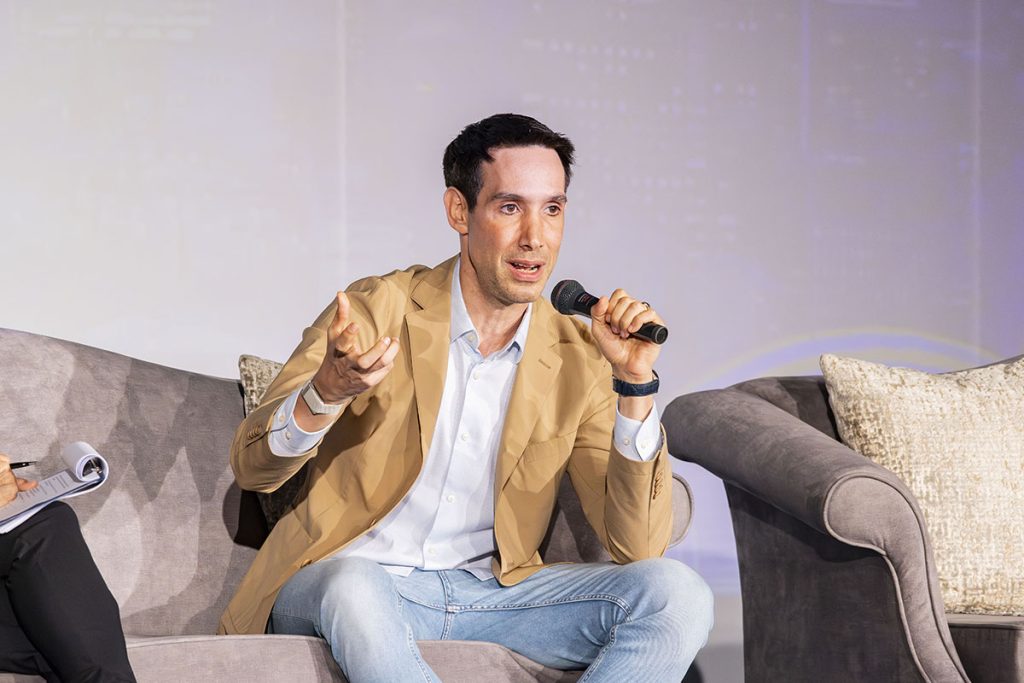
Self-disruption, he argued, is not about abandoning rigour entirely. It is about carving out a deliberate portion of your bets – 30%, 40%, whatever number you choose – for things that cannot be A/B tested into existence. “You can’t tell the story of all the hypotheses that would need to be proven before you reach the destination. So at some point you make a leap.”
He offered three specific bets Agoda is placing.
- First: that one engineer will be able to do the work of 10 in the foreseeable future – and Agoda wants to be the first to get there.
- Second: that one customer support agent, augmented by AI, will be able to do the work of 50 –and again, first mover matters.
- Third: that consumers will consolidate their travel journey – planning, inspiration, booking across multiple verticals – into a single platform, rather than stitching it together across tabs and apps. “I’m betting on the consumer to do more of the funnel in one place. Including booking. Including inspiration.”
On AI and joy, and not confusing automation with simplification
The conversation touched on something raised at the recent Expedia’s Explore conference: that people actually enjoy travel planning. The difficulty, the discovery, the friction – it is part of the pleasure. Does AI risk stripping that out?
Morgenshtern drew a careful line. “Simplifying and automating are not the same thing. Some people just want it done. But the majority want to know what they’re buying. They want to be empowered, not dictated to.”
The right model, in his view, is AI as canvas – providing recommendations, handling complexity, but keeping the human in control. “It’s very easy to think AI is there to take control away from us. I’m in the camp that says AI is here to recommend, but the control stays with us.”
User experience, he was quick to add, is as important as the AI itself. “It’s not only the AI. It’s how you present that’s equally important.”
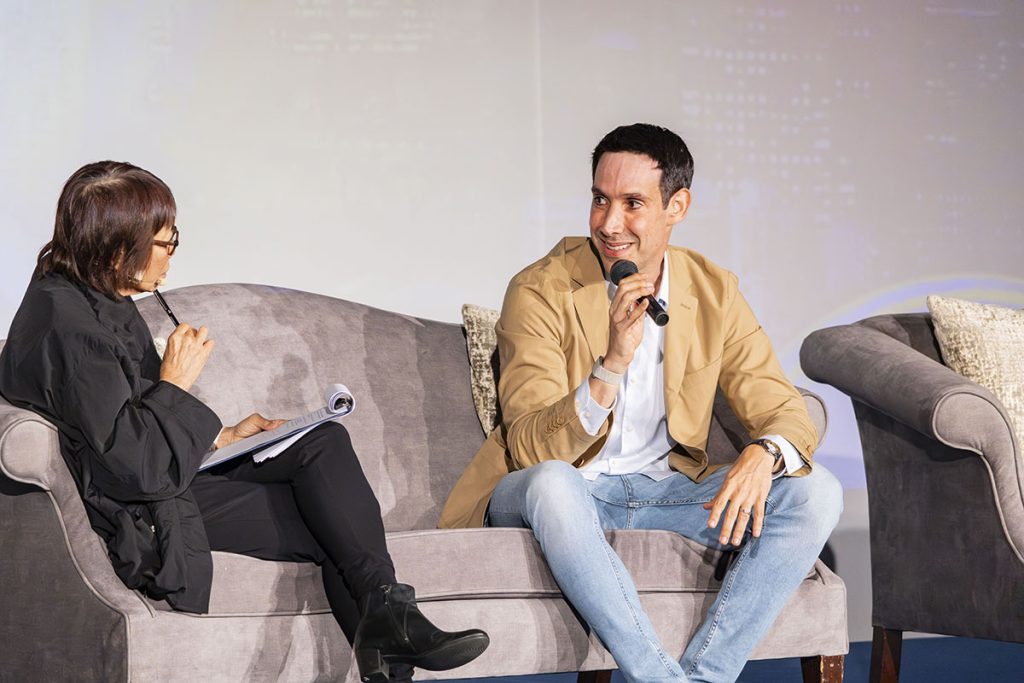
The B2B bet – bringing it together in one place
Perhaps the most structurally significant move Agoda is making is the consolidation of B2B operations across Booking Holdings – Agoda, Priceline, Booking.com – under Morgenshtern’s oversight.
Asked how easy it would be to bring those brands together when they’ve always competed against one another in the consumer front, he said that in B2C, the separation of brands serves everyone well: different brands attract different consumers, different partners, different markets. “The consumer base is so big and so different that having separate brands makes sense.”
In B2B, the calculus changes. “There are far fewer partners. And having separate teams building the same fundamental products again and again creates internal competition and overinvestment.”
The opportunity: pool the engineering talent, build one world-class B2B product, and access segments that no single brand can reach alone. His example – a US consumer who wants to book using Citibank points, and will only book via the platform that accepts them – illustrated the market expansion logic neatly.
“If we could take all the engineers working on B2B and put them on one product, we’d have the best B2B product in the marketplace by far.”
He said, “I love the potential. When I see huge potential – like growing something 10x in 10 years – I’m drawn to that immediately.”
And, he added, “My task is very clear and I tend to hit my tasks.”
Precision and velocity: not a trade-off
One of the more practically interesting moments in the conversation came when Morgenshtern described running AI against customer support standard operating procedures. The AI matched the SOPs 97% of the time. His team was frustrated – not good enough, they said. He asked: how often do the humans hit that standard? Ninety-two percent.
“We are emotional. We get tired. All sorts of things. AI doesn’t get tired. It has bugs, but it doesn’t get tired.”
His view: AI will improve both precision and velocity simultaneously – not as a trade-off, but as a compounding advantage. The catch is that you have to build verification and quality processes into every autonomous workflow. “It’s a journey. But the tools are getting there.”

What Japan knows, and what it has to work on
Tying it back to the conference theme, “The Next 20: Precision, Reinvention, Quiet Power”, it seemed right to ask what Japan could teach the rest of the world.
“The combination of an extraordinary willingness to work hard, the dedication to achieve perfection, and the power to generate beauty, beyond anything, anywhere. From the food you eat to the museums to just everything. It’s a crazy amount of investment and wondrous beauty, and in Japan it’s like the next level.”
The lesson he drew for Agoda: that diversity is the mechanism, but perfection is the destination. “You need people who can go quick and dirty – expose fast, learn fast, iterate. But where you want to end up, once you’ve learned, is that sense of perfection that is so unique to this place.”
What does Japan need to bring into the equation? More willingness to make mistakes – not as a failure of standards, but as the only route to earning them. “Perfection means you’re not making mistakes. But you need to make mistakes in order to learn.”
He paused. “The amount of mistakes I’ve made — I’m sure we could bring my wife here to catalogue them. But all of them made me able to create something closer to perfection than I would have otherwise.”