


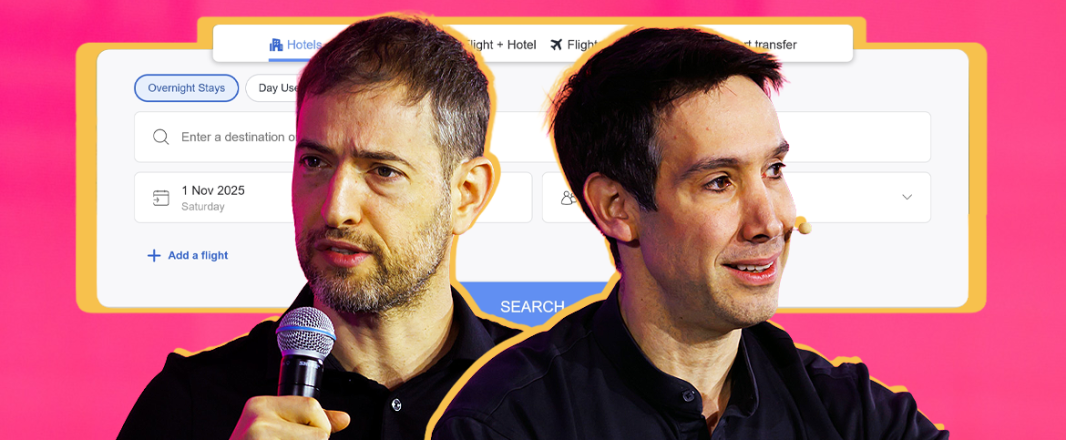
What CEO Omri Morgenshtern and CTO Idan Zalzberg say comes next: exponential change, trust-by-design, and a connected trip that finally feels…connected.
The pivot: from “search & save” to “anticipate & serve”
Turning 20 is a moment for reinvention. Omri Morgenshtern frames Agoda’s next chapter in two words: “exponential” and “shifting.” The consumer experience in travel “stayed very similar for close to 20 years.”
That changes now. GenAI is the catalyst, but the bigger story is a willingness to invest – especially up-funnel – where OTAs previously struggled to monetize. The bet: in three to five years, travellers will feel a jump “like the move from desktop to apps.”
“There’s now a plausible future where, at the top of the funnel, OTAs, not search engines, own discovery in travel,” said Morghenshtern.

Trust before tricks: 80% or bust
Demos are easy; durable behaviour change is hard. For Morgenshtern, an AI-native OTA must deliver a compelling experience that works for 80% of people, 80% of the time – or risk eroding trust. That’s why Agoda’s approach is evolution, not revolution: progressively making the existing product better, rather than launching “Agoda AI” for novelty’s sake.
Bottom-of-funnel first: answer the hard questions
Idan’s team started where stakes are highest – property detail pages – with “Ask me anything” for ultra-specific queries: garage height, pet size limits, edge-case amenities. When Agoda doesn’t know, the system pings the hotel, learns, and answers the next traveller instantly. It’s AI that closes knowledge gaps rather than hallucinating around them – precisely how you compound trust, said Zalzberg.

Self-disruption with a governor
The leadership dilemma: innovate hard without breaking the cash engine. Omri’s rule is to continuously allocate “firepower” (people, money) to disrupt yourself – more in volatile times like now, less in steady periods – while never letting the core slip.
“This is a period of time where businesses, especially big businesses, need to spend a lot of the firepower, money, people, on trying to disrupt yourself, on building things that you wouldn’t have built otherwise,” he said.
Two notable shifts:
- Up-funnel investment: inspiration and proactive assistance, historically under-resourced, are now priorities.
- Platformized compliance: regulatory scale (payments, data, consumer protection) becomes central plumbing so product teams can move fast without tripping legal wires.
Connected trip, for real
Agoda has pushed beyond hotels into flights and activities, but Idan is blunt: each vertical has gnarly, different problems.
- Flights: deep integrations (seat maps, meals, reissues), fast-changing prices, and suppliers whose cheapest fares don’t always have the best tech. The target experience: never bounce a user to the airline – solve it in-flow.
- Activities: normalize messy catalogues (“Is this the same Universal Studios ticket?”), surface meaningful differences, and make intent the organizing lens.
On stitching, the aim is simple: no dead ends – search, plan, book, modify, and recover in one flow, with context preserved.

Fintech is the flywheel (but it’s a marathon)
Agoda’s price reputation isn’t going away—“price remains decisive across all verticals”—but the moat is getting wider: 111+ non-card payment options, localized fintech, and a path toward ‘OTA-as-bank’ features (multi-currency cards with superior FX, savings/credit, working capital for partners).
The timing is long because regulation is slow by design; doing it right is what earns the trust to hold your travel wallet.
What they won’t outsource: the user relationship
Idan admires the LLM ecosystem but is clear-eyed about platform risk. Agoda will integrate (e.g., through partner surfaces) without becoming a background pipe. The brand must own the experience and the conversation – in chat, in app, across the journey – so it can understand delight and deliver it.
The human thesis
“People are going to have more time. We’re going to make travel more available to everyone and it will happen much more. The passion to travel, this idea that I want to explore, is so rooted in being human that we believe it will become more and more of how we spend our time and then do we have the right technology to support it?” said Zalzberg.
So more time, more travel, more inclusion. Longevity and “living-as-a-service” will blend hospitality into everyday life. AI will take the grunt work out of logistics; humans keep the meaning. Even two decades out, both think we’ll still be talking about AI – and authenticity, privacy, and what we value as people.
Rapid-fire signals for 2045 (their bets)
- What disappears: cash.
- What persists: text-based chat as a control surface.
- What changes travel most: AI.
- Where heats up: Vietnam and Punjab.
- Spirit of the age: exponential.


