
The International Air Transport Association (IATA) has reported that the global air travel demand in November 2023 surged past 99% of 2019 levels, showcasing yet another milestone in the rebound from the challenges posed by the COVID-19 pandemic.
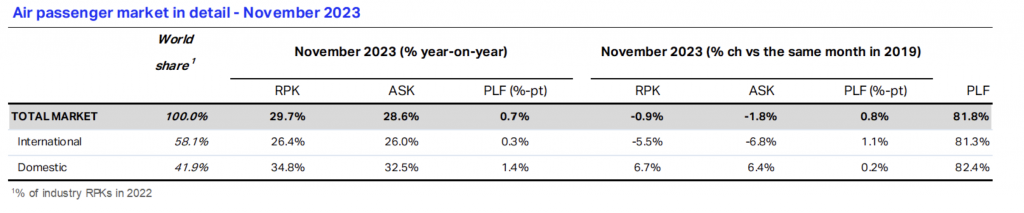
November 2023 witnessed an increase of 29.7% in total air traffic measured in revenue passenger kilometers (RPKs) compared to the same month the previous year. The global air traffic now stands at an impressive 99.1% of the levels observed in November 2019. The recovery was broad-based, with both international and domestic segments contributing to the positive trend.
International travel momentum
International air travel displayed robust growth, experiencing a 26.4% surge compared to November 2022. The Asia-Pacific region emerged as a powerhouse with a 63.8% year-over-year increase, showcasing the strongest performance among all regions. In November 2023, international RPKs (Revenue Passenger Kilometers, measures actual passenger traffic) reached 94.5% of pre-pandemic levels, marking another step towards a full recovery.
Domestic markets on the rise
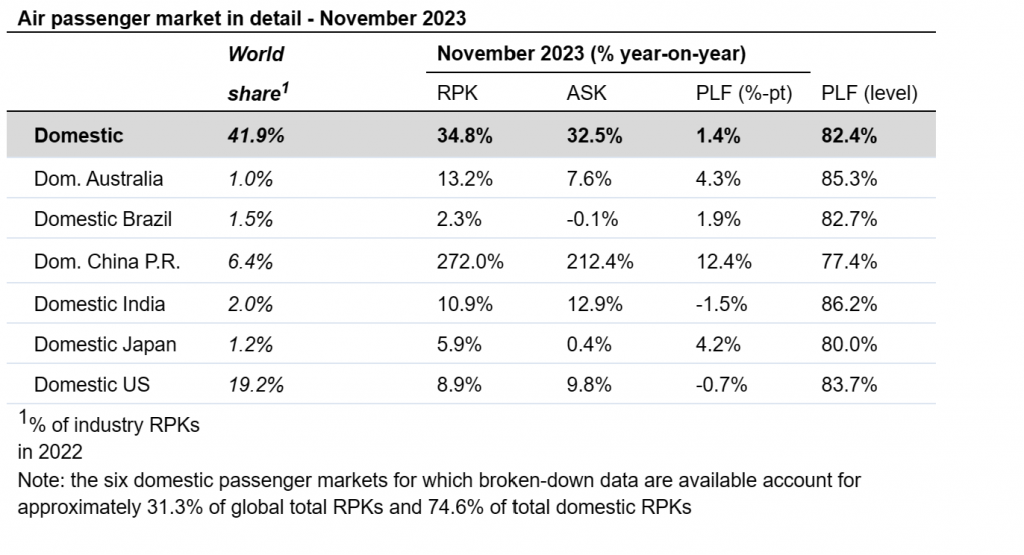
Domestic air travel in November 2023 witnessed an upswing, recording a 34.8% increase compared to the same period in 2022. Notably, the total domestic traffic surpassed November 2019 levels by 6.7%. China stood out with a growth rate of 272%, rebounding from the COVID-related travel restrictions imposed a year earlier. The United States also experienced a surge, reaching a new high with a 9.1% expansion over November 2019, fueled by the Thanksgiving holiday demand.
Willie Walsh, IATA’s Director General, commented, “We are moving ever closer to surpassing the 2019 peak year for air travel. Economic headwinds are not deterring people from taking to the skies. International travel remains 5.5% below pre-pandemic levels, but that gap is rapidly closing. And domestic markets have been above their pre-pandemic levels continuously since April.”
Regional air traffic insights
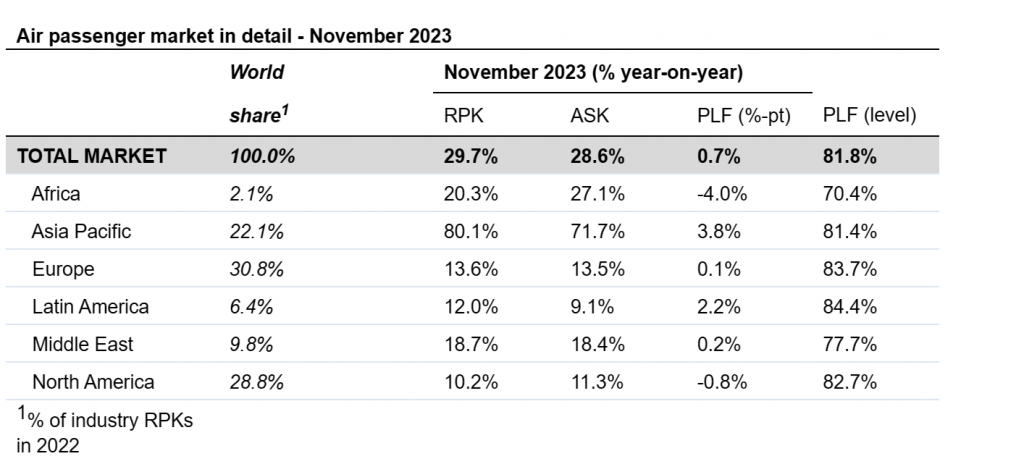
Asia-Pacific: Airlines in the Asia-Pacific region exhibited a remarkable 63.8% rise in November traffic, coupled with a 58.0% increase in capacity. The load factor reached 82.6%, underlining the region’s resilience and recovery.
Europe: European carriers experienced a solid 14.8% increase in November traffic. With a capacity rise of 15.2%, the load factor slightly declined to 83.3%.
Middle East: Middle Eastern airlines saw an 18.6% increase in November traffic, with a capacity rise of 19.0%. The load factor dipped slightly to 77.4%.
North America: North American carriers reported a 14.3% increase in November traffic, supported by a capacity rise of 16.3%. However, the load factor fell to 80.0%.
Latin America: Latin American airlines marked a 20.0% increase in November traffic, outpacing other regions. The load factor reached an impressive 84.9%.
Africa: African airlines experienced a substantial 22.1% rise in November RPKs, with a capacity increase of 29.6%. However, the load factor dropped to 69.7%, the lowest among regions.
Sustainable aviation fuel (SAF) and climate change commitments
Walsh emphasised the aviation industry’s commitment to sustainability, stating, “Airlines agreed to achieve net-zero carbon emissions by 2050, and every drop of SAF ever made in that effort has been bought and used.” He pointed to the urgency for governments to follow through on their declarations and implement comprehensive policy measures in 2024 to incentivize the rapid scaling-up of SAF production. This aligns with recent international agreements, including the Third Conference on Aviation Alternative Fuels (CAAF/3) and COP28, which highlighted the need for transitioning to sustainable aviation fuels to combat climate change.