IN what has become a familiar cadence of biannual comprehensive updates, Airbnb is releasing the newest version of its platform, described as “the biggest change to Airbnb in a decade.”
In 2021, Airbnb also released widespread revisions in May and again in November.
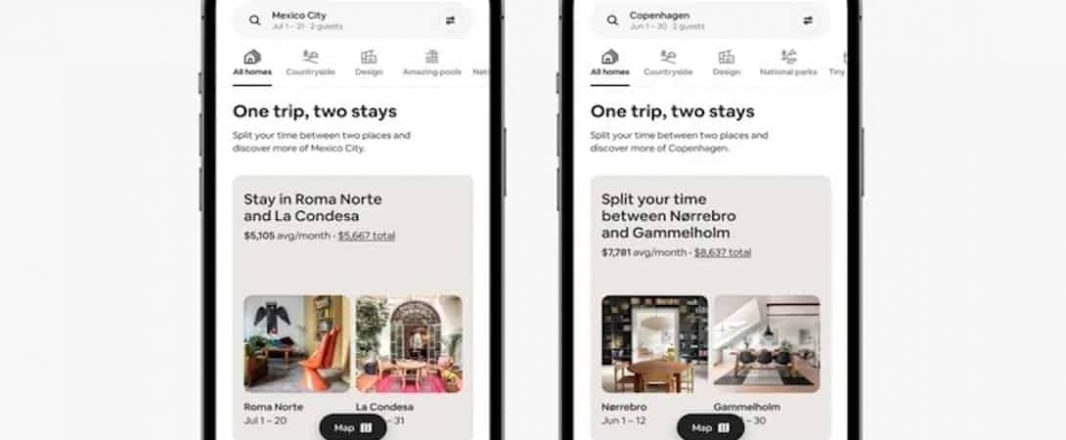
One of the most interesting updates in the “Airbnb 2022 Summer Release” is a feature to split bookings for stays of at least one week and up to six months between two properties – creating a solution to address the growing demand for longer stays.
In a call with financial analysts last week to review the company’s Q1 2022 earnings report, co-founder and CEO Brian Chesky said: “Stays of a month or longer continue to be our fastest-growing category by tripling compared to 2019. And nearly half of our nights booked in Q1 were for stays of a week or longer and one in five nights booked were for stays of a month or longer.”
Eighty-seven percent of Airbnb’s listings accept stays of 28 days or longer, but in some markets demand is outpacing available inventory for those types of bookings.
“We saw that people were struggling to find places that were open for 20, 30, 40 days at a time, particularly in markets where we see a high demand. So the team came up with this idea – why don’t we have an algorithm that basically helps folks find inventory, or will stitch together split stays, in order to be able accommodate the time frame and the length of the stay,” says Tara Bunch, Airbnb’s head of global operations, in an interview with PhocusWire.
When a search for a longer stay returns fewer than 300 properties, Airbnb will automatically offer options to split the stay between two properties that meet the property type and amenities from the search. The company says this will surface up to 40% more listings in inventory-constrained markets.
Users can indicate how far they are willing to drive between the two locations, from two to six hours, view the properties on a map that shows the route and then reserve them, one after the other, in a single booking flow.
Comprehensive categories
The “split stays” feature is also integrated with another feature launching today, called “Airbnb Categories,” which organizes properties based on their style, location or proximity to an activity.
The categories are an expansion of the “Flexible Destinations” tool that launched in May 2021 whereby a user could choose “I’m Flexible” in the location field to be presented with options to select homes in one of 27 categories. Now users will see 56 categories on the Airbnb homepage of its website and in the app.
Bunch says the purpose is to make users aware of the variety of properties that are available on Airbnb and to give them more choice in how they begin their discovery. Those that begin by selecting a category can then narrow the results with dates, location and other filters such as the average price per night or number of bedrooms.
Style categories include “amazing pools,” with one million properties; “design,” with 27,000 properties that have been featured in design publications or designed by a renowned architect; and “windmills,” with 190. Location categories include 900,000 properties near a beach, 120,000 near a vineyard and 6,500 inside or near the Arctic Circle. And activity categories relate to a property’s suitability for an activity – such as skiing, for which there are 400,000 properties.
Airbnb says, to date, four million of its six million properties have been put into at least one of the 56 categories through machine-learning systems that have analyzed the title, descriptions, photo captions and structured data from hosts and from guest reviews.
Computer-vision technology also surfaces the appropriate lead photo for each property, based on the category searched. For example, a home listed in the categories of both “chef’s kitchen” and “grand piano” will display the corresponding photo, depending on how the user finds the property.
Fourteen of the 56 categories also offer the option of splitting the stay between properties, meaning a user could choose the “surfing” category and split the stay between properties in two different beach towns.
“It’s an incredibly smart algorithm. And the more that we build on that, the more we’ll be able to meet whatever unique needs any guest has, whatever the criteria is,” Bunch says.
“It’s, I think, unlocking creativity in travel that maybe we haven’t seen for a long time.”
Guest protections
Also as part of these latest updates, Airbnb is enabling a suite of guarantees for guests. The protections are part of Airbnb’s “AirCover” programme, which launched in November with protections for hosts.
Now, in expanding it to guests, Airbnb says it is “the biggest upgrade to Airbnb customer service in a decade.”
The guarantees include a promise to find a similar home or issue a refund if the host cancels a stay within 30 days of check-in; if the guest is not able to check in to the property; or if the property is not as advertised.
Airbnb has also created a 24-hour communication line available in 16 languages through the app and on its website, staffed by agents trained to resolve issues and assist with rebooking as necessary.
“You will see a big red ‘get help’ button. … Any time you need help from us, you hit that ‘get help’ button and you are let into, essentially, a support flow that includes human and messaging interactions,” Bunch says.
“It’s really a more proactive approach to getting help for our guests when an issue occurs. It is rare … but we feel like when it happens, it can really be acute if we don’t lean in and take care of it quickly.”
Airbnb revenue hit $1.5 billion for the January to March period for the first time in the company’s history. The U.S.-based home-sharing and alternative accommodation giant saw revenue increase by 70% year-over-year – 80% higher than the corresponding quarter in 2019 ($839 million), before its listing on the public markets.
* This article was first published in PhocusWire.