
Dykes to “farm” SEA for deeper partnerships to drive membership programme
Increasing loyalty members and app users and doubling down on its B2B will be the key thrusts of Expedia’s strategy in Asia Pacific as it rebuilds its business in the region post-pandemic.
Specifically in South-east Asia, Michael Dykes, vice president, market management, Asia Pacific, who’s recently relocated to Singapore from Tokyo and learning the nuances of the region, said the focus would be skewed towards more B2B where he sees his role as being more of a farmer than a hunter.

Michael Dykes: Bringing a balanced approach between hunting and farming to build a bigger Expedia world in Asia Pacific.
“It’s not very glamorous,” he laughed, “but my priority will be to help our B2B team deepen our relationships with local partners and build those APIs necessary for us to support both our businesses”.
For Dykes, it’s been interesting to learn how different South-east Asia is from North-east Asia, not only in market structure, but also down to social practices, such as exchanging of name cards or, in Singapore’s case, exchanging WhatsApp contacts, which can be strange for those who see the latter as more of a personal channel.
Added Dykes, “Obviously, I know North-east Asia well and Australia and New Zealand. South-east Asia is a new place and it’s been a lot of discovery. Here, there’s a whole ecosystem built around a growing middle class and we have massive local partners for our private white label business so we want to look at how we can gather the goodness of that, without our own brands.”
Asked if this strategy is in place because its retail brands are not as strong in South-east Asia as in North Asia and Australia/New Zealand, Dykes said, “We are making choices as to where to invest in brands. If you look at the overall travel market, it’s a super fractured market and consumers have lots of different brands to choose from – direct supplier, local OTAs, global OTAs. That will not change.
“During Covid, we struggled but in Asia Pacific, it wasn’t as bad because of our B2B channels and we were able to ride on the domestic demand of partners such as Trip.com and Traveloka.”
Globally, the group has 50,000 partners. He could not disclose the number of partners in APAC but said “we have good coverage and we are always looking for areas to expand into, and partners to develop”.
A key priority is to deepen existing partnerships, in particular, to support its loyalty programme, which CEO Peter Kern, in the most recent earnings call, had called out as a winning strategy. “With the proof now very clear that our strategy is working, we will begin more aggressively rolling it out to our other brands and our non-US markets,” Kern had said.
It is poised to launch its new OneKey loyalty program, which will span all its main brands, including Vrbo, its vacation rental business. Kern called it “the broadest, most flexible loyalty programme in the world … and importantly, it will complement our many partners’ loyalty programmes as well”.
Supporting that, Dykes said, “We will put a lot of energy into our programme’s member-only deals, and we will pass that to our demand partners as well if they have a membership programme.”
While Dykes could not disclose how many loyalty members there were in Asia Pacific, he said, “About 60-80% of the demand in North Asia is coming from our loyalty programme. It is clear loyal members drive production and new members have increased dramatically globally – 60% in 2022 versus 2019 while mobile memberships have gone up by 40%.
“We will focus on developing our membership programme and increase in app users. It is paying dividends in North-east Asia. In South-east Asia, it is more oriented towards inbound, the region as a destination and global members are critical to that growth.”
Another leg of its B2B strategy is package penetration, said Dykes. “Traditionally, we get a rate that can be bundled with flights. That’s helpful for Japan and Thailand, they like that. But can there be a broader definition – can we bundle with activities, or trains? There’s a whole area to be developed, our demand partners to take advantage of our bundled rates? Are we leveraging our packaged rates enough within our B2B ecosystem?”
China reopening will propel growth, Japan outbound is “final piece”
Asked how much of a role APAC had to play in the group’s robust earnings, Dykes said, “The growth in terms of searches and bookings is aggressive in APAC right now, it’s definitely an important factor in the continued recovery of the company. Searches increased by 10% in Q4, a lot of that was driven by APAC.”
Phocuswright’s latest report projects that APAC will regain its top spot as the world’s largest regional travel market in 2025 when it reaches a projected $490 billion, 10% higher than its 2019 value.
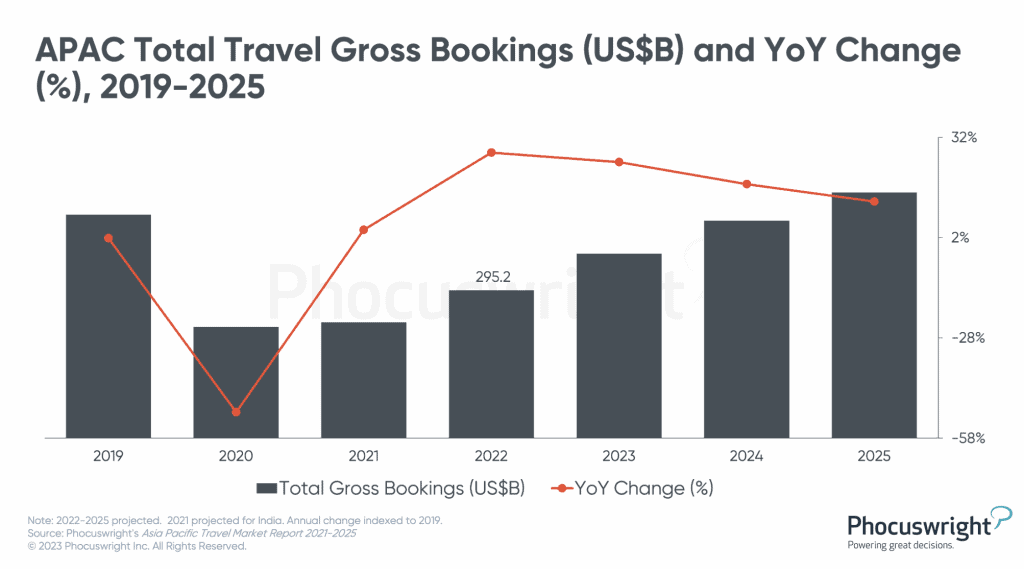
Said Dykes, “The middle class population in India, China and Indonesia is way bigger than any of the other markets. We have seen APAC recovering rapidly and we are on the cusp of finally getting back to 2019 levels.
“At the end of last year, we were concerned because China is 20%-30% of APAC travel and our worry was, how to fill that big hole, so we did a lot of work to develop India and Indonesia, and now that is running really well. So China is incremental. We’re pretty bullish on this year.
“The only market we’re hoping to see more momentum on is Japan. Perhaps as the domestic travel stimulus by the government runs out, we hope to see more Japanese travel abroad – that’s the final piece.”
Aggressive searches for APAC, preferences shift from beaches to cities, and about hotel rates in Japan
Meanwhile, he said that searches in North America for APAC destinations were up 20% in 2022 over 2019, and within APAC, searches are also over 2019 levels. “That’s good news, and with China opening, memberships really matter because it will bring in travellers.”
He said that destination trends have also shifted – in 2022, the top destinations were Maldives, Hong Kong and Fiji while in 2023, traditionally strong city destinations have come back. “Tokyo and Osaka are back, Bangkok, Seoul, Bali – people are shifting from beach and coastal to cities. Look at how busy Singapore is, seems urban is back and I wonder, when will we worry about over tourism again.”
He said that the more measured opening in Asia spared the industry “the worst of the pain, it gave us more time to adjust and bring some people back”.
Speaking of his home, he said Japan, like everywhere else, is still struggling to find people to work in the industry. “We have hotels preferring to keep occupancies low because they don’t want to compromise on the level of service.”
Average rates though, he observed, had increased only a little – “nowhere near the levels of Singapore or Australia”.
“Japanese hotels are in a tricky situation – they have to balance domestic and international demand. I was speaking to a domestic hotel chain and they said, if I increase my rates, my traditional customer may struggle with that.
“The good news is there are many new hotels being opened by foreign companies and without legacy, they can set the prices at a new level. In my personal opinion, this is good for the travel economy in general, it will open the door for others and perhaps we will have a slow gravitational pull-up which will help the overall economy.”