
“Sustainability is not just about carbon emissions but the difference you make in people’s lives”
South-east Asia’s hospitality industry is in the midst of a “rainbow revolution” driven by new demographics of customers, said Ho Kwon Ping, executive chairman of Banyan Tree Holdings, which turns 30 next year.
Speaking at the sixth PHIST, the sustainability event run by Phuket Hotels Association, C9 Hotelworks and Greenview, Ho said, “There’s been a complete change of demographics in South-east Asia – tourism used to be uni-colour and uni-direction. It’s a rainbow revolution now – all colours even in low season in Phuket and within South-east Asia.”
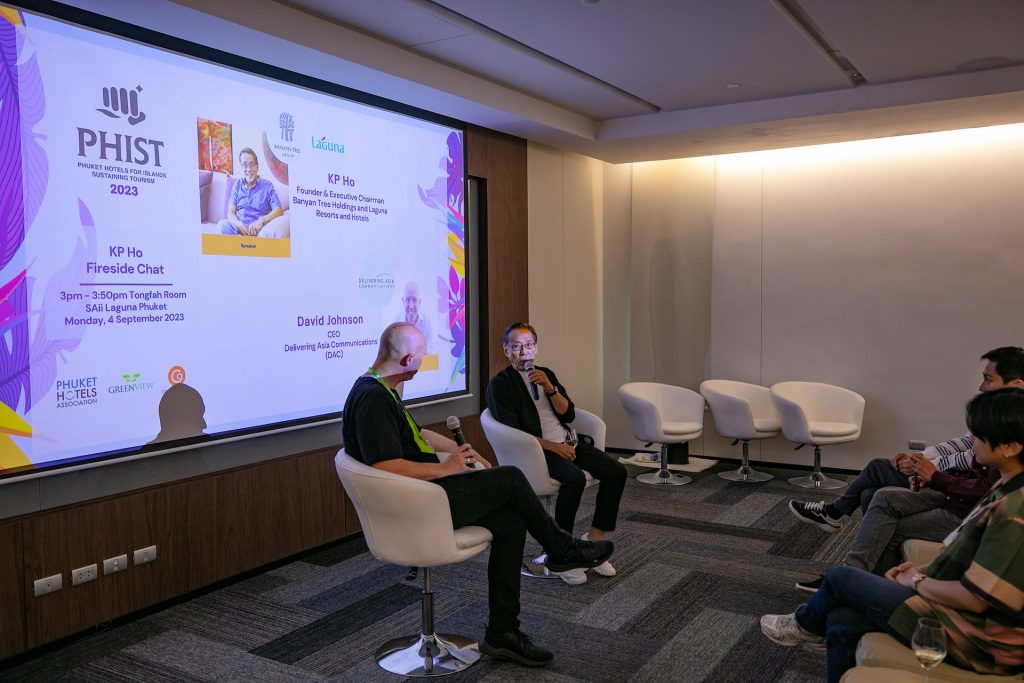
Ho Kwon Ping: “It’s the owners choice. If you can’t hold it, don’t do it. It’s not supposed to be something you tick off the boxes. It’s a continuing journey.”
He said this was also being seen in human capital with different nationalities now assuming management roles and on the ground level reflected in menu choices, with more international offerings versus uni-cuisine.
In terms of sustainability, the key lesson learnt over the past three decades is, “sustainability is done through grassroots levels” and “through a culture of trust between employer and employees”.
When he and his wife, Claire Chiang, started Banyan Tree, their mission was to empower people and embrace the environment. He feels the developed world has too defined an idea of the environment.
“Sustainability is not just about carbon emissions but the difference you make in people’s lives. It’s a long burn journey. If a business focuses only on profits, it takes away the essence of what’s important.”
In the past, he said, there were no terms such as sustainability, CSR, ESG like today but he and Claire knew they wanted to develop something based on their mission. “We’ve seen bad times. During crises, staff take voluntary pay cuts; when times are good, management pays back, so there’s an element of trust. It is important to build a culture where associates of the resort and restaurant feel they make a difference to the enterprise.”
Banyan Tree was also the first chain to enter the Maldives, which was a poor country. “Tourism was the only way to get income into the country,” he said. “We wanted to make a connection between the people who serve and the guests, to create a whole those of community, to create jobs for the locals.”
The key was to “get young people off the street, to train them so they work at the resort and restaurants”, he said.
Ironically, with the current focus on sustainability, he feels some businesses are focusing too much on such initiatives. “There needs to be a reasonable balance,” he said.

Banyan Tree Vabbinfaru, Maldives: “We wanted to make a connection between the people who serve and the guests, to create a whole those of community, to create jobs for the locals.”
For Banyan Tree, he feels they are 95% close to sustainability and if the other 5% is too difficult financially, “let it go”.
“It’s the owners choice. If you can’t hold it, don’t do it. It’s not supposed to be something you tick off the boxes. It’s a continuing journey.”
He observed that “there is nothing more powerful than sticking to a commitment and to experience the journey of change”.
Tourism can be a double edged sword, he said, when you have irresponsible developers and contractors. “You have the power in tourism to empower people, help the environment and to make a difference.”
He said that while the public relations battle has been won in terms of the mood around global climate change, “the physical battle has not yet been won”.
“In the past, owners were offensive towards sustainability. Now they are defensive for the lack of sustainability.”
He added, “Innovation doesn’t fall from the sky. It’s a response to real life problems, it comes out of necessity.”
What upsets him about the industry are unappreciative and abusive guests towards staff who cannot respond back, as well as businesses that collect service charges and do not distribute to the staff, and this is an area that Banyan Tree stands firm on.
“The service culture between guests and service provider – it’s not for salaries alone, it’s got to be because you can create special moments for the customer. Hospitality has got to be exciting and motivating for young people to attract them to the industry.”
As for what’s next, he said, “You’ve got to successively pass on things to the next generation.”
The key challenge is how to preserve what the founders built, “but also not to abide by the original playbook, you need to innovate and watch trends, to keep the ethos, values and culture – keep the legacy and what you stand for, but to continue to innovate.”
As for Phuket in the next 10 years, he observed that only when you have resorts elsewhere “do you realise there are very few international class destinations in this area. It meets the climatic needs of people – it has great weather during winter for people from North Asia and Europe.”
He sees a greater Phuket evolving where it will become a hub, including Samui and Phanga in South Thailand. “The infrastructure will enable it to happen, the cuisine in Thailand is truly unique plus Thai people’s great attitude.