“Remember when we met last November in Florida at Phocuswright?” asked Michael Becker, CEO and co-founder of Geosure, the safety assessment app for travellers. “It was a collection of some of the biggest and most well-known travel industry luminaries – to think that trend could be broken and $8 trillion brought to its knees. No one saw this coming.”
“Yes, we were all so innocent and ignorant then,” I replied.
Becker is aware of the irony of what he’s saying because since 2014, when he started Geosure, his mission has been to make the world a safer, more predictable place “by making safety available to everyone in a scalable, understandable way”, and creating a location safety score, GeoSafeScores™. Just as you have Michelin stars for restaurants, you should also have safety scores for places, he believes.

Covid-19 and its decimation of the travel industry proved how unpredictable the world can be, but Becker is undeterred in his mission to make the world a safer and more predictable place, using big data, predictive analytics and AI. Indeed, you could call this crisis a breakout moment for Geosure because, suddenly, medical and health have risen to the top of the agenda for all travellers.
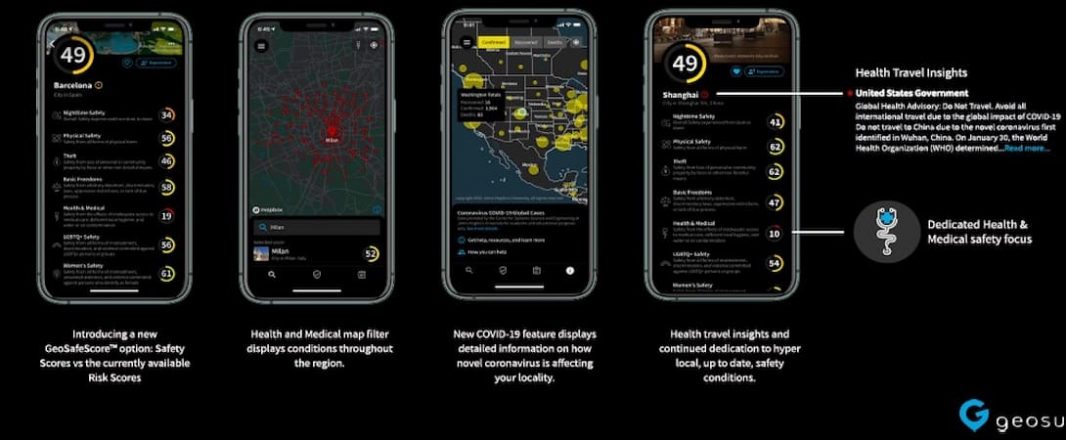
Geosure ranks safety across seven categories – physical harm, theft, women, LGBTQ, AM/PM, political freedoms and health and medical. “The last two – political and health and medical – were backwater categories. No one really cared about that,” said Becker, “until now.”
With its experience in risk modelling, Geosure has been keeping watch on the evolving pandemic and baking in Covid-19 and health signals into its platform. “We have been getting a lot of queries from travel companies as well as integration requests – also from non-travel companies.
“Everyone’s keen to get the right information to help their customers and how it can help them get to the other side of recovery,” said Becker. eDreams ODIGEO is one of the OTAs that has integrated Geosure scores into its offerings, and SAP Concur is one of its key TMC clients.
Indeed, as far back as mid-January 2020, Geosure signals had been monitoring the situation in Wuhan. In this blog, dated February 20, it said “we did not and still don’t view coronavirus as a “fast rise time, fast decay time” event, but more persistent” and “we expect sustained impact, including within the United States, albeit with moderated effects due to better testing and response”.
In addition, an article, written by one of its advisors and investors, pointed out that “what GeoSure’s data is saying with confidence is that the pathogen will remain a health risk for at least six-to-twelve months. They do not see abatement for between four-and-six months, even if we do everything right.”
Becker shies away from making a prediction on when the Covid-19 crisis will ease up and travel can begin to recover. “What we are doing is working with companies who need a Covid-19 response and a Health & Medical response for when the cycle turns.
“This is one of the most rapidly evolving environments that anyone has faced. We are monitoring data and signals and for the most part, we are looking at various locations, what cities and countries may move the trend sooner rather than later, and travel industry clients, across a huge spectrum – destinations, OTAs, TMCs, hotels, travel insurance, tech startups – are asking, how can we best position ourselves?”
It has launched a new mobile app which measures safety scores in 65,000 cities and neighbourhoods. The app measures the safety of an area on a scale from one to 100 – the higher the number, the safer it is. A check on Singapore (May 5) shows high scores in all categories except health and medical.
In line with its original vision of democratizing safety, the new mobile app is free with a premium tool, GeoSure Plus. It has also put together a GeoSure Covid Compendium and is working on the launch in the second quarter of what it says will be “one of the largest GDS’ API of only Health & Medical safety ratings related to Covid for 65,000 communities”.

Safety information should boost confidence, not create fear
GeoSure has come a long way since its founding in 2014. Becker said, “I used to travel a lot, mountaineering, adventure trips and I used to ask, what does safety look like in Mongolia, Central Asia, Peru? When I did my research, I found most answers also raised more fear and anxiety. I felt we needed safety information that gives you confidence, doesn’t make you feel afraid.”
With his background in data and safety and security, he thought of a way to index or quantify safety to make the world “a safer and more predictable place”.
He recalled the early challenges. “Back then, people would look at me funny and asked, why would I want that, even though safety is a fundamental part of traveller confidence. It’s not been easy, it’s one of the hardest things I’ve ever done. We knew the world needed an empowered hyper-local awareness safety quant.”
Its focus on women safety, launched in 2014, gave it a powerful use case that caught the attention of TMCs like SAP Concur. Last year, it introduced LGBTQ safety ratings as well as AM/PM (daytime/nighttime).
Given the hyper-local nature of safety, granularity in data is an important part of the value proposition. “I can’t tell you the tens of thousands of man hours that has gone into putting this together over the last eight years,” he laughed. For example, it’s scaled San Francisco from one location to 49, New York City from 28 to 236 and Los Angeles has more than 250 locations.
One important dimension of its safety scoring is “the ability for community members and travellers to participate and contribute to their own safety”, said Becker. “Safety is an unalienable right – so you should get to participate in it. That’s good for everyone, travellers, business, communities. It creates a positive feedback loop.”
In many ways, Geosure works like a Tripadvisor of safety but clearly it’s not as sexy as travel reviews. It’s also stayed focused on B2B, and B2B2C and even though it has a consumer-facing app, Becker said, “We will not stray from the core foundation of our B2B business, which touches 20 million users.”
He said Covid-19 has also sparked an awareness of the need to collaborate on data sharing. “We are in a crisis – now is the moment to work together and collaborate on data rather than be concerned about privacy.”