
From b-boy dancers to fashion designers, young Koreans are expressing themselves and are sharing and telling the world about it
For the next generation of travellers, the human experience as well as community will still be paramount even as their use of tech in how they plan, buy and experience travel becomes more prevalent. Expect, however, a more engaged and demanding Gen Z consumer.
That was the key message from “The Next Human Revolution” session at WiT Seoul which brought together a diverse panel of local talent ranging from fashion designers and bboy dancers to content creators and one Chief Marketing Officer for a car sharing service – all of whom have found their own unconventional paths in life.
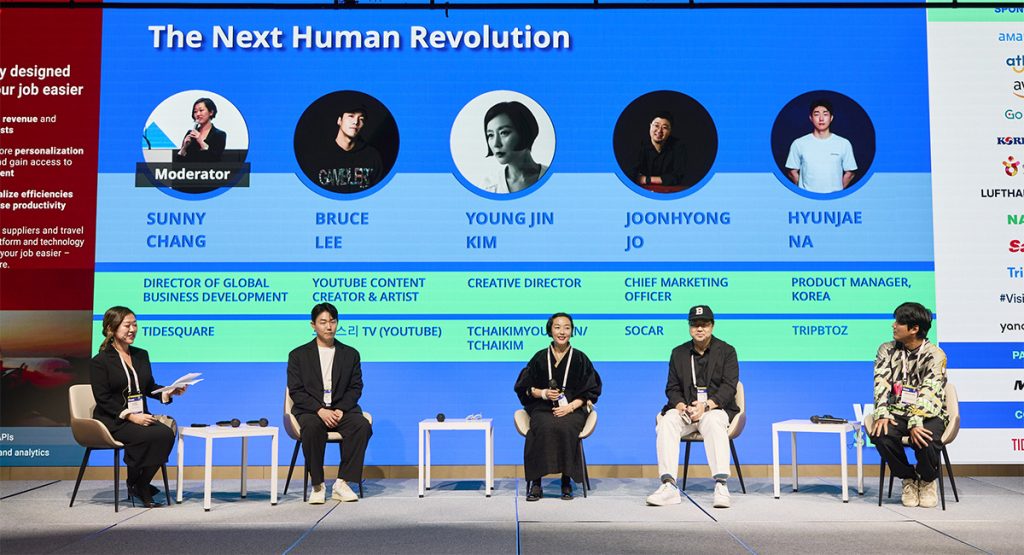
Bruce Lee, a travelling YouTube artist with a big following on his channel, as well as bboy performer, stated that community and humanity has been key in helping shape his lifestyle. Lee is a founding member of Gamblerz, a South Korean b-boy crew formed in 2002, and which performed at the opening of WiT Seoul. They are considered to be the pioneers who brought K-culture to the outside world, and have won several awards, both in the country and on the global stage.
Lee said that without the community which formed around the dance, he would not have been able to undertake his first round-the-world trip in 2018. Over 476 days, Lee danced around the world, performing with local dancers wherever he went, and uploaded videos onto his YouTube channel, gaining quite a following.
Today, Lee and his wife are digital nomads – they live in a campervan and are currently travelling around South Korea and represent a new generation of Koreans seeking a different kind of life than their parents.
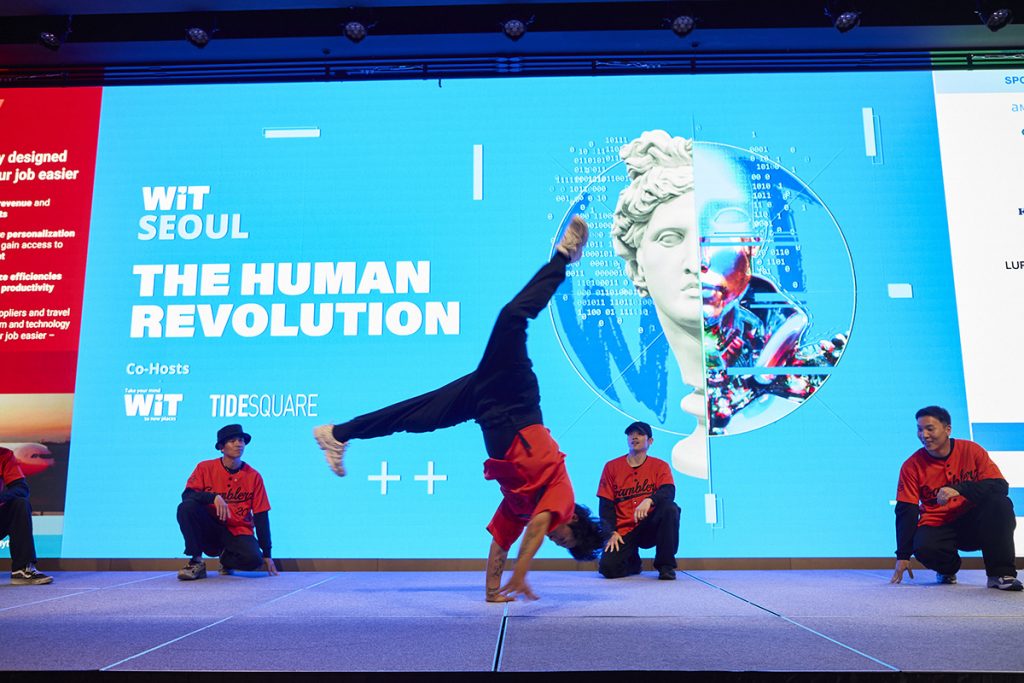
Lee’s South Korean b-boy crew, the Gamblerz, kicked-off WiT Seoul with headstands, backflips and logic-defying dance moves.
The importance of community was underscored by Hyunjae Na, product manager from Tripbtoz, the OTA which relies on community-generated videos to help its users plan and book travel on the site. It recently launched a real-time talk app, Triptalk, which allows travellers while in destinations to connect and share real-time recommendations and reviews of destinations, local sites and restaurants.
Joonhyong Jo, CMO of SOCAR (쏘카), an app-based, car-sharing service, said that its service would not exist without an active and engaged community that has supported the brand since its beginnings in March 2010. It raised an $18 million round of funding in 2015, led by Bain Capital, which was considered one of the highest funding deals for a South Korean startup. Its website says it has over 1,700,000 registered users, 50,000 of whom use the service each month, with around 80,000 transactions per month – more than one car booking every 30 seconds.
Recently, it signed a partnership agreement with Naver, and will leverage AI technology to expand its service to a younger generation of Koreans who do not want to own a car. Joonhyoung said SOCAR constantly adapts its messaging to meet the different needs of younger users.
For Kim Young Jin, fashion creative director of a contemporary hanbok (Korean traditional clothing) brand, Tchai Kim, the younger generation is also seeking individuality even while wanting to embrace traditions.
In her designs, which fuse the traditional with modern, she’s “looking for the individuality in humanity” while interpreting for a new generation.
Young Jin, who launched her ready-to-wear brand Tchai Kim in 2012, said, “Being Korean, I wondered about what my ancestors wore in the past and what type of clothes I should design for the future. I wanted to go down a path that had not been tread before. I wanted to make clothes that our ancestors wore; approach fashion design from an Eastern, not Western, perspective; and create designs from a Korean point of view.”
In this interview, she said, “With the development of the internet, Korean culture, spearheaded by K-pop, K-drama, and K-movies, has become increasingly popular on the global scene. I believe that hanbok has played its part as a representative icon of Korean culture. Today, many foreigners think of hanbok when they think about Korea. Hallyu (the Korean wave) has also contributed positively to raising the awareness of hanbok globally. Meanwhile, I find that those who show interest in Tchai Kim are more attracted by the brand’s distinctive designs rather than follow the brand in the context of Hallyu.”
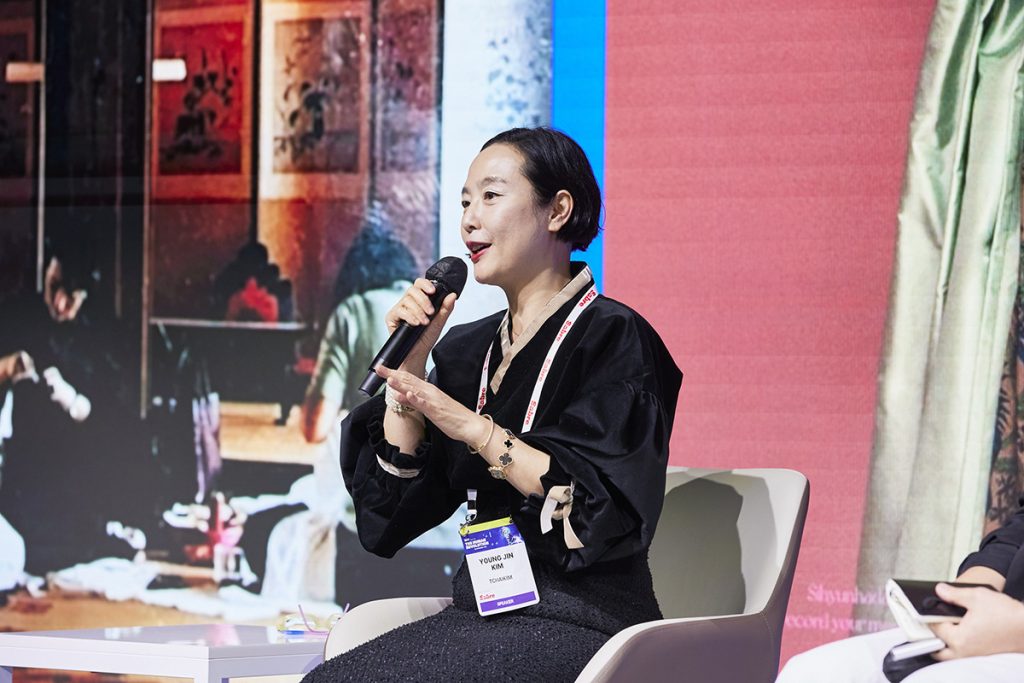
Young Jin always wanted her ready-to-wear brand, Tchai Kim, to reflect Eastern, and not Western, fashion sensibilities – inspired by South Korean history and culture
All four noted the changing consumer behaviour and trends of a new generation of Korean travellers, which they represent. Mobile apps, friends’ and celebrities’ social media and blogs are bigger influences for Generation Z than for older generations. A Gallup study also found that eight in 10 students grade 5 to 12 reported they want to be their own boss, rather than work for someone else.
Hyunjae Na from Tripbtoz said its users were very active and highly engaged on the site, asking questions, sharing recommendations and giving feedback. “They like to be involved with and participate actively with brands they feel passionate about.”