“Not just another OTA” as local experiences platform rolls out to help hotels sell ancillaries
IF you haven’t heard of DayAway, you may soon. Within five minutes of meeting Martha Waslen, founder of the Singapore-based local experiences startup, two things are clear. One, that she doesn’t want to build just another OTA and two, that she is not just another tech start-up founder.
Being well informed and knowledgeable about the industry is one thing but Waslen is also disarmingly enthusiastic about the space that it wants to disrupt and add value to. Her experience, connections and relationships, built over the years in ecommerce and fashion and cosmetics, also sets her apart in the travel tech space.

Set up just six months ago DayAway is getting into what many see as a Covid breakout space – hyper local experiences – and it is working with selected hotel partners, currently in the luxury category, to sell “beyond beds” experiences to customers looking for things they can do in or around a hotel in a day.
Describing her journey in creating DayAway, she said, “I just love it so much … I am obsessed” sharing that she was practically in tears at the prospect of partnering with Raffles Hotel because of its iconic beauty and heritage, even wistfully musing that she wishes she had started in hotels and hospitality because “I love everything about this space”.
Waslen may wish she had started her career in hospitality, but reviewing the journey that brought her here one gets the feeling that each step in that career was bringing her inexorably to this point.
Starting her career at Ralph Lauren, she stayed in corporate fashion until 2011 when she moved to Singapore to work on e-commerce start-up, Luxola, which was acquired by LVMH in 2015 and rebranded Sephora. In the meantime, she had returned to New York and took a break to start her family. In 2018, she returned to Singapore as her husband decided to headquarter his business in the city and, until Covid hit, was raising two babies under two while supporting her husband in his fintech business.
It was when Circuit Breaker (a uniquely Singaporean take on the global lockdowns) lifted that she said the seeds for DayAway were really planted. At the time her husband was working from home. The family would go out for coffee only to notice that hotel amenities were severely underutilised. She remembers “beautiful gyms and beautiful pools, sitting empty”, and knew there was a supply and demand problem that was waiting to be solved around the ancillary amenities and services of hotels.
With a background in e-commerce startups she originally envisioned DayAway as a booking aggregator of hotels’ ancillaries. It was a trend in the US and Europe that had already been taking off pre-Covid, and there was a sense of certainty that it was coming to Asia.
Recalling her thought process, she said, “This is coming. So, what I’m going to start doing is building a network in hospitality, and reaching out to developers. Because when this comes, there’s going to have to be a platform that aggregates all these offers in one place … I want to be the one in Singapore.”
While the original concept for DayAway was a lot less emotionally involved – aggregation versus curation, she soon realised that the opportunities presented in the space and accelerated by Covid were much bigger than she had originally envisioned.
She got to work.
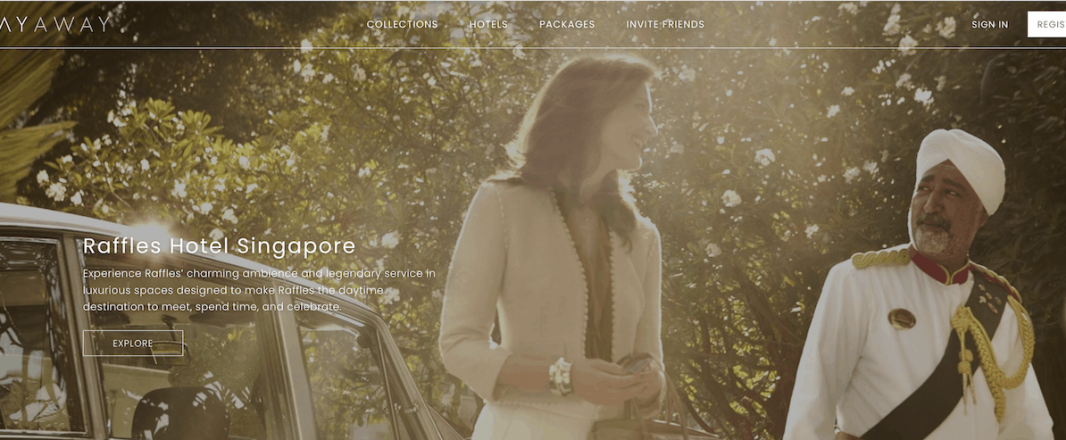
In partnership with Raffles Hotel, DayAway curated a series of experiences for guests to enjoy hotel facilities, even if they were not staying there. The Sunrise Spa and Swim for example, is a spa treatment at Raffles Spa followed by an early lunch with pool access after, while the Sling and Swim is a three-hour pool pass with a complimentary Singapore Sling, Raffles Hotel’s signature cocktail.

More than just offering ultra-luxe experiences though, DayAway is building what it says will be a serious tech platform. As a back-end inventory management system, DayAway hopes to be an answer to the prayers of the hotel industry, wherein many hotels still manage ancillary spaces manually, finding it prohibitively expensive to overhaul their existing legacy systems, or incorporate facility booking capabilities into already convoluted websites.
Limin Cheng, director of revenue and Raffles service at Raffles Hotel Singapore, acknowledges that ancillary revenues have always been a key area that hotels want to push, but that “from a consumer perspective, on a hotel website, [they] have to look through so much content to find a Sling and Swim … do [they] want it badly enough”. The answer is usually “no”, which opens the door wide for solutions like DayAway, to bring these experiences to the attention of consumers within a platform that allows for seamless browsing and booking.
In many ways Waslen sees DayAway as the perfect partnership, marrying the ease-of-use of a consumer platform, to the operations expertise and “flawless execution” that hotels like Raffles specialise in delivering for their guests.
But how is DayAway different from existing experience aggregators – for example, Klook, KK Day, the myriad companies playing in the space of local tours and activities? For one, it says it is not a discount aggregator, nor is its business model about volume. Waslen has her sights on “a more sophisticated, elevated target” of consumers who are excited to shell out for the kind of curated experiences that DayAway can provide with its hotel partners.
And it really is partnerships that they are trying to build. After initially considering it, she moved away from a commission model because she did not “want to start on a commission model [which would be] antithetical” to these partnerships.
Unlike many OTAs, Cheng said, DayAway also shares its data and analytics with hotel partners, allowing hotels to better understand consumption patterns, and – crucially – contact guests booked through the platform. In this way, added Cheng, the platform and the hotel “own the guest together”, a vital differentiating factor in this competitive space.
Though DayAway may have had its genesis in the Covid-19 pandemic she sees the model lasting long after the pandemic. Whether foreign or domestic, travellers are experience-seekers, and there will always be demand for thoughtfully curated experiences that can speak to their needs, she believes.
Already, DayAway is exploring experiences for corporate consumers in the form of “Work Hard/Play Hard” offerings of cocktails and dinner for small groups in hotel suites, and the possibility of being integrated into employee wellness programmes, and she is speaking to other hoteliers in Singapore and beyond.
There is little doubt that Waslen and DayAway would like to be here for the long haul. Bootstrapped at the start, it has closed an initial round of US$350,000 in seed funding. “Everyone who has invested is an advisor.”
She could have raised more but said there are two things most startups make mistakes on – spend too much money too quickly and hire the wrong team. She and Go Pin Tsin (formerly TripAdvisor) make up the Singapore team while the development team is in Vietnam.
Currently, she is offering free pilots to hotels and acknowledges that to scale, she needs to expand the number of hotels, go beyond Singapore and balance the mission of curation and quality vs scale. She is exploring the idea of subscription models for hotels, hence her focus on building a great tech solution that will prove valuable for hotel partners.
Waslen is undaunted, “there are no diamonds without a tonne of pressure” she said, half-laughing. She is of course referring to DayAway, though I cannot shake the feeling that this could apply to her as well.
• All images credit: DayAway