
WiT Seoul 2020 captured how online travel players are executing by millimetres to last the long game
If there’s one overwhelming feeling I got out of hosting WiT Seoul Virtual yesterday, it is that South Koreans are overwhelming in their creativity and fighting spirit. Yes, we see it in their K-dramas and K-pop, and definitely in their destination videos (more of that later), but 2020 has brought out K-travel in the WiT community like nothing else.
Here’s how.
Inspired by our hybrid WiT Experience Week in Singapore, our partners at Tidesquare took it upon themselves to host their own physical gathering at the Courtyard Marriott prior to the virtual event. They invited about 25 people for WiT Innovation Stage, which is focused on startups and held mentoring circles.
This was no easy feat in the current times, trust me. That same morning, I had just spoken at another hybrid event in Singapore with a physical audience of 14, and it was hard enough with prevailing health and safety restrictions while bridging two audiences across one platform.
“I didn’t realise how hard a hybrid event would be,”’ laughed Min Yoon, CEO of Tidesquare. I could only nod in agreement. At the morning event, organised by GEVME, called “The Future is Hybrid”, I had been asked by Elizabeth Rich, owner of Agenda, Australia, why we bothered with hybrid for WiT Experience Week when we could have done virtual.
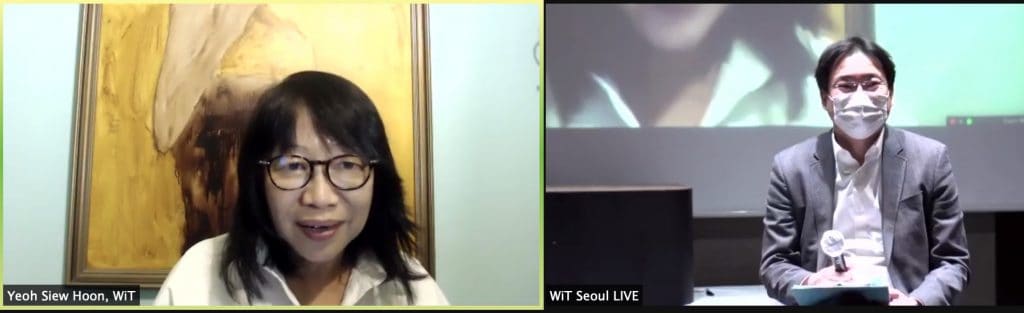
My answer was, we all have to push the envelope, no matter how hard it is, so that we can all keep moving ahead, even if it is in millimetres, and not inches, a term brought up by Timothy Hughes, vice president, corporate development, Agoda at WiT Seoul during a panel discussion. “I think Covid turned travel from an inches game to a millimetres game, so a lot of the breakout tech is just your ability to execute quickly … this is a game now of millimetres of being able to execute today to capture the demand tomorrow,” he said.
And that’s what the South Koreans did yesterday – they executed and moved their industry a little step ahead by pulling together a physical event to commune over the challenges and yet the opportunities that have come up at this time.
About the Innovation Stage, Min Yoon said, “Years ago, we saw startups that were targeting general platforms such as MyRealTrip or Dailyhotel, if you remember, they pitched at WIT Japan in 2014. Recently, start-ups are targeting more specialized areas, such as camper van or luxury vacation rental.
“It is interesting to see many B2B startups emerging in Korea, which we hadn’t seen before. Because of the high cost of new customer acquisition recently, rather than competing with well-established competitors, they are choosing new playgrounds. Tours and activities sector is still hot, and there’s lots of room to grow here.”
He said that most of the startup questions asked yesterday related to investments and scale-ups, not only because of the Covid crunch but due to their aspirations to grow big in the future. “Many of them are also targeting the recent boom in the domestic market – so it seems that someone’s misfortune is another’s blessing in disguise.”
The audience in Seoul then joined the virtual attendees on Zoom and watched our event on the big screen and for two hours, the stories told were all of resilience, determination and creativity.
President of Korean Air, Kee-Hong Woo, dialled in from his car on the way to another meeting. He spoke of how he’s not had much time for anything else other than ensure the well-being of its 20,000 employees and making sure it wasn’t losing money in its operations.
He spoke of how cargo had saved the airline – it’s had two profitable quarters and looks set to have a profitable third quarter – and how its alliance with Delta Airlines, forged in 2018, came in handy because it was able to fly cargo to almost all destinations in the US. Pre-Covid, its domestic business was small at six per cent, so you can imagine the challenges it had during this time when it’s all about domestic business. Plus domestic is highly competitive – there’s even a new airline that’s started at this time, Aero-K – and Woo acknowledged it was too tough to compete at their level.
He sees cargo as remaining the saviour and does not see “anything change in terms of passenger demand” till maybe middle next year.
He also sees this as a time when airlines like his can accelerate towards more direct distribution – during the past months its share of direct sales grew to 40% compared to 20-25% previously. Albeit it’s on a much smaller base, he sees this as indicative of the trend going ahead.
MyRealTrip’s CEO and co-founder Donggun Lee, facing a death-or-life moment, moved a business built on outbound to domestic, on tours and activities to accommodation and raised US$36m funding to continue business. That’s a strong endorsement of his team from investors – similar with GetYourGuide which this week raised a US$133m convertible note to keep going.
Lee admitted it wasn’t easy getting into the completely new territory of domestic accommodation but what he did right at the beginning was to pick one area – Jeju Island – and dug deep into that destination. He’s also getting into premium accommodation because “our main customers have higher willingness to pay”.
What’s not working as well is cross-selling of flights and tours and activities with him saying the cross-sell rates was below half his expectations.
Klook also took a micro-step, said Lee. “A lot of our merchants in Korea were mostly inbound focus, and they lost their business overnight. We worked very closely with a lot of the merchants to make sure that we support them in pivoting to business to domestic.” One of the ways was in developing contactless solutions. One lesson it learnt was that it “pivoted too fast”, trying to sell certain activities by its inbound-focused partners to the domestic customer “which didn’t really work too well”.
It also launched Klook LIVE, its live streaming channel, to acquire and engage with a domestic market that it had largely not paid attention to before.
Tidesquare, big on flights, is investing in building out accommodation and direct connectivity with global hotel chains, and improving its Extranet for direct contracting.
Everyone is testing and doing something new and what I like is they are constantly thinking ahead. They are also super aware of the threat being posed by tech giants like Naver, Kakao and Coupang whose businesses have boomed during this period, and they are seeing if they can take lessons from these businesses which have moved forward by miles while travel is inching ahead in millimetres.
MyRealTrip wants to be the travel superapp for South Koreans and Donggun Lee wonders if there are lessons he can learn from Kakao which has become the defacto safe check-in app for the country. Could he become the defacto safe travel check-in app?
Klook’s Lee is observing “new apps that are bound to be superapps” such as Karrot Market (or Danggeun Market), a used goods marketplace, which is now using location-based targeting to tell you of goods within two kilometres from you. “That has evolved into a community kind of app and now people are sharing travel-related information. I think that foundation is really interesting on how a new app is just really, on its way transforming into potentially being a super app.”
He added, “How we leverage it is going to be very important in how we capture a niche moment and able to develop that out into maybe a super app moment.”
So what’s the sacred cow that’s been killed in South Korea by Covid? For Min Yoon, it’s group packages. Korea is traditionally very strong in group packages and that demand has gone to virtually zero. “Nobody is sure about its future right now. Group packages were based on massive purchase and discounted prices but there are doubts that after Covid whether the demand will still be there. And maybe even on the supply side, it will be less.”
But what’s for sure is one thing – the digitisation of travel, once dismissed as hype by some quarters, has become real and it will definitely be survival of the fittest and feistiest.
There’s also no quenching the creative spirit of K-travel – look at these videos and tell me if they make you want to return to Seoul as soon as you can.
This is one featuring BTS, the breakout boy band, put out by Seoul Tourism Organisation.
But this one to me trumps it, “Feel The Rhythm of Korea” – a really fun one from Korea Tourism Organisation.
Watch them and tell me if you agree with me that K-travel is alive and well, and fighting.
• Featured image is the South Korean boy band BTS in the Seoul promotional video