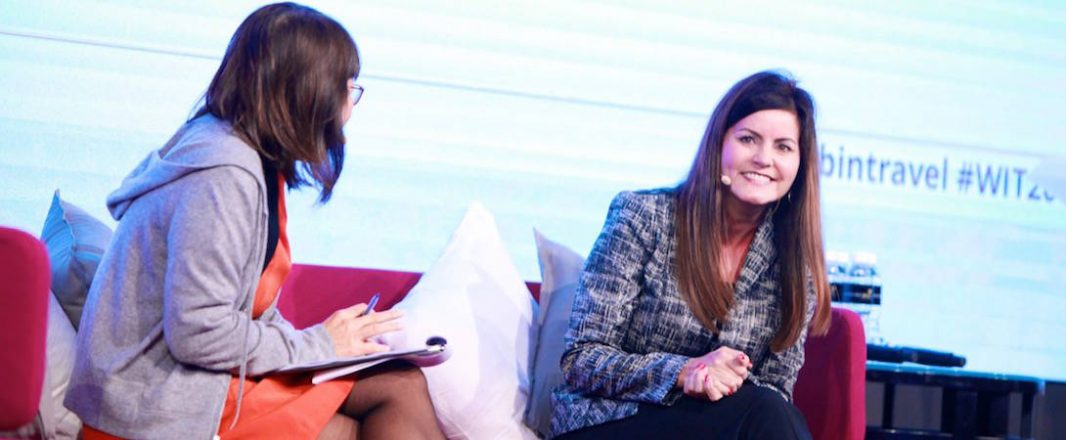
At WIT 2017, Melissa Maher (Senior Vice President, Global Partner Group, Expedia, Inc.) discussed how Expedia perpetuates a strong culture of diversity – from its suite of brands down to the people they hire.
As someone who has been with Expedia since 2001 and risen through the ranks, she remarked that one of the key differences she’s noticed is the rate at which technology has developed and transformed the industry.
“When I first started, we would plan our technology roadmap for five years out… Today we actually plan our tech roadmap about 120 days out.”
Asked how she keeps up as an individual, Maher said “it’s about talking to partners, our consumers and watching our competitors. Just making sure that we think differently, innovate and are constantly evolving. We have a ‘test and learn’ approach in Expedia and not just in technology but across the company.”
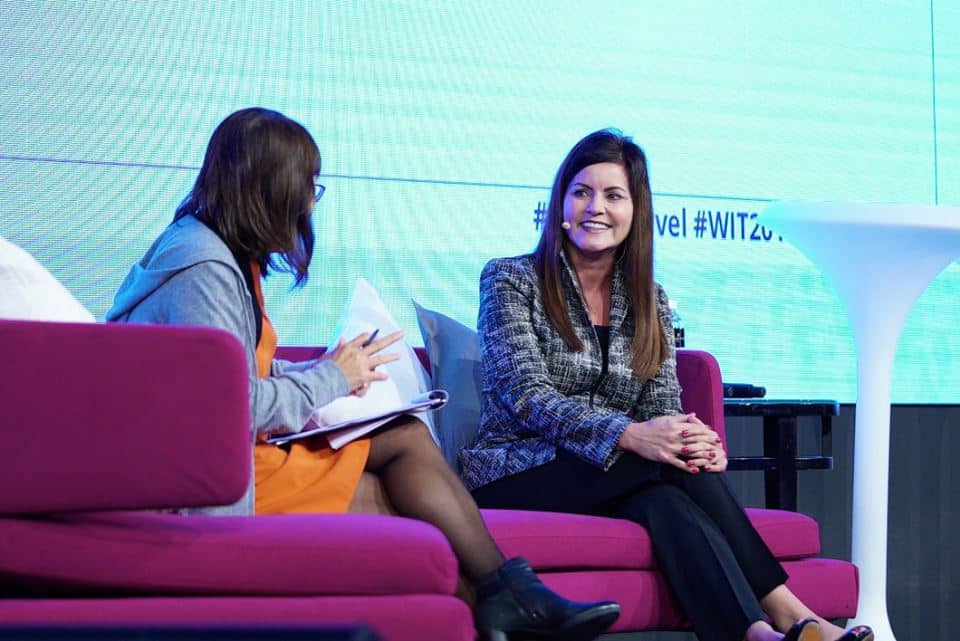
Expedia’s Melissa Maher (Senior VP, Global Partner Group) took the hot seat at WIT 2017
When it comes to diversifying their brand profile, Maher confirmed and emphasised Expedia’s laser focus on Asia. “Right now, Southeast Asia is where we’re putting a lot of emphasis and focus but growing in Asia in general is one of our very big goals.”
“In the past couple of years, we’ve increased our presence in Asia by about 50%… we recently launched our innovation lab in Singapore… and we’re also focusing on local partners.”

Henry Hendrawan (Group CFO, Traveloka) was also at WIT 2017 to discuss its investment by Expedia
“There are loads of acquisitions we look at every day,” but in terms of where Maher believes the company should place its chips when it comes to investing in the region, “it would probably be a market play”.
“We have 14 large brands for leisure to corporate. We want to take our global scale and use that as an asset but also be very local as well,” said Maher. “We do partner locally where we need to gain efficiencies and be more relevant.”
Yeoh Siew Hoon (Founder and Managing Director, WIT) pointed out that perhaps Expedia sees more value in local partnerships as it might let on, citing its partnership with Traveloka – an Indonesian company – which grants each other with access to their hotel content.
Maher conceded, adding, “it will put us both in a better position to be more locally relevant, and for them to utilise our technology and marketing support.”
Veering away from the company as an industry, moderator Yeoh asked about the working culture, especially as Expedia was recently identified as “one of the best places for women to work.”
Maher believes this is largely because of Expedia’s staunch focus on creating a “diverse and inclusive culture” both within and between its brands. “One of the first things we do is look at equal pay parity… we’ve also looked at other programmes… to help diversity.”
“For me, it is mentorship programmes, making sure that [we] are supporting young leaders.”
Expedia also has a gender quota – pledging to have 30% of vice president positions and above by led by women, by 2020 (they currently stand at 23%).
However, Maher did add that she didn’t personally feel a quota is necessarily a good thing. “In my leadership role, its always about the best person for the role… diversity is massively important, but quotas are tough.”
On the topic of leadership, it begged the question of how Expedia has adapted since the departure of Dara Khosrowshahi to Uber and his replacement by new CEO, Mark Okerstrom.
“Mark has been with our company for many years and Dara was grooming him for years, so far it’s been a very smooth transition.”