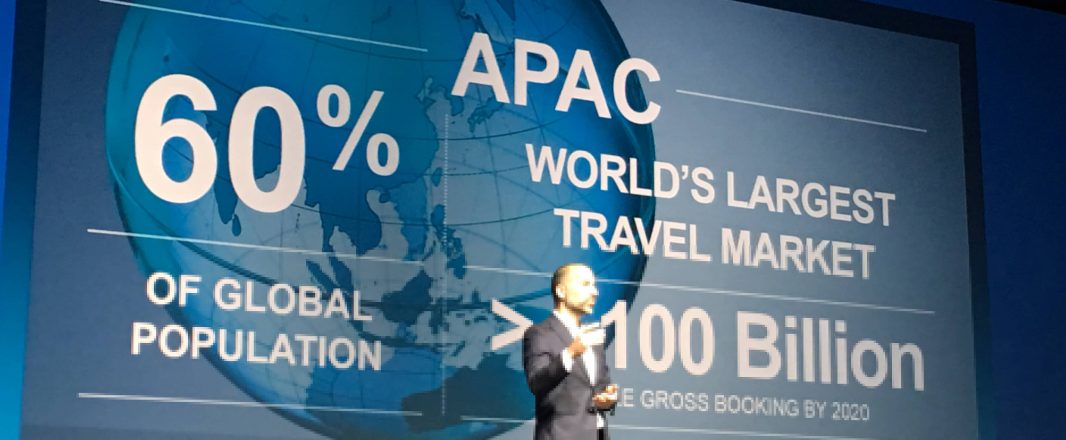
Twenty years on since its founding, Expedia Inc intends to become the first $100b travel agency in the world and it is pulling out all stops to hit that target.
With current gross bookings standing at $71b, representing a 29% year-on-year growth, and if you take into consideration the journey so far of a company that started as a division within Microsoft and founded on a $10 URL, and now powered by an army of brands, you can see that target is clearly within reach.
Over two days in Las Vegas, the 4,000 delegates who attended the annual Expedia Partners Conference learnt about the many things Expedia Inc was doing to make that additional $30 billion through its house of brands and business units.
It means globalising its business – growing the current one-third share to two-thirds.
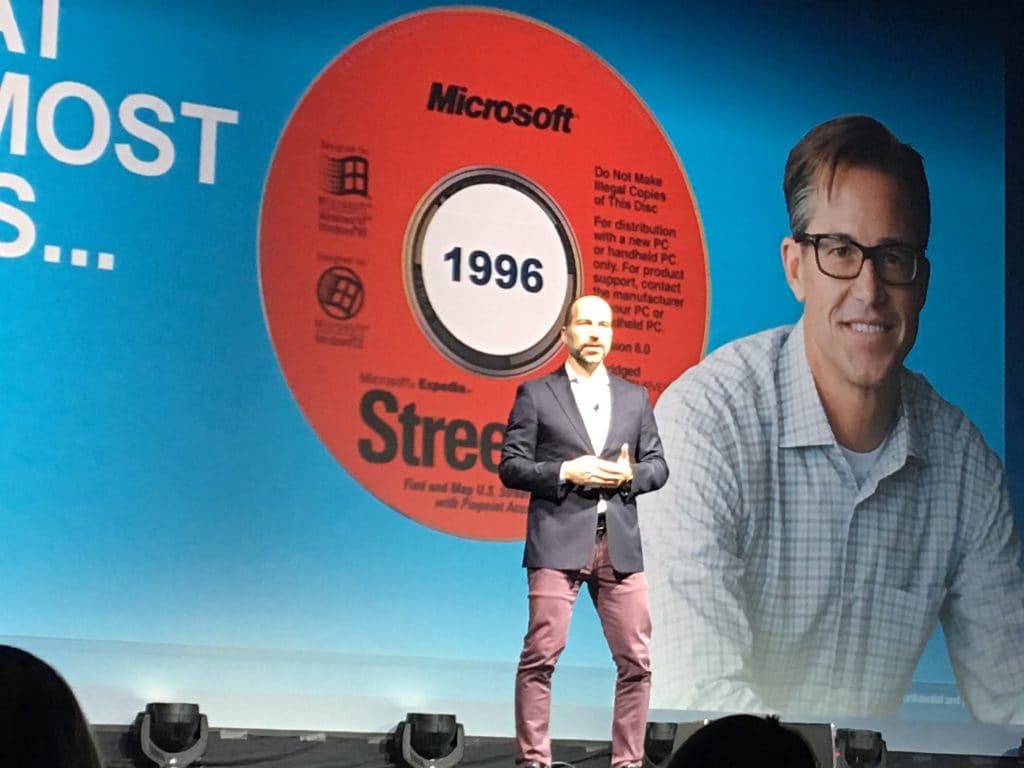
Dara Khosrowshahi relating the 20-year story of Expedia
That means “Investing and succeeding in Asia Pacific”, said CEO Dara Khosrowshahi. “The Asia Pacific travel market is already bigger than Europe or the US and growing twice as fast.”
To win there, it has to lead in mobile. Mobile is now 50% of traffic and more than 40% of transactions company-wide but the numbers are much higher in Asia. Johan Svanstrom, CEO of Hotels.com, said mobile was “astounding” in markets like China, Japan and South Korea. “This is another piece we need to step up. What you see in those markets, you can predict what will follow.” (The group’s second largest team of developers is now in Asia.)
Clearly leading the mobile charge, Hotels.com also announced the launch of a prototype app that will allow hotel customers to check in and out, as well as generate a room key. It is currently running a pilot test and Svanstrom said this was aimed at the small and independent hotels who do not have the resources to invest in such technology.
Henrik Kjellberg, CEO of Hotwire, said contrary to what Western media was portraying, a lot of innovation was coming from Asia – China, in particular with companies like WeChat and Alibaba coming up with phenomenal products that are consumer-friendly.
Khosrowshahi called out the launch of full service Expedia sites in Taiwan and, soon, South Korea, so expect more marketing dollars to be spent in those two markets. In China which he called “an incredibly important market”, its private label business is growing well.
It also intends to redouble its efforts in India and wants to be ready for Indian travellers when they start to look outwards. That incidentally also happens to be the personal mission of president of Brand Expedia Group Aman Bhutani’s personal mission – to make a dent in India.
It means attacking the $100b vacation rentals market through HomeAway and making its one million properties bookable in its bid to capture a new generation of travellers.
It means going after the $130b business opportunity in rail. It’s launched rail in the UK with plans to expand across to Europe, Americas and Asia.
It means digging deep into the $130b tours & activities market with the division now headed by a very able new leader, Jen O’ Twomney.
With senior vice president Greg Schulze now based in Asia, the region’s clearly getting more attention and resources from management. Schulze called his move to Singapore a life-changing experience. “There’s such energy, optimism and possibility in the region and it changes you.” Indeed, of the executive team heading Expedia’s brands, most have lived in Asia at some point in their career.
It means expanding its corporate travel business through Egencia which has opened offices in Singapore and Hong Kong. CEO Rob Greber said he intends Egencia to be a major contributor towards the $100b target. “We’re investing in Australia, New Zealand, India and China,” he said
It means leveraging the $1 billion investment it’s made in its technology platform to bring along its hotel partners and shifting its positioning from distribution to full marketing and technology partner.
The audience, comprising two-thirds hoteliers, learnt of the many features it’s introducing into the Expedia Partner Central platform from making available a fully-automated upgrade function to opening up its destination content to hoteliers. To be rolled out first quarter 2017, the destination content module will allow hoteliers to dynamically edit up to 10 places of interest around their properties, add images and include special events.
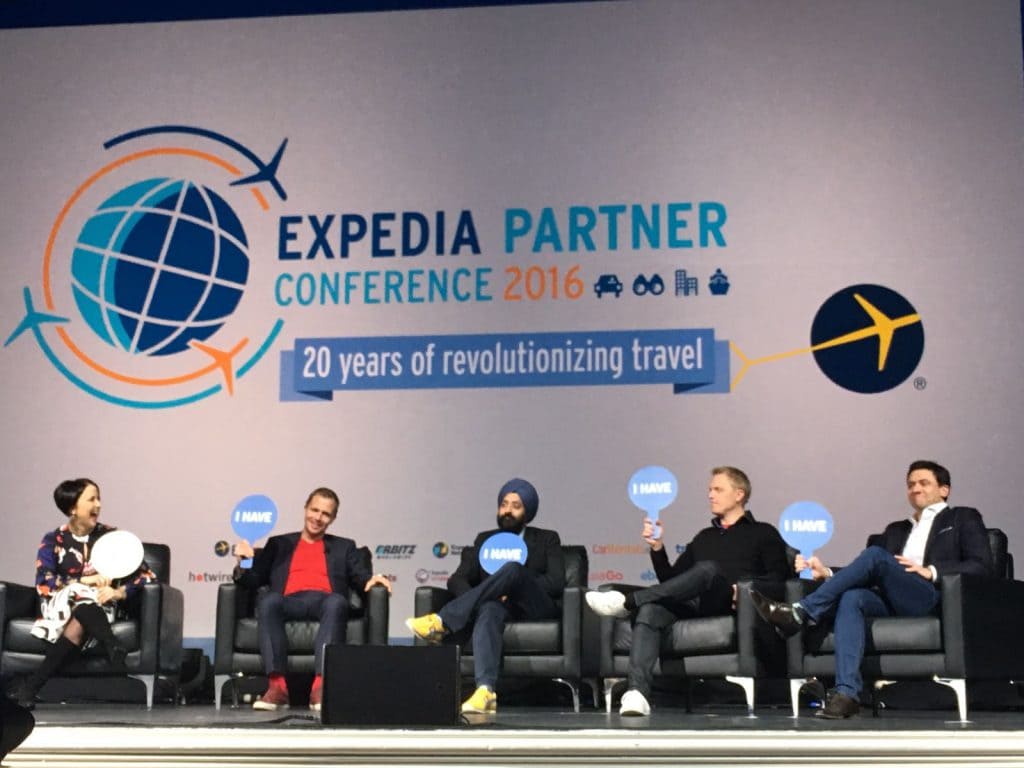
Expedia’s band of warriors, from left, Jen O’ Twomney, tours & activities; Henrik Kjellberg, Hotwire, Aman Bhutani, Brand Expedia, Johan Svanstrom; Roy Greber, Egencia
In all, it’s been an amazing journey for Expedia. Founded on the idea of “turning around that green screen to consumers”, it had a staff of under 100 and revenues of $2.7m in 1996. “I was an investment banker on Wall Street and Expedia was one of the hot startups then,” Khosrowshahi recalled.
In 2002, IAC took interest in the company when “I recognised travel as the next big ecommerce sector” and as founder Rich Barton recalled in a later conversation with him, “that’s when you started buying assets like collecting marbles”.
In 2002, revenues totaled $500m and staff numbered 1,700 and by 2005, the numbers had climbed to $2.1b and 6,500 staff, and that’s when it became Expedia Inc. The tough years came after 2007 ($2.7b in revenues) when “we needed to quadruple our investment in technology, it was ageing technology”.
It got the go-ahead but then came the 2008 financial crisis. “It was tough for all businesses but we survived and thrived,” said Khosrowshahi
By 2009, it achieved $3b in revenues and the years that followed were years of looking forward. In 2011, it signed its joint venture with AirAsia so that it could dig into Asia and the revenue numbers climbed – from $4.8 billion in 2015 to $8 billion in 2016. Today, it has 18,000 staff.
“We now have a collection of brands that we own and power, we have 1b customer events a month and 450 million customers visit us each month. Two thirds of tests do not work – it’s a humbling experience. But those wrong turns teach us something.”
Twenty years on, he said, “just as we turned around that green screen to consumers, now we want to turn around that green screen back to you.”
All this in a bid to “be the best global marketplace for all things travel”. And oh yes, a $100b marketplace at that.