


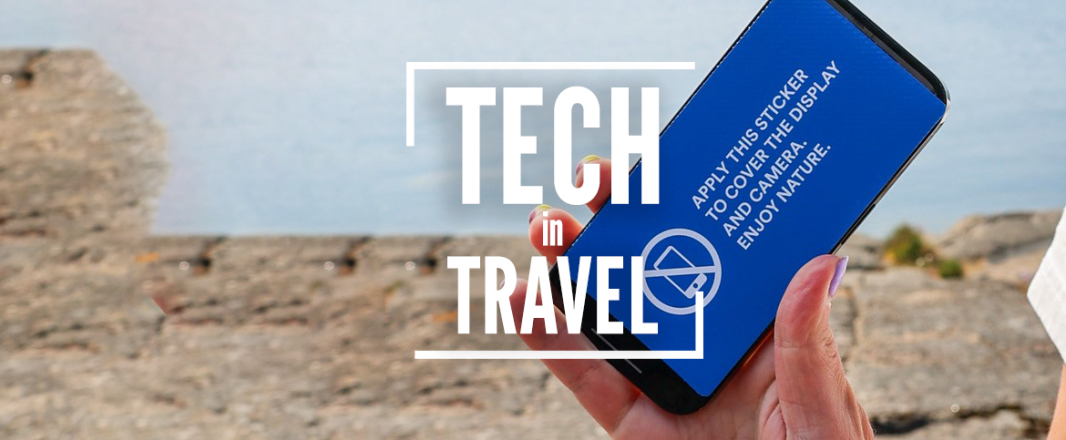
Tourist island declares itself phone free
Finland’s Ulko-Tammio tourist island is going phone-free this summer.
Those travelling to the island, located in the Eastern Gulf of Finland National Park, will be encouraged to switch off their smart devices, take a break from social media and enjoy nature.
Ulko-Tammio is believed to be the world’s first phone-free tourist island.
“We encourage visitors to put their phones away voluntarily and to focus their senses on nature rather than on their phones. This is a great initiative that could be implemented in other nature and recreational destinations,” said Joel Heino, manager, outdoor recreation and visitor management at Parks & Wildlife Finland.

Located far from the mainland, Ulko-Tammio offers interesting history, nature, birds – along with a birdwatching tower – and a cabin maintained by Parks & Wildlife Finland.
“Even a short digital fast can be useful and improve our well-being and help relieve symptoms of anxiety and depression”, said Terhi Mustonen, a psychologist at Finland’s social and health Sosped Foundation.
The reputational risk of claims of sustainability
Travel companies love to promote their sustainability credentials, yet many are aware that eco-warriors are out there ready to pounce on anyone who overstates environmental-friendly claims.
Reputations are at risk when companies attempt to become sustainable only for their efforts to be labelled as “greenwashing”.
So, what should travel companies be doing at a communications level – keeping a low profile or shouting their sustainability measures from the rooftops? And where should they focus their efforts?
Travel technology industry experts have stepped up to the podium to offer their advice. Here’s what they are saying:
Janet Jaiswal, VP of Marketing from Cloudbeds – which provides technology to independent hotels – believes that “it’s not enough to just make changes behind the scenes; companies also need to communicate these efforts to their customers in order to truly make a difference.
“But in a world where travellers are increasingly prioritising eco-friendliness, if you fail to follow through on sustainability initiatives once the guest is on the property then that can lead to lower guest satisfaction, cancellations, and less bookings in the longer term.
“Companies must take a holistic approach to sustainability in order to benefit the environment and maintain their bottom line.”
Small steps to reduce carbon footprint
Alex Gisbert CEO of FastPayhotels – a B2B platform for travel sellers and hotels globally says that whilst much of the focus is on those who have a heavy carbon footprint, for example the airlines or the hotels, all businesses across the travel distribution ecosystem must accept that the days of saying ‘that’s not me’ are gone.
“The carbon footprint of the tech sector focused on travel – bedbanks, GDS providers, channel managers, payments services, property management systems, PSS platforms, and so on – might well have a very small direct carbon impact compared to the suppliers, but it is there, nonetheless.
“Besides, true sustainability is not just about carbon footprint, it is so much more. There are steps in the right direction for sure, but they’re not as well communicated or coordinated as in the B2C space and they need to find their voice, neither over-emphasing their role and impact nor downplaying it. Start small would be my advice.”
Think about the empty seats, unconsumed meals
Martin Eade from travel booking technology provider Vibe points out that companies have “generally promoted sustainability in terms of what their business is doing, rather than how the services they provide can actually lead to a more sustainable world”.
“Consider for example NDC solutions that enable passengers to easily access only the elements they require – think about the carbon footprint of unconsumed meals or unwanted extra legroom, for instance – or more efficient rebooking tools that help reduce the number of empty seats on a plane.
“As long as you can back up your claim to show a demonstrable impact, do so not just because your company benefits but because it inspires others to think the same way.”
How investors view sustainability
Morgann Lesné from boutique travel investment bank Cambon Partners offers a view from the perspective of an investor: “There is a growing desire among investors to align themselves with green-related businesses. However, it’s crucial to remember that authenticity is key in this arena.
“Attempting to greenwash investors by overselling your environmental actions or making false claims is not only unethical, but it could also land you in legal trouble.
“As part of an industry at the forefront of environmental issues, it’s imperative for travel companies to be transparent and honest about their environmental practices whatever they may be, whilst at the same time always striving for continuous improvement.
“Contrary to what some think, investors value honesty and trust, integrity, thinking long-term and doing the right thing.”
New app puts users on the map
Mapnow, a customisable world map to explore new locations around the world has gone live.
The app offers real-time exploration through a community-based map, allowing travellers to discover locations, follow places of interest and contribute anonymously to the map in real-time.
The app allows users to interact with other mappers’ contributions and invite friends to a private mapcircle.
Real-time geolocation technology allows users to navigate their surroundings “with unmatched precision and accuracy,” says promoter Cécile du Passage.
Mapnow’s developers say artificial intelligence technology enables users to discover a world of personalised content tailored to their interests, while user profiles and contributions are anonymous.
Shiji takes the friction out of payment requests
Global hospitality innovator Shiji has launched Shiji Digital PayBy, an integrated globally compliant payment solution tailored for hotel operators and managers.
Built on the foundation of 2-WayPMS connectivity, Shiji Digital PayBy allows hoteliers to securely capture card details or collect payment from guests via a simple link.
Shiji says the solution is “designed to simplify and streamline payment processes while maximizing security and minimizing risk”.
Shiji Digital PayBy, integrates reservation details speeding up the payment request process. To support accuracy and transparency, agents are provided with a real-time folio balance view during the creation of payment links.
Payments are then automatically posted into the Property Management System (PMS), or updated to the attached token, saving hoteliers the time-consuming task of manual updates.
Shiji has ensured an Application Programming Interface (API) interacts with PayBy. The API functionality allows various platforms, such as pre-stay communication, In Room TV, and Banquet/Event platforms, to independently generate payment requests, eliminating the need for an agent user interface.
“Thus, removing payment request friction,” Shiji says.
The system processes payments via eCommerce channels, incorporating the latest 3D Secure (PSD2) and fraud screening measures.
Where ‘old’ money still has currency
Where in the world are people with “old money” splashing their cash on luxury hotels and experiences?
No surprise, according to SlotTracker.com, Paris is the most popular destination for those who seek understated refinement.
‘Old money’, also referred to as ‘quiet luxury’, is TikTok’s newest trend with more than 2.5 billion views for #oldmoneyaesthetic.
The trend “exudes sophistication that is understated, subtle, and free from overt displays of wealth”, according to SlotTracker which analysed more than 400 million Instagram hashtags to discover the most popular ‘old money’ destinations around the world.
With 41,990,847 hashtags on Instagram, Paris was way ahead of its nearest rival, Morocco, a destination that SlotTracker says, “transports people to an era of old-world grandeur, making it an ideal choice for those seeking a taste of refined luxury”.
Jamaica made it into third place, with the rest of the top ten comprising Maldives, Kenya, Florence, Tuscany, Bordeaux, Santorini and Sardinia.
The one-time haunt of the rich and famous and James Bond, Cannes managed 15th place.


