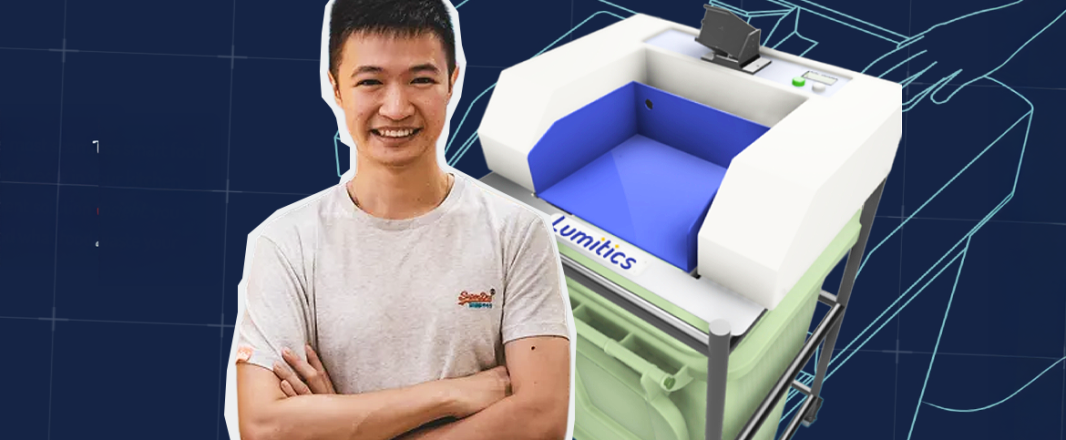
Lumitics acquired by Winnow to strengthen APAC’s foothold
Ten years ago, Rayner Loi stood in a hotel bin centre in Singapore, staring at 20 to 30 green 120-litre bins waiting for the waste collector. It was his first time in a hotel’s back-of-house. He had no hospitality, no culinary experience. He’d simply asked a hotel F&B director if he could buy him a coffee to ask him questions about food waste – and the man, the only responder among 100 cold outreaches, had taken him there instead.
“It horrified me – seeing it for real,” Loi recalls. “That day, food waste became an emotional thing for me. I’d read the data and I had registered the problem in my mind. This went to my heart.”
Ten years later, that moment in the bin centre has come full circle. On 1 July 2026, Lumitics – the company Loi and co-founder Adriel Tan built from that life-changing visit – was acquired by Winnow, the London-headquartered AI food waste giant it had spent a decade competing against.
Loi and co-founder Adriel Tan have been retained to lead the transition. For the first time in his working life, Loi is a salaried man, and has a boss. “I’ll have some adapting to do,” he says, with a smile.
The detour: From finance to food waste
Loi didn’t set out to fight food waste. In his first year at the University of Social Sciences (SUSS), he was headed for finance – equities, private banking, the well-worn script of study hard, get into university, succeed. But Singapore’s startup scene was beginning to get exciting.
He watched founders at the likes of Carousell and ShopBack grow and one startup in particular, Glints, inspired him. The co-founders had walked away from government scholarships to build their companies. “This went completely against the narrative I was used to. I couldn’t shake the feeling,” he recalls.
Then he read a BCG report: 1.3 billion tonnes of food wasted globally every year. Loi wasn’t entirely unaware of the problem, but he hadn’t grasped its scale. Digging further, he noticed most companies in the space were focused on recycling and redistribution – dealing with waste after the fact. Nobody, he thought, was going after prevention.
So he did what founders with no industry contacts do: he went to LinkedIn and started cold-messaging F&B directors and chefs, asking for coffee. Silence, mostly. Then someone named Freddie, F&B director at the Mandarin Orchard (now a Hilton property), said yes – and took him to that bin centre.
What Loi saw from the visit became Lumitics’ founding thesis: hotels struggle to reduce food waste because they lack visibility into it. You can’t manage what you don’t measure. Build chefs a feedback loop – show them exactly what’s being thrown out after a buffet service – and they’ll start to optimise.
Never going back to class
Loi took a semester off in his second year to chase the idea, won Singapore’s founder grant for first-time entrepreneurs in 2017, and never returned to a lecture hall. His professor kept asking when he was coming back. Instead, the university let him clear his remaining credits through participation in an entrepreneurship programme – start a company, get funded – which he then came back to mentor.
He graduated without having to sit for another exam. This, he says, with a cheeky grin.
The early years were rough by his own account. “I am CEO of everything except product and tech,” he says of that period, crediting Tan – his technical co-founder and, in Loi’s words, his complete opposite – with absorbing failed pilot after failed pilot as part of the process.
Loi had assumed the sell would be easy, a no-brainer: reduce food waste, cut costs, help the planet – an obvious triple-bottom-line win. Ten years on, he’s more circumspect. There are plenty of people in hospitality who care deeply about F&B and ESG, he says, but for most operators the issue still sits as a second-order priority.
The numbers, and their limits
Where Lumitics did find traction, the results were sharp: an average 30% reduction in food waste within a hotel’s first six months on the platform. But Loi is candid about the ceiling. Gains taper – to roughly 5% annually by years three and four – as kitchens exhaust the easy wins. The pitch has to evolve alongside the plateau, from waste-reduction tool to maintenance tool, folded into a hotel’s compliance and ESG reporting and menu engineering.
Global chains moved first. Accor and Hyatt now mandate food waste tracking and target-setting across their regional portfolios. Regional and local groups have lagged five to seven years behind – Loi cites Minor Group in Thailand, without a food waste mandate of its own, choosing to engage Lumitics anyway to build the business case internally.
Funding was also a slow journey. An initial pool of around S$200,000 combining the founder grant, an angel matching round and a Temasek Foundation Eco Sparity grant; a S$850,000 seed round in June 2019 from Jonathon and Nicholas Cocks (pre-Velocity Ventures days) and other hospitality-adjacent angels; and a further S$900,000 in November 2021 from PropertyGuru founder Steve Melhuish, raised as Lumitics eyed the opportunities emerging out of Covid.
In total, Lumitics ran on under S$2 million – a lean sum for a company that, at its peak, employed 25 people in Singapore plus a remote team in Malaysia and served large hotel brands across more than 20 countries.
Terms of the acquisition are not disclosed but to Loi, it’s a win for all – Winnow becomes the undisputed leader in APAC, investors get their returns and Lumitics gets to plug into a better-funded global player to accelerate its mission of food waste reduction in hospitality.
Boxing the bigger brother
His acquirer, Winnow was no stranger. “Our biggest competition – exchanging punches in the boxing ring every day,” is how Loi describes the relationship. He credits Winnow, founded in 2013, four years ahead of Lumitics, as doing the hard work of educating chefs and laying the category’s foundations.
Competing against a better-funded rival, Loi had to double down on what differentiated Lumitics – the first to use AI to measure food waste and providing more of a white-glove service – a hands-on approach to hospitality clients, new to the idea of food waste reduction.
That differentiation may have worked in the beginning. Today, it’s a different story. I asked Loi if he felt that Lumitics would have found it harder to compete against a global company like Winnow, with its scale and access to more data, today, if it had chosen to go it alone.
“Probably, but it’s also the access to capital. Winnow has more access to capital than we, at least not at the same pace. If we play the long game, we’ll not be able to compete so aggressively,” he admits.
“Ten years is a good run, I have beautiful memories,” he adds. “Our missions are aligned. Winnow has set its target of reducing $1 billion in food waste and it recently reached its $100 million milestone – so one-tenth of the way. We could still chug along. We’d just reach the destination slower. This makes sense.”
The transition is already underway. Lumitics’ customers are being folded into Winnow’s product suite, including VisionAI and its “Throw & Go” automated waste-weighing capability, with the Lumitics brand and platform set to be sunset over time.
About half the team has moved on. The remaining team is mostly in operations – customer success and hardware engineering. Loi now reports to Winnow’s APAC managing director Ken Kuguru.
He’s telling his wife, three years into their marriage, that he’s about to find out what it’s like to be “a salaried man” for the first time.
A toothpick at Everest
The BCG figure that first pulled Loi off his finance track was 1.3 billion tonnes of food wasted annually. The most recent estimate has climbed to 1.6 billion tonnes. “It’s not going away,” says Loi of the growing problem of food waste.
What he and Lumitics have achieved, he says plainly, is a small toothpick’s worth of progress against a mountain the size of Everest – with methane from rotting food remaining one of the most overlooked drivers of climate change, even as more people start to feel its effects directly.
The urgency, in his view, isn’t going to wait for the industry to catch up at its own pace.
Still, looking back at the 2017 version of himself – bright-eyed, certain the sell would be obvious – the 2026 version of Loi is much more philosophical and pragmatic.
“I underestimated how hard it would be to build a company in the ESG space,” he says, adding the industry has taught him to walk, or stroll, when he wants to sprint.
What keeps him going into the Winnow chapter is a simpler calculation: when Winnow wins, Lumitics wins. And for an industry-wide problem that has only gotten bigger since he first walked into that bin centre, he believes being part of a bigger platform moving at a faster pace may be exactly what the mission needs next.