


In Japan, there is a saying, 縁は異なもの味なもの」(En wa i na mono, aji na mono) – which means literally, “Fate is a strange thing, and a flavourful thing” – meaning “the ties and encounters in life are unexpected and mysterious, but they bring richness and delight”.
It was with this saying that WiT’s founder Yeoh Siew Hoon welcomed Eijiro Yamakita, President and CEO of JTB Corp, onto the WiT Singapore stage last Wednesday. The timing was poetic.
Only days earlier, JTB had announced its acquisition of Northstar Travel Group, the parent company of WiT, a move that took many in the industry by surprise, including him apparently.
“I didn’t expect this myself,” he said, smiling modestly, when asked the reason for the move. “But the reason was quite simple – I wanted to make the tourism industry more value-added and better.”
A new chapter: Intelligence meets experience
For Yamakita, the deal with Northstar isn’t just a business transaction. It is a meeting of minds between Japan’s largest travel company and a global travel intelligence network.
“Looking back 20 years ago, when the Internet happened, the travel industry changed a lot. Booking became easier, information spread everywhere,” he reflected. “But productivity in tourism is still low compared to other industries. We need to deploy technology to make more value-added products – and intelligence is essential for that.”
In his view, Northstar’s media, events, and research platforms represent the intellectual engine that can help modernize tourism – and make it not just bigger, but smarter.

Japan’s tourism paradox: Growth amid imbalance
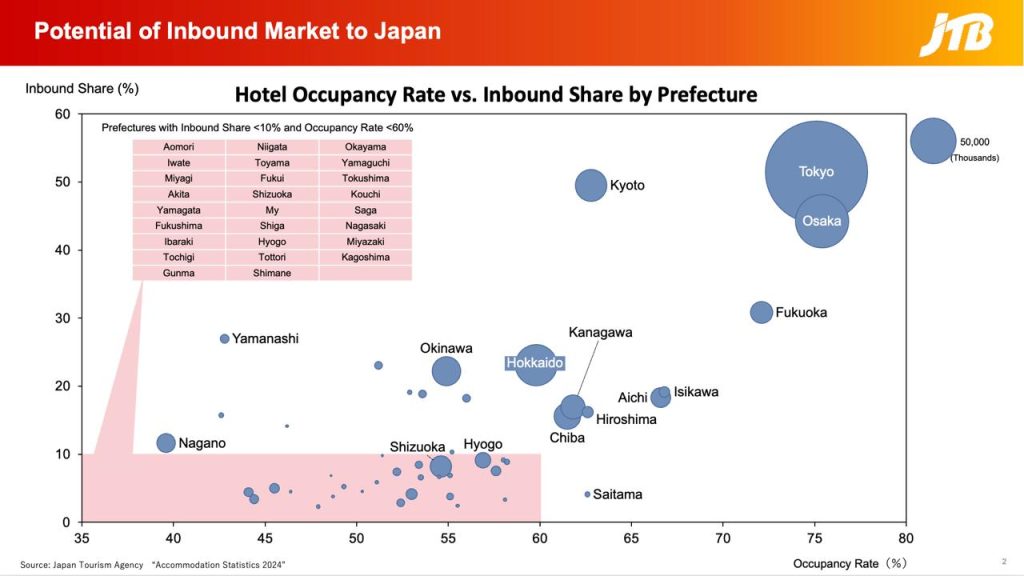
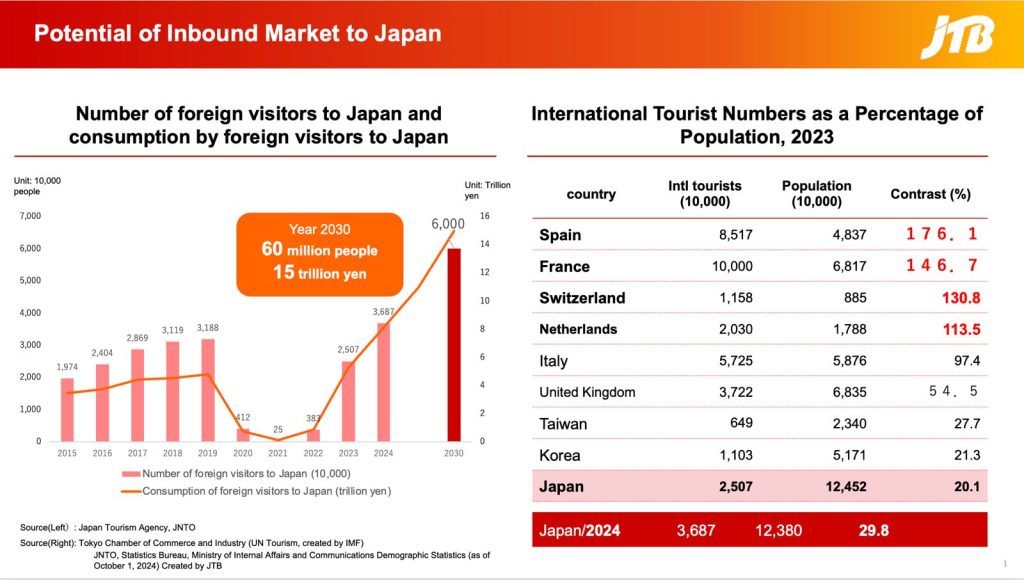
Japan welcomed 36.8 million visitors in 2024, expects 40.2 million in 2025, and is targeting 60 million by 2030. But compared to Europe, the numbers still trail behind.
“France has 100 million, Spain 80 million,” he pointed out. “Compared to population, Japan still has room to grow.”
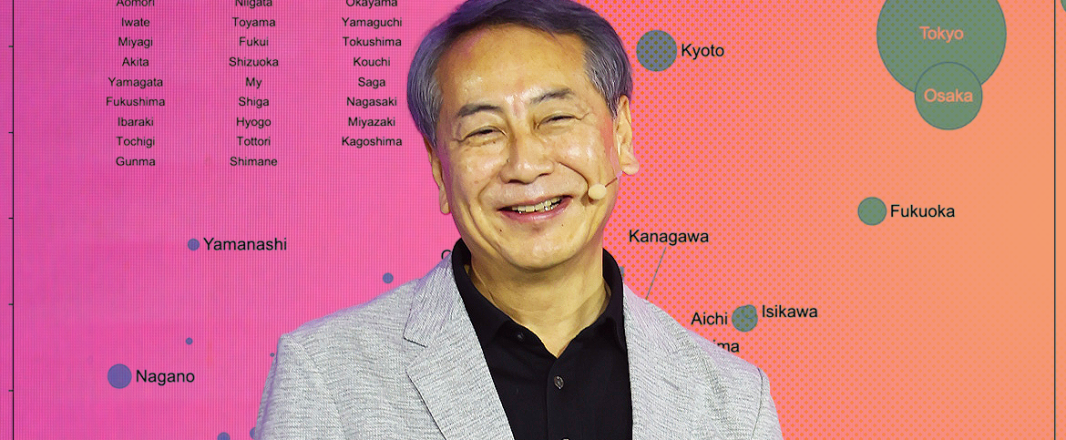
The real issue, Yamakita believes, isn’t overtourism but poor distribution. “People rush into Tokyo, Osaka, Kyoto but they never visit the local cities. Japan is long, 3,000 kilometers from north to south, with different seasons, foods, and landscapes. There’s so much potential, we just need to develop the contents, the reasons to visit.”
He’s visited all 47 prefectures of Japan himself, often giving talks in small towns to inspire local leaders. “In Usuki, a small town in Oita Prefecture, they have beautiful streets and incredible food – like fugu (blowfish sashimi),” he said, eyes lighting up. “But very few foreign visitors go there. I told the mayor, don’t just say, ‘Visit my town.’ Work with others. Combine places, create routes, collaborate.”
The advice was simple: cooperation, not competition, must be the foundation of Japan’s regional tourism strategy.
The road to 100 million
Yamakita sees a clear path to 100 million inbound visitors by 2045 – a symbolic benchmark that would put Japan alongside Europe’s tourism giants. But he emphasizes that achieving it will require infrastructure, mobility, and technology, especially in language and cultural interfaces.
“It’s very difficult for local communities to accept foreign visitors because of language barriers,” he said. “Technology must help bridge that gap.”
In short: Japan must modernize its software, not just its hardware.
Outbound Japan: Reviving wanderlust
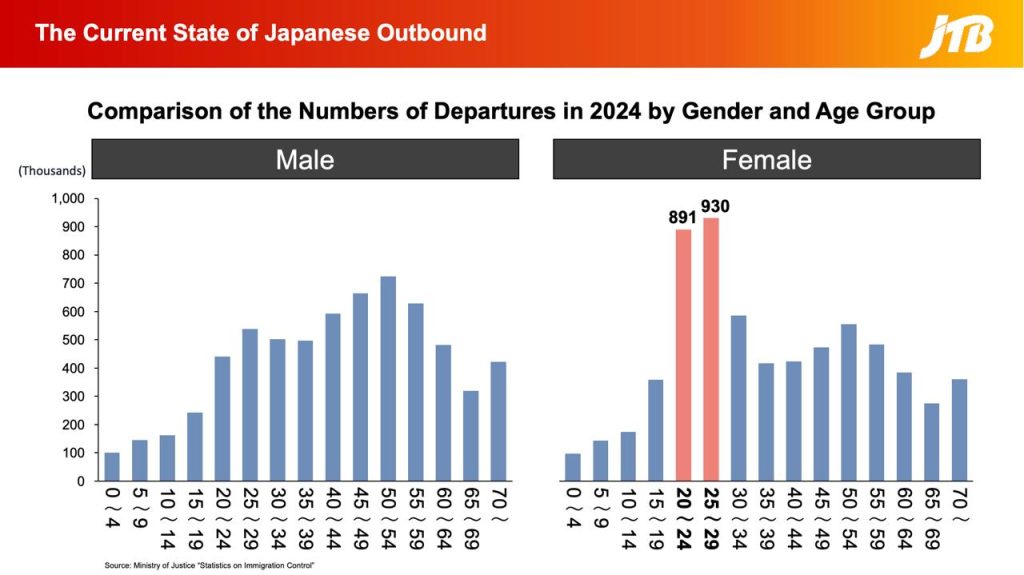
While inbound numbers soar, Japan’s outbound travel has been slow to recover, stagnating after the pandemic. “41 million people are travelling outside of Japan, it sounds like a very small number, but a big number compared to population,” he said.
Two trends are playing out – active travellers are women, aged 20-29, and polarisation, with the rich travelling to Europe, even though tour prices have doubled.
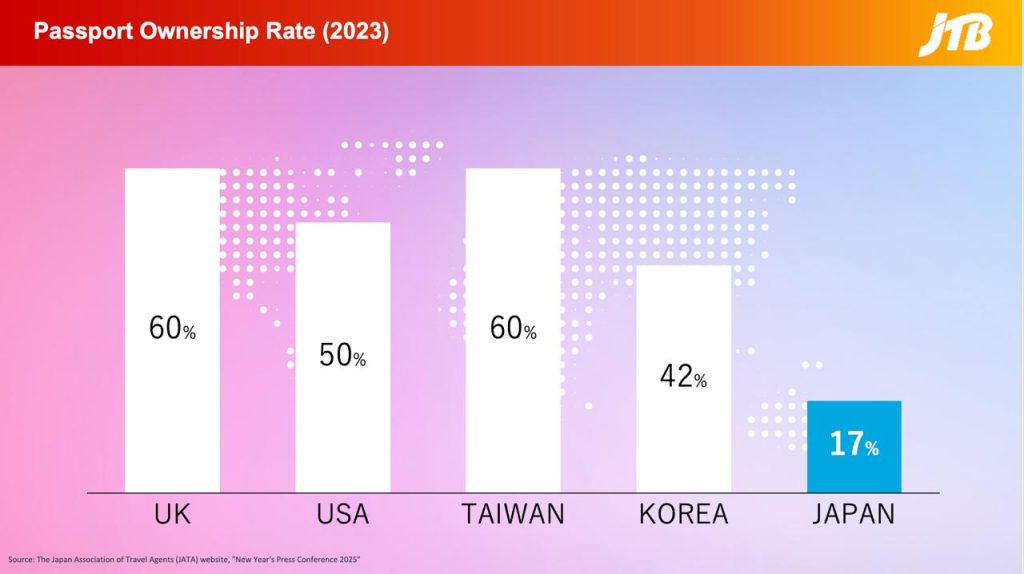
The root problem is low passport ownership, which stands at a mere 17% – lower even than the US.
“That’s my headache,” Yamakita admitted with a laugh. “People in Tokyo and Osaka have 30% passport rates, but in local cities, only 5% or less. Many never travel outside Japan.”
The reasons are twofold: Japan itself is so attractive that people feel no need to leave — and schools, which once mandated overseas programmes, no longer do.
“So we must create reasons for youths to travel,” he said. “Not just discounts, reasons.”
From sports tourism (JTB sponsors Major League Baseball in the US) to student exchanges (its Global Link programme brings together hundreds of youth across Asia), JTB is betting on experiences that ignite curiosity rather than compete on price.
“If you create the right reason, people will travel,” he said. “That’s what drives us.”
The rise of the ‘Granfluencers’
Japan’s aging population is often portrayed as a challenge, but Yamakita sees opportunity. “The active senior generation is expanding, people up to 85 are still traveling,” he said. “The common sense in the past is when you get old, you stop travelling. Now social media allows them to express themselves. It’s a very good trend – I like it.”
He even follows Japan’s now-famous senior influencer couple, bonpon511. “They show that old is cool,” he said, grinning.
Transforming a legacy
Founded in 1912, JTB is one of the world’s oldest travel agencies and longevity brings both pride and inertia.
“The hardest thing to change is mindset,” Yamakita admitted. “People stick to past success stories. That gives them identity, which is good, but we must keep inputting new information, new technology, new intelligence. That changes mindset and culture.”
This emphasis on intelligence echoes his earlier vision – that tourism’s next transformation will be driven not by transactions, but by insight.
Japan’s gift to the world: Well-being
Asked what he wants Japan to give the world in the next 20 years, Yamakita didn’t hesitate. “Well-being,” he said.
“Well-being, happiness – this is what Japan needs to present to the world. Good food, safety, resilience, sustainability – all part of well-being. I want to develop this feeling in Japan and expand it to the world.”
It’s a poetic answer, rooted in Japan’s cultural DNA – a country that finds joy in impermanence and beauty in small moments. Indeed, JTB’s branding slogan is “Perfect moments, always”.
The Next 20: Life is a journey
To close, Yamakita offered two Japanese sayings to carry forward:
“Jinsei wa tabi” – Life is a journey.
And “Kawaii koni wa tabisaseyo” – Let your children travel the world.
His hope for the future JTB–Northstar partnership? “Enrich tourism together.”
And the headline he dreams of reading in 2045? “Travel to the Moon.”
He laughed, but one suspects he wasn’t entirely joking.
After all, for a man who sees travel as the essence of life, the destination will always be — beyond.


