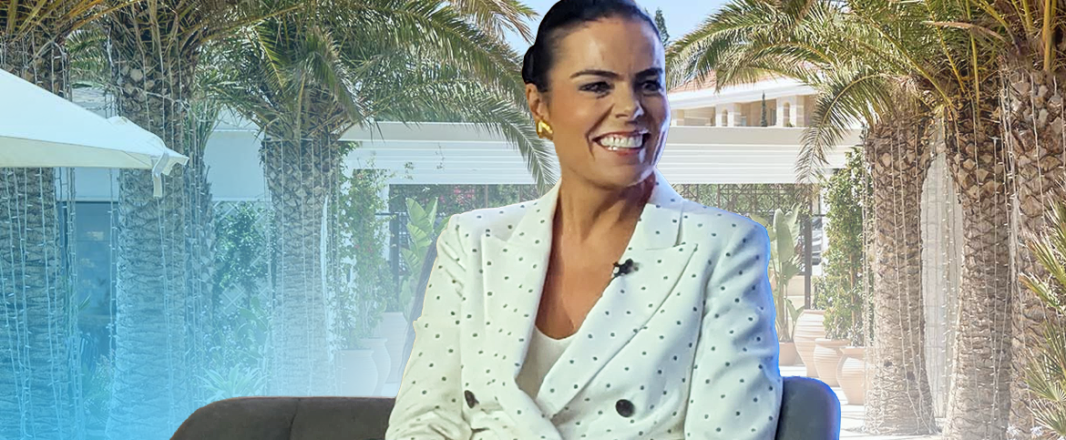
Carolyn Turnbull on luxury with personality and why she didn’t run a mile when the war started
Carolyn Turnbull grew up four hours south of Sydney, in a small country town where, she says with a grin, the sleeves stay rolled up.
She has since led luxury hotels across Asia for Aman, run destination marketing for Western Australia, sat on the board of Super Rugby Pacific, and is now building a Mediterranean lifestyle hotel brand from a head office in Dubai, with a flagship opening on the Red Sea and a $200 million property under construction in the Maldives.
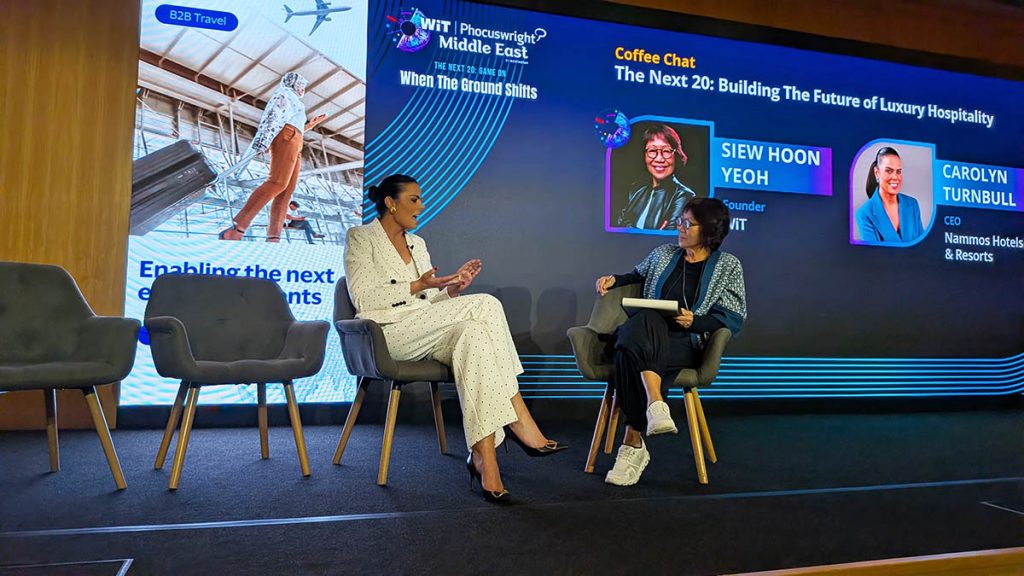
“I don’t know if I’ve gone from country girl to glamour girl,” she said at WiT Phocuswright Middle East, when I prompted her on her career transition and path. “But I certainly work hard every day for this incredible industry.”
She is the brand custodian of Nammos, a Greek brand that began as a beachside tavern in Mykonos two decades ago, evolved into a village of beach clubs, designer retail, and a 30-room boutique hotel, and is now stepping into serious hospitality with sovereign capital behind it and iconic neighbours like Rosewood, Ritz-Carlton, and Six Senses.
The long road to this moment
Turnbull spent 15 years with Aman, working alongside founder Adrian Zecha and the team, an experience she describes as always driven by a “destination first” approach. When she returned to Australia after nearly two decades in Asia, she took that philosophy directly into her role as CEO of Tourism Western Australia, approaching destination marketing the way she had always thought about hotels: position the destination in the right lens first, understand the ecosystem of hospitality and aviation, and invest in the relationship between public and private sectors.
“Any destination deserves a great hero approach to positioning,” she said. “And understanding the relationship between the public and private sector, I don’t think that’s spoken about enough.”
She then moved to Nammos, relocated to Dubai, arrived mid-last year, and almost immediately found herself leading through regional conflict in the first quarter of 2026. Asked whether she considered walking away, she was unequivocal: “That’s just not in my DNA.”
The many shades of luxury
When I polled the audience on the new luxury: time, space, silence, joy, or connection, the answers were spread across all five which, she suggested, is precisely the point.
“The way that you make someone feel is really the essence of travel. Whether someone’s seeking space, human connection, or time out, all of those elements come into play in different ways for different people.”
What drew her to Nammos was its core proposition: a place where guests feel seen, feel the best version of themselves, and feel a certain kind of unforced joy. During COVID, the Dubai Nammos, a standalone restaurant and beach club beside the Four Seasons in Jumeirah Beach, became the highest-yielding restaurant in the world. “People want to be in a place where they feel connected. A place where they’re seen.”
Her rapid-fire verdict on luxury today: room size is overrated. Authenticity is underrated. And the one thing money can’t buy? “Those spontaneous moments with loved ones.”
Her word for luxury in 2045: joyful.
AMAALA: Punching above its weight in rate
The flagship project is Nammos AMAALA, part of Red Sea Global’s development, 110 rooms, 20 private residences, on a dedicated island (Hejaz Island) just off Triple Bay, with neighbours including Rosewood, Ritz-Carlton, and Six Senses. Target opening: September.
When it was suggested Nammos should price below the established luxury stalwarts around it, Turnbull pushed back. “If you’re going to put me in the same neighbourhood, I’m not going to be seen as an affordable lifestyle brand. Absolutely not.”
Her argument: Nammos brings world-class architects and designers, executives recruited from the top tier of global hospitality, and something the bigger brands often lack – personality.
Sixty percent of the residences have already sold. Demand from investors has not softened through the conflict. “There was certainly a stalling period when everybody was concerned for a number of weeks. But the stability, particularly the domestic and regional demand, has held.”
Two further announcements are coming soon: one project within the region, one in Europe, both in what she called “iconic locations.”
The challenges of sovereign capital and staying pure
Nammos is backed by Admiral Lifestyle Holding, which carries sovereign capital. The question of how to keep a brand pure under that kind of ownership structure – Turnbull was at Aman when it moved from owned-and-operated to asset-light and has seen the challenges firsthand – is one she takes seriously.
“Any time you get into an asset-light model where you have individual owners for each property, you’ve got a very different stakeholder dynamic. There are always going to be challenges around upholding brand standards and design guidelines.”
Her answer is nimbleness. Nammos runs a small, centralised operating team that can move at pace, flex on room size and inventory when needed, and carry enough personality to compensate for what larger brands deliver through sheer scale. “We are young enough to be a little flexible. We come in with personality to punch it.”
Rugby and the leadership lesson
I asked her about her position as a non-executive board member of Super Rugby Pacific and that connection to travel and hospitality.
“Going back to diversifying my career, having opportunities to sit on different boards is really important because you’re not just brainwashed by one industry and one lens.”
The principles of team sport, she argued, are not different from building a hotel and onboarding two or three hundred staff members. The underlying question is the same: how do you get everyone working together toward an exceptional result?
On the leadership skill most needed right now – in a conversation where the room had been debating whether leaders should be “techies” or “fuzzies” – she landed clearly on emotional intelligence. AI fills operational gaps with extraordinary efficiency. But looking at your team, your employees, and your guests with sincerity and genuine intuition is “a quality that is sometimes forgotten.”
“At the end of the day, you need to be able to do it all with heart.”