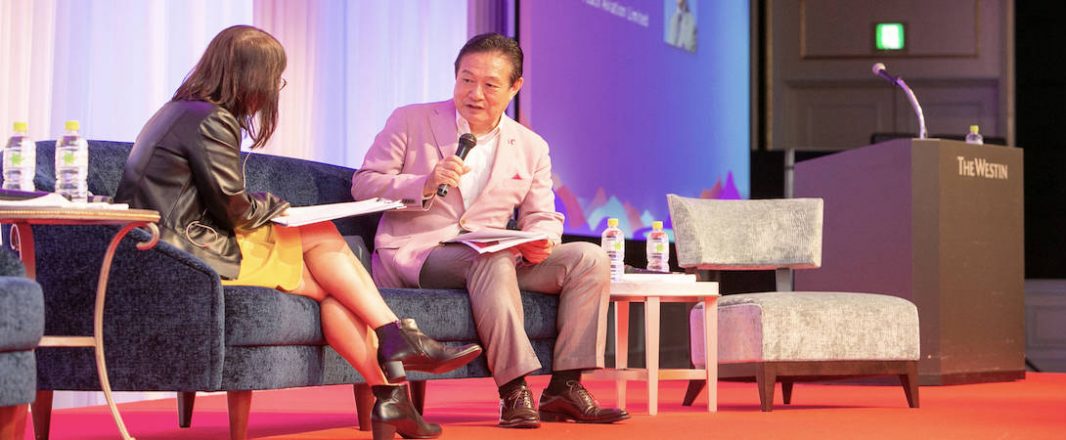
Peach CEO Shinichi Inoue has the reputation of being different, doing things in a creative and smart way, yet always coming across as someone who just uses plain old common sense a lot. At least that’s what I have gathered from the few interviews and interactions I’ve had with him over the years.
Many still recall the phrase he kept repeating during one of his on-stage interviews at WiT Japan & North Asia when I asked him how he does what he does – achieve profitability for six consecutive years for the low cost airline in a market like Japan, known for its high cost and customers you’d think would not appreciate a low cost product: “Use your brain.”
The airline’s success speaks for itself – at the end of FY2018 ending March, it achieved a total load factor of 87.8% and since its launch in 2012, it has maintained a completion factor of 98% and carried over 30 million passengers.
“Using your brain” in a creative and smart way is the theme of the book he’s written on Peach. Called “Peach No Yarikuri” (an interesting way of working so that both employees and companies soar ), the book, which went on sale in Japan in June, aims to share the Peach ways of doing things – how to be creative in different ways to wow and surprise customers and yet keep costs low.
Inoue spoke briefly about the book during his presentation at WiT Japan & North Asia. During his talk, he shared three ways in which Peach was different.
• I do not have a CEO room, no partition either. Not only that, when I am out of the office, my desk and chair are quite often occupied by someone else.
• When we were recruiting cabin attendants for the first time, it was quite challenging as not many people knew Peach and we didn’t have a big budget to advertise. So we decided. Startup staff and I distributed flyers on the streets in central Osaka. Fortunately, we managed to gather enough people to start operation.
• ANA is our parent company. But Peach is not an obedient child. Like me or not like me? When ANA goes West, Peach goes East.
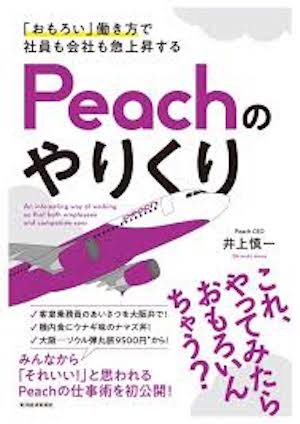
Peach No Yarikuri
At the launch of the book which went on sale in Japan in June, Inoue said, “In this book, I have shared the way of working that we follow at Peach from the standpoint of ‘managing things’. Peach’s business model is to maximise productivity through efficient operations instead of cost cutting. I will be very happy if this book helps spread to appreciate the other side of operations of LCC that are not known to people and the interesting ways of working that we follow at Peach.”
Curious to find out more about the book, I asked Kei Shibata, co-founder of WiT Japan & North Asia, to translate it for me over a weekend.
The book starts by linking Peach to its sense of place of being based in Osaka, the Kansai area, the western part of Japan which he says is very different from Tokyo and the Kanto area. People have more sense of humour and they use the word “Omoroi” a lot – which means “fun and witty”.
If you’ve been to Osaka and Tokyo, you will know what this means. There’s a friendly rivalry between the two cities just as there is often between two cities in the same country – take Sydney and Melbourne, for example.
“Omoroi” is therefore embedded in Peach’s DNA. “We want to do everything with fun,” is how it’s translated.
He gives different examples. Inflight announcements – doing it in Kansai dialect. It was an idea brought up by employees and Inoue said, “Let’s do that.”
When it started a new route to Niigata, which is known for having the best rice in Japan, some employees suggested selling the rice on the plane. Inoue said, “Omoroi. Let’s do that.”
Indeed, a lot of ideas come from employees who are encouraged to be creative. The airline runs a lot of cross-functional idea-generating contests. Brainstorming is encouraged, the team comes up with ideas and mainly, women in their 20-30s are heavily involved in these exercises.
Another example – since Kobe is located in Kansai and is known for its beef, the team wanted to figure out a way to sell Kobe beef steak inflight. It ended up giving up on the steak but came up with a bento box with roast beef, one of its top-selling items.
The idea to collaborate with Volkswagen to sell cars also came from these contests.
Peach’s philosophy is not to own anything and so it relies on cloud computing. It’d rather use someone else’s assets where possible.
In internal meetings, Inoue does not sell powerpoints (like Amazon’s Jeff Bezos). “Speed is very important, write your ideas down, no need for beautiful powerpoints” is his rationale.
One thing Shibata said he was inspired by was “how important it is to be creative in every single thing, he cares about everything”.
I saw this first hand when I visited Peach’s offices a couple of years ago. Inoue is creative down to the smallest detail. Power cords hanging from ceilings, they are covered with plants – an employee suggested that.
Said Shibata, “He’s creative in everything and constantly finding disruptive ways to change. He believes human beings have a tendency to be status quo and so he’s on an endless pursuit to be creative in every detail.”
He encourages employees to communicate verbally, not rely on emails or chat, believing it is less productive and causes misunderstandings.
He believes in keeping a physical operations manual, and keeping it updated. For example, they thought of a way to make touchdown and taxiing announcements more interesting and most importantly, keep people in their seats until the plane comes to a complete stop.
The crew says something like, “The plane is pretending to stop but it’s going to take a quick right turn, be prepared, so please stay in your seat.”
The book stresses the importance of safety which is Peach’s number one priority and Inoue repeatedly emphasises that. He believes in indepth examination and analysis of every single detail of what went wrong in a mechanical fault.
“He cares about the details,” translated Shibata.
He also cares about employees a lot. His message to employees is, you don’t work for the company, you work for yourself. The most important thing is whether there’s a fun element or not, you have to enjoy your work.
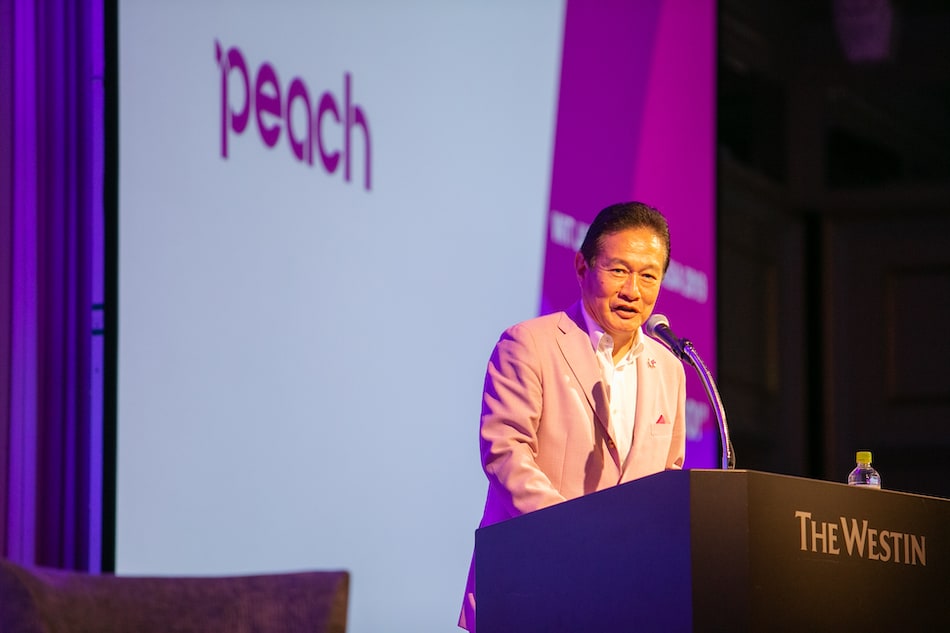
Each year, when college students join Peach, he makes a speech to the effect that “Peach is an organisation that actually increases your value, don’t work for the company, work for yourself. Leverage Peach for yourself. If going forward, some headhunter comes with a higher salary, I will be happy for you but I will try my best to increase the value of this company and make you feel I want to go back to Peach again.”
He sees himself at the bottom of the food chain – customers first, employees second, the CEO last. “Your salary will be paid by the customers.”
He is someone who believes professionals care about the results, not the process. “The value you provide will be delivered to society, not the company.”
He believes in allowing people to work in the area they are good at, rather than what they were hired for.
In communications, he believes that only 30% of what you say will be understood so it is important to reiterate and “being creative to find effective ways to communicate”.
He cites an example – for example, staff morale is down, it is a dark moment, how do you lighten the mood? He said, “let’s make our workplace happier, let’s change something or let’s be like Italians, fun – which one do you want to choose?”
Apparently, eight out of 10 people said they wanted to be like Italians.
“Find a creative way to communicate. Don’t be too serious – that’s the Kansai mentality.”
He also likes to tell a story within three minutes, believing a 10-minute speech does not work.
He encourages employees to spend 10-20% of their time on creativity and innovation, the rest on operations.
In conclusion, be “Omoroi” and “use your brain”.