
It all started with the opening keynote by Ram Badrinathan, general manager-Asia Pacific for PhoCusWright, who in calling for a freeing of the travel market to allow technological innovation particularly in travel retailing in China, quoted Gandhi, “I do not want my house to be walled on all sides and my windows to be stuffed, I want the cultures of all the lands to be blown about my house as freely as possible but to refuse to be blown off my feet by any.”
Ram said that while travel and tourism in China had grown by leaps and bounds in all aspects, there was still one aspect where it lagged behind other markets, in particular, India – innovation in travel retailing – and he attributed this to the closed GDS market which was restricting travel agents’ ability to meet changing customer needs.
He said the GDS environment had evolved considerably globally to meet the changing needs of customers such as airlines and travel agents.
In a benchmarking survey conducted by PhoCusWright in China, the company found that gaps such as efficiency tools, fare transparency and integrity, reporting tools, merchandising capabilities and relationships tools and attributes existed in the current GDS environment in China.
The Chinese GDS lacked certain functionalities for example service fee management module, automated ticket refunds and reissuing, PNR quality checks and unused ticket reports.
“Fare guarantee policy is not available for international fares in China – 40% of agents said they have to check with global GDS – and in terms of integrity of fare quote engine, agents said they have to check with individual airlines,” said Ram.
This, he said, created a lack of trust in agents.
Drawing comparisons between India and China, he said that while China outstripped India in terms of physical infrastructure, it lagged behind in terms of soft infrastructure.
In India, global GDSs are allowed to operate, there is private ownership of airlines, the travel retailing chain is deregulated and low cost airlines have a 50% penetration. All this encourages invesments and innovations by entrepreneurs.
In the Online Travel Agency markets, touchless bookings dominate – close to 90% of MakeMyTrip bookings are totally automated in contrast to 80% of Ctrip’s transactions that are done offline.
While he said that not all globalization was good – for example, McDonald’s – he said that China was sitting on the sidelines as the world of travel retailing passes by. It is time, he said, for key stakeholders in China’s retail travel industry to take their place alongside other global players.
His remarks prompted an unscheduled response from Larry Liang, general manager of airline solutions of TravelSky.
First, he explained to the audience that there were two types of GDSs – one was run by investors and shareholders who set profitability targets and the other was run by airline shareholders whose aim was to provide services to shareholders and customers. “Both are different business models and have different performance criteria and cannot be compared in the same breath.”
He then compared GDSs to nuclear weapons, saying there were some countries that chose to have GDS or nuclear weapons and those that did not.
“China is a big country; we have to choose what we want to do.” He said that while the situation was not ideal – and no one wants to sell their core technology (ie nuclear weapon) – “we are ready to learn”.
“Are we going to become competitive or go into war without nuclear weapons?”
The China travel transactions market, in any case, was huge with figures scaling from US$800 million to $1.5 billion to $3.5 billion. Global transactions by GDSs worldwide only come up to $1 billion. “Who will be capable of handling the huge travel market in China. I don’t think any system in Europe or US can handle it.”
He said a different solution was needed to solve the Chinese problem and concluded that perhaps instead of turning to Gandhi for inspiration, the Chinese should look to Confucius for the answer.
* Picture shows Charlie Li, organiser, opening the two-day conference in Beijing
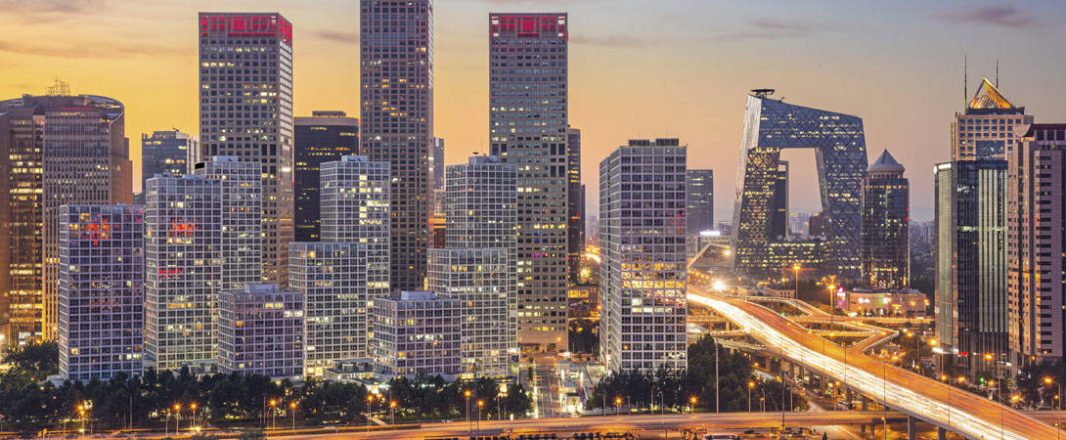
Featured image credit (Beijing Financial District): Ockra/iStock