
Mobile technology has changed retail marketing, as well as consumer buying behaviour. In Asia Pacific (APAC), where smartphones are (almost) ubiquitous, their use are evolving faster than ever before especially for travel.
The smart device is changing the travel booking experience from start to finish, said Alban Villani, general manager, Southeast Asia, Hong Kong & Taiwan for Criteo.

Criteo’s Alban Villani at WIT 2017
He was at the WIT 2017 conference in Singapore last October to present insights into the latest mobile trends, and how to capitalise on these trends and customer insights to drive better travel retail. These are the three main mobile trends in APAC.
1. Mobile rising in Asia and APAC regions
Smartphones are everywhere and across all markets. But in some markets there are more and better penetration. Most of the emerging markets are catching up extremely fast on smartphone adoption. Vietnam, for example, is going to grow considerably until 2020, from 35% to 65% smartphone household possession.
The share of mobile sales in Vietnam and China will increase considerably (Image credit: Weedezign/iStock-GettyImages)
“By 2020 almost three out of four households in China, and two out of three in Vietnam will be equipped with a mobile device,” said Villani.
It’s also about how you’re going to purchase, said Villani. “We’ re seeing very similar trend in the mobile travel consumption. Total number of sales as percentage of online travel sales is already above 50%. For 2017 it’s just above 50%, and this is going to go up and up. By 2020 this will grow to 58%”
With massive adoption of smartphones in countries like Vietnam and China the share of mobile sales in these countries will increase considerably. Three out of four households in China are going to have smartphones and they are going to start consuming massively there, he added.
2. Millennials and Gen X are changing the retail pattern
Villani said that to understand who’s actually consuming online and on mobile we need to understand their age groups.

About 65% of millennials and Gen X plan to book online once a month (DisobeyArt-iStock-Getty-Images)
Two major generations or age group that are consuming on smartphones and actually booking travel online are the millennials (born between 1977 and 1994) and Generation X (born between 1961 and 1981). About 65% already plan to book online once a month, while 88% made an online travel booking in the past three months.
This means there’s huge opportunity for travel providers, and this is just the beginning. Although these two generations are currently limited in their purchasing power they are progressively getting better purchasing power and going to spend more on travel.
Generation X and millennials are looking at different types of travel and trips, and tend to go on shorter trips within the APAC region and not long haul.
However, in terms of spending the Baby Boomers (aged over 55) trump these two generations in bringing the money to travel suppliers. They are the highest spenders when purchasing through retail apps, with a third of the respondents spending more than US$100 via an app.
3. What travellers want today
Findings from Criteo showed that everything is basically turning to consumer-centric view. Consumers are accessing online websites/application and they start to have a clear view of what they want.

Consumers want thrills on their travel (Image credit: littlehenrabi/iStock-GettyImages)
These are the emerging trends:
- New habits: Use of mobile across multiple devices such as desktops, laptops and mobile phones, to book travel. Consumers also have short attention span especially among millennials and Generation X.
- New expectations: For the most part they are looking at deals, discounts, promotions and frictionless methods of payment.
- New things to excite them: Looking at better customisation and that the app/website is able to offer to them what they want on their travel i.e. something ‘absolutely unique’.
Criteo Commerce Marketing Ecosystem
The commerce marketing technology company recently introduced the Criteo Commerce Marketing Ecosystem, a network of tens of thousands of retailers, brands, publishers, cantered on integrated marketing technology, built for commerce and powered by machine learning. It offers two new solutions— Criteo Audience Match and Criteo Customer Acquisition.
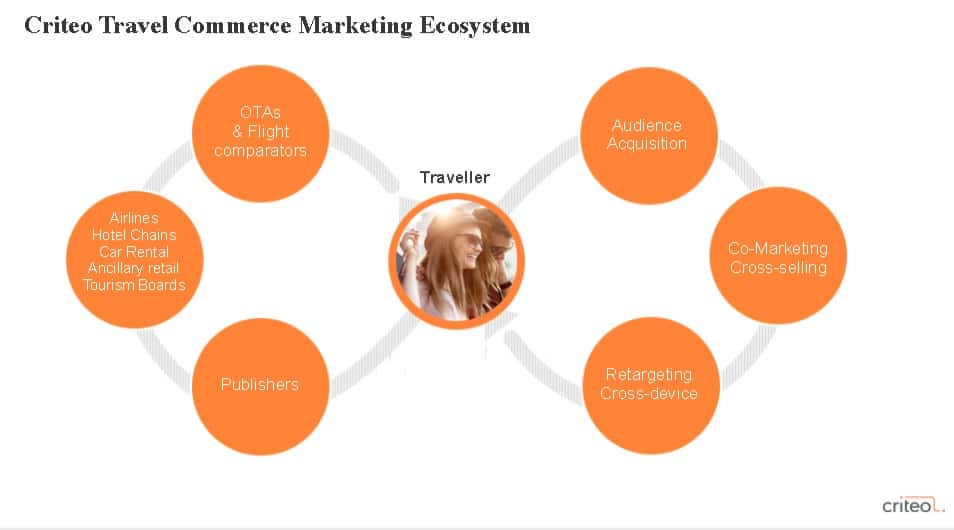
According to Criteo, shoppers are now “extremely demanding and volatile” and retailers and brands must deliver seamless and relevant shopping experiences across all devices and channels, and at all stages of the journey.
“This has introduced a new battleground, where the likes of Amazon and Alibaba have a head start: how to organise and apply data at scale to understand the shopper, reach them, and inspire them to buy,” added Criteo in a statement.
The ecosystem is levelling the playing field, enabling retailers and brands that participate “to benefit from a much broader data set and more intelligent technology than they could acquire or develop on their own.” (Read the full statement on how the ecosystem works here).
• Watch Alban Villani’s presentation at WIT 2017 below
• Featured image credit: DivVector/iStock