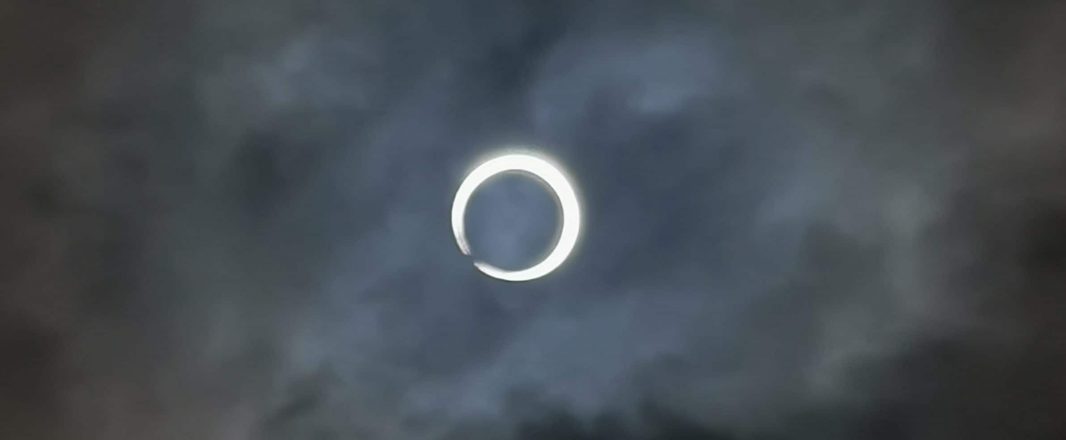
We couldn’t have asked for a more spectacular way to mark the end of a decade in Asia – the annular solar eclipse on December 26. According to experts, the next time this will occur in our part of the world will be in 2063 and given I won’t be able to wait that long, I didn’t want to miss it.
It’s kind of an eerie moment right before the eclipse. Everything gets bathed in a muted, golden glow as the moon covers the sun’s centre, and then you see a ring appear around the moon, formed by the sun’s visible outer edges. (Thank you Jason Chan of Bananamana Films for the photo).
It brought me back to October 24, 1995, when I witnessed the total solar eclipse in Angkor Wat, except that in Cambodia, the event was filled with superstition and ceremony whereas in Singapore, it was more about the science and facts, less about the beliefs and myths.
Which brings me to the good news of 2019 – the world is actually in far better shape than the media (social or otherwise) would have us believe. This is according to the book, “Factfulness: Ten Reasons We’re Wrong About the World – and Why Things Are Better Than You Think”, a continuation of the Rosling family’s efforts to “fight devastating ignorance”.
Hans Rosling started the Gapminder Foundation in 2005, thinking he could do this with facts, and if you’ve seen his TED talks, he brought to life data with “beautiful animated bubble charts” that was meant to educate people about the reality of the world – that things are better than we think in terms of global health and poverty. He even swallowed a sword at the end of his talks to prove a point.
However, all the tricks he threw into his act didn’t work – and the book, “based on years of trying to teach a fact-based worldview and listening to how people misinterpret the facts even when they are right there in front of them”, is his latest attempt to address the problem.
Described by Bill Gates as “an indispensable guide to thinking clearly about the world”, the book argues that it’s the way our brains work that’s the problem and so it teaches us to practise “factfulness”.
In a nutshell, it shares three tips. First: Realize that we don’t see the world as it is. Second: Recognise what types of stories trigger our dramatic instincts. Third: Use simple rules of thumb to resist over-dramatic stories.
So being mindful of these tips, I am trying to think clearly this holiday period as I stay at home and catch up on quiet time, and reflect. It’s hard to recall a year, let alone a decade, but I think a combination of mindfulness and factfulness will tell us that this decade has changed travel forever, from the way it’s planned, bought, sold, priced, experienced, shared and expected.
From a nice-to-have, it’s become a must-have. From a cannot-have, it’s become a can-have. From a good-to-have (because it’s good for our health), now there are those that tell us it’s bad-to-have (because it’s bad for our planet). One thing is for sure, we cannot keep having it if we take it for granted.
So here are my top lessons of 2019.
• Challenge status quo
I don’t know about you but I feel we just cannot continue as usual. To do things the same way, to think the same way, to say “it’s always been this way because …” Everyone has to think different. Is there a different way to go about this? Can I do this differently?
I tried to do this with our October conference by taking on a theme that would make people think hard about what the last decade has meant for our industry, our world, where we were and where we are and did we see all of that coming, and if not, how and why did we miss it? And how do we make sure we don’t miss it this turn of a decade? Let’s be mindful of the facts of what happened in 2019 and mark them as pivotal events that will impact our industry.
In this decade, we’ve seen the flattening of the travel funnel in Asia, starting in China, which showed the world how to suck, condense and flatten the complex world of travel into a small screen, and within that vortex, brands have created entire commerce ecosystems. Other mobile-first markets have followed.
In this decade, we’ve seen “niche” players go big, first with funding and then with ambition, as they try to find their own path to success. Consider the different paths being taken by GetYourGuide, which sees itself as “more entertainment, less OTA” and Klook, which is building out more of a lifestyle platform of services and products (hotels, movie tickets, festivals).
In this decade, we’ve seen alternative become mainstream – Airbnb buying Hotel Tonight. One-trick ponies turn into full circus acts (Grab, Uber, Go-Jek). Chats turn into commerce empires. Wallets turn into banks.
What all of them have done, for better or for worse, is challenged the status quo, and in the next decade, they too will be challenged. For sure, it’s going to be an exciting ride for us in travel, and only for the brave.
How will you challenge yourself?
• Nothing is to be taken for granted
I know, a cliché, don’t take anything for granted but in the everyday humdrum of life, even that truth is taken for granted.
I started the year with a personal injury which knocked my confidence for six and then mid-year, I received a sucker punch to my gut with a piece of family news which forced me to confront my biggest fears. Thankfully, my heart is still beating and so the biggest lesson from this is to do only stuff that makes your heart beat faster.
What makes your heart beat faster?
• Express yourself
I know, you’re probably thinking, do people really need more encouragement to express themselves? We already have posts of food, pets, holiday photos ad nauseum on our social feeds, do we need more?
But I mean a different form of expression, one that captures who you are, conveys your point of view, your unique perspective. It can be any medium – baking a cake, moderating a panel, writing a poem, launching and building a business – long as it captures you.
For me, 2019 was about learning about podcasting – from getting a list of equipment to buy (which I’ve never used because I then decided I wanted to do it all in a studio for the experience) to learning to edit (which I’ve hardly used because I then decided I should leave it to the expert).
The top lesson is, just do it, and do it with great people. You learn more than you lose.
What have you got to lose?
• Seek meaning over mumbo jumbo
Bringing mindfulness and factfulness together, I hope we will fall less for click bait, more for substance. I know it’s getting harder as we get swamped by social media posts that are mostly self-serving and media organisations such as Guardian and NPR have to ask us for donations to keep them going, but I am optimistic the pendulum will swing back towards thoughtful content as we demand respect for our time and attention.
It’s our most precious asset, we shouldn’t squander it on those who don’t deserve it.
What do you deserve?
I was listening to the Slate “Hit Parade” podcast the other day and Chris Molanphy was reflecting on the top hits of the decade and how, for the first time, the charts were driven more by tech, less by melody.
At the beginning of this decade, streaming was factored into the compilation as companies like Spotify changed the status quo and a new string of artists emerged and then in 2015, video streaming was added into the mix which gave us the viral sensations of “Gangnam Style” and “Despasito”.
One artist, though, was always present in the charts through the decade, through the ups and downs, through the different machinations of the hit parade, and that was Rihanna. Whether she was going it alone or collaborating with artists as diverse as Paul McCartney and DJ Khalid, Rihanna, said Molanphy, was “always consistently different and in tune with the times”.
May we all find our inner Rihanna 2020 and beyond. Happy new year.