


WiT Queenstown was James Thornton’s first day back at work, fresh off three weeks in Greece, where, he stressed to the audience, he was fully, deliberately offline.
“I think some CEOs find it really bizarre that I wouldn’t do emails and calls on holiday,” he said. “But great companies have great teams. I don’t need to be online. I need to dedicate time to my family, to relax, to think, to refresh.”
I asked him therefore if “unplugged trips” was something Intrepid would start selling to other CEOs like himself – to which he instantly said no.
Intrepid had tried a range of “disconnected trips” five or six years ago – they generated global media coverage (CNN, BBC, Financial Times) but never built meaningful volume. “People are not willing to turn off their mobile phones,” Thornton said. “The number one question our tour leaders still get is: what’s the Wi-Fi password?”
His read on where that leaves the market: full digital detox may never scale, but he expects a growing premium for the undigitised – “the question people are asking is whether travellers will pay a premium for that.”
From a 42-hour train ride in India to CEO
Thornton, a former banker who has publicly said he left banking because he was tired of “making rich people richer”, also shared his personal story of how he landed in Intrepid.
Fresh out of the UK’s south coast on a round-the-world ticket, terrified of arriving cold into India, he planned a “gentle” entry: a Mumbai-to-Kochi train ticket, 17 hours down the coast, according to his stack of five Lonely Planet guides – “that was half my luggage allowance.”
The train took 42 hours instead, cutting straight across the country through the Western Ghats, with Thornton sharing a second-class sleeper berth with an Indian holy man.
“That was my introduction to adventure travel,” he said. “And I got hooked.”
A honeymoon safari trip years later sealed it. He joined Intrepid in 2005 planning to stay two or three years before returning to a “real” corporate career. Twenty-one years and a decade as CEO later, he’s still there. “Best decision I ever made.”
Growth with purpose, and profitability follows
Explaining Intrepid’s model, he said it runs on five company goals, weighted equally: revenue, profit, customer NPS, employee engagement, and purpose outcomes, with incentives tied to the full set rather than skewed toward the financial ones.
“What gets measured gets done,” he said. “The more you invest in purpose, the more engaged your people are. The more engaged your people, the more engaged your customers. The more engaged your customers, the more holidays you sell. And if you’ve got a decent commercial model – which we do – the more money you make.”
It’s why Intrepid had its best year in 37 years: $800 million in revenue, record EBITDA, and an NPS of 83.
The $1 billion milestone, which he has publicly declared, has been tantalisingly close but painfully sensitive to global events.
Thornton described sitting in Dubai airport in February, at the end of Intrepid’s four biggest months on record, watching momentum build toward the billion – before regional unrest broke out and bookings stalled.
June turned into the fourth-biggest bookings month in company history the moment travel advisories eased. “The billion will come,” he said. “Whether it’s this year or, I imagine, more likely next year.”
A founder-run business with a professional CEO
Pressed on whether Intrepid’s growth could have come without a professional CEO like him running it under founder Darrell Wade, Thornton said they made a good team.
He joined as a salesman and learned the business from the founder. Darrell, he said, generates “10 ideas a day, wants them done by lunch, and has forgotten about them by evening. Of the 10: three are world-class and I go implement them immediately. Three would send us broke, so I bury them. Three we’ll toss around.”
The partnership works, he argued, because of their complementary skills and a founder willing to defer. “You’ve got to have humility as a founder. Great companies have great teams. You can’t win with one great player and ten average ones on the pitch.”
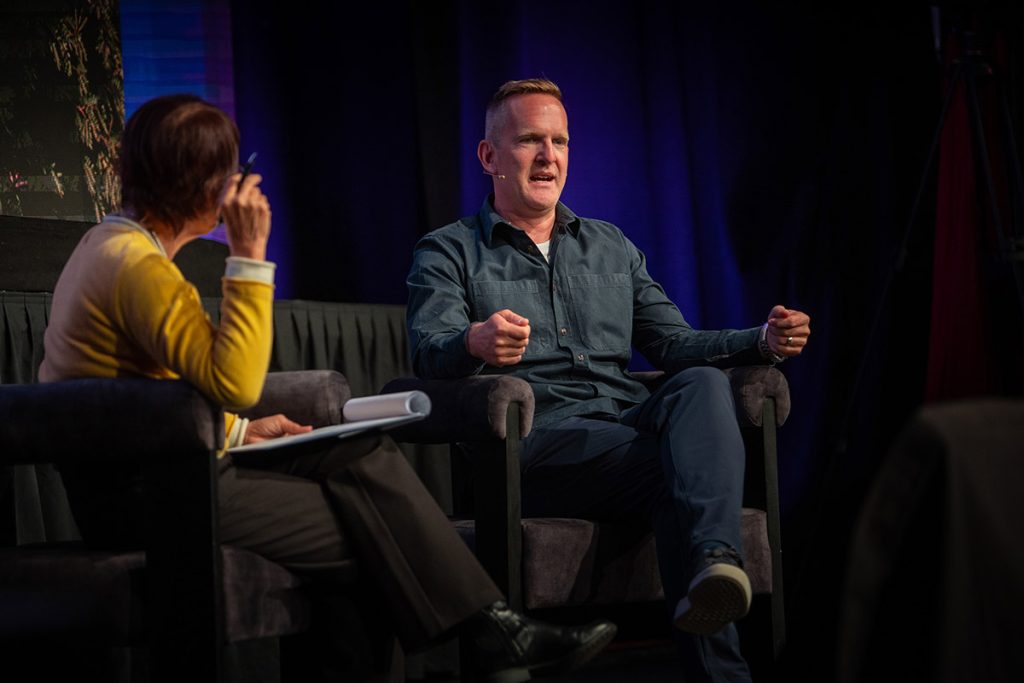
James Thornton: “I think some CEOs find it really bizarre that I wouldn’t do emails and calls on holiday. But great companies have great teams. I don’t need to be online. I need to dedicate time to my family, to relax, to think, to refresh.”
Never waste a crisis
Switching the topic to resilience, I referenced Air New Zealand CEO Nikhil Ravishankar’s earlier comment that “the world’s best airline is also the world’s most resilient airline” and that the industry was going through yet another series of shocks. I asked him how he thinks of building resilience.
His answer doubled as a potted history of Intrepid’s growth strategy. COVID cost the company 90% of revenue and two and a half years without profit – its last pre-pandemic profit came in November 2019, its next in July 2022.
But Thornton traced the same pattern through every prior crisis: SARS and bird flu, which wiped out Intrepid’s Asia business and forced its first expansion into Europe; the loss of the STA Travel account, which cost 22% of revenue overnight and forced a rapid shift to direct-to-consumer distribution; and COVID itself, which pushed the company harder into close-to-home travel, brand investment and accommodation ownership.
“The key thing is every time there’s been a crisis, Intrepid has taken a step forward,” he said. “Never waste a crisis. That’s why we’re three times the size we were in 2019.”
Notably, Thornton pushed back on the idea that resilience is primarily a technology story. “Technology does enable a degree of resilience, but ours comes from our people. We’re a people business – 4,000 people around the world, hundreds of collective years of travel experience, our own destination management companies in over 40 countries.”
He tied it back to Intrepid’s definition of adventure as “leading without fear” – including a willingness to be contrarian on purpose. “We say things a lot of people don’t agree with, and we’re totally comfortable with that. That’s one of the joys of private ownership. If everyone goes right, we’ll often be going left. Sometimes we’ll get it right, sometimes wrong – we’re okay with getting things wrong too.”

James Thornton: “The key thing is every time there’s been a crisis, Intrepid has taken a step forward. Never waste a crisis. That’s why we’re three times the size we were in 2019.”
Buying the roof over travellers’ heads
Asked where Intrepid is placing its next bets, Thornton pointed to an accommodation buying spree: eight properties acquired in the past two years, spanning an ecolodge on the edge of Cradle Mountain in Tasmania, a riad in Morocco, two properties in Finland, and recent luxury assets in Australia.
The logic is retention as much as diversification. “Even our most loyal Intrepid traveller only travels with us once every 700 days,” he said. “I need a way for people to feel the Intrepid brand on a more regular basis.”
On where Intrepid is directing fresh investment, Thornton named tailor-made FIT travel as the fastest-growing part of the business – currently a small fraction of Intrepid’s roughly $800–900 million in revenue, but one he expects to match small-group travel in scale within five years.
The Not Hot List, and a flat rejection of “responsible travel is a luxury”
On the overcrowding issues being faced by certain destinations, Thornton positioned Intrepid’s dispersal strategy around four levers: small-group travel by design, support for local regulation capping visitor numbers, ensuring spend stays in local communities, and – most distinctively – an annual “Not Hot List” steering demand toward under-visited places with the infrastructure and appetite for tourism but not the profile.
Past picks have included Greenland and Vissing, Croatia (the latter, he noted wryly, now crowded in its own right); this year’s list is still being finalised ahead of a September release.
Put to him directly – that responsible travel is a premium product only wealthier travellers like himself can afford to care about – he pushed back with vehemence. “Massively disagree. Staying in local accommodation, using local transport, eating in local restaurants doesn’t carry a premium cost. Intrepid’s roots are as a $10-a-day budget travel company – $10 a day accommodation, $10 transport, $10 food. I totally dismiss that.”
What he’d change about the industry
Closing on the session’s theme – rethinking the purpose of travel – Thornton, when asked the one thing he’d like to change about travel, said, “It would be that travel was designed to benefit communities, not just customers. The way we’ve all grown up designing travel is for the benefit of the traveller – give them a wonderful time, they come back, that’s an NPS of 83, and I know people do come back to us and have wonderful times.
“But travel doesn’t have the equilibrium right at the moment. Communities aren’t sufficiently benefiting, and when they are, it’s too infrequent, and it goes to too few people. If I could redesign travel tomorrow, it would be that more of it benefits the local communities providing the services in the first place.”


