IHG’s Motoe Katsushima on gender quota in hospitality, Expedia’s focus on women travellers and Booking launches Travel Proud in Japan
It is astounding that in an industry where it’s the women who are the decision-makers in travel, and who are the ones actually travelling, despite the outbound slump in Japan, that women continue to be pretty much absent from the ranks of senior leadership in travel. But things are changing, albeit perhaps too slowly for some of us.
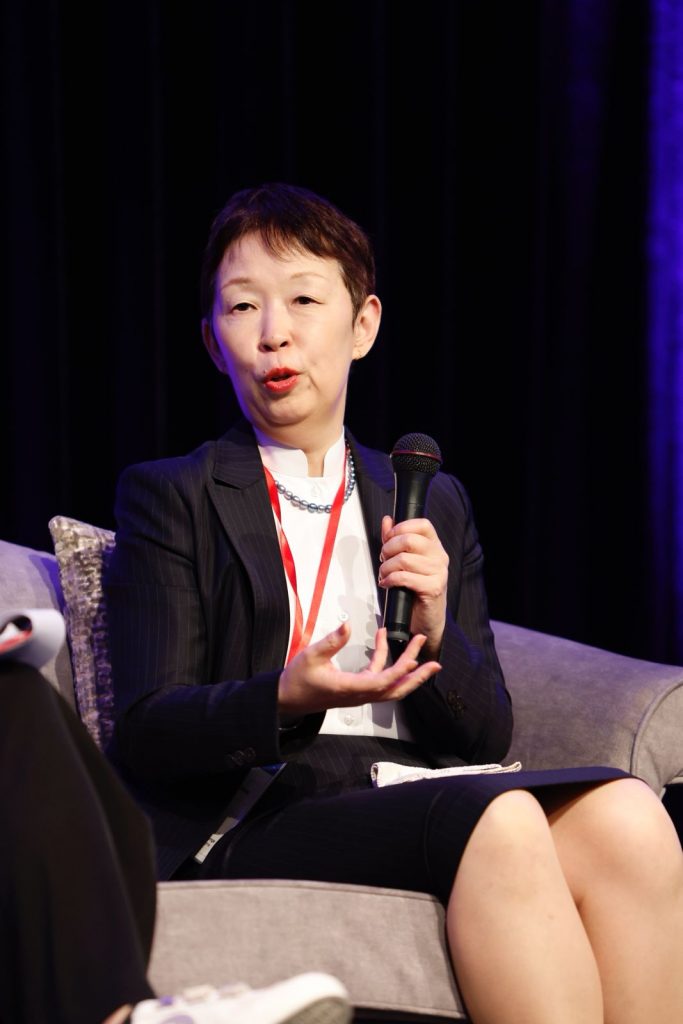
Motoe Katsushima: “Most Japanese females are very humble, they said ‘oh, I cannot do that’. But they sense, okay, maybe they are not recognized.”
Motoe Katsushima is an example of a woman leader in Japan who wants to speed things up when it comes to gender diversity in hospitality. As the Chief Operating Officer, Director of Operations, IHG Hotels & Resorts and IHG ANA Hotels Group, Japan, she herself has had to work for decades, and through the ranks. She started as a secretary to a finance director and then worked in various admin, accounting, finance and operations roles before being appointed to her current role about a year ago.
As a member of the IHG JAPAC Diversity, Equity & Inclusion (DE&I) Council, she wants to achieve 20% female general managers in the group in Japan. She thought long and hard about setting quotas initially but concluded that it can be an effective strategy to drive organizational change and encourage active consideration of qualified women for leadership positions.
“We should set some quota target so people think differently about it, and act upon it.”
Since her appointment, IHG now has five female general managers. “It’s a start,” she said.
As with other global hotel groups, IHG is expanding fast in Japan. In January 2024, it announced plans to launch the Garner™ brand in Japan this year, marking the first deal outside of North America for its new midscale conversion brand. The partnership between IHG and Axe Management Partners will see Garner make its Japan debut in the second half of 2024 with three conversion hotels in Osaka. IHG currently has 54 open or pipeline hotels across the country.
This fast expansion across hospitality is putting a strain on manpower, a pointed noted in another panel. Christian Baudat, country general manager, Japan, The Ascott Limited, addressing the manpower challenges facing Japan’s expanding hospitality industry, mentioned almost 90% of applications were from women. “Where are the boys,” he said. When I asked why, given this ratio in applications, there were so few women in leadership positions, he said it would take another conference or a full day to get into it but it is generally acknowledged the challenges are numerous.
Katsushima said one challenge is to have women considered in the initial selection process in the first place. “In Japan, most of the management is afraid to take a risk with changing some policies – for example, if they promoted some female senior leaders and they are not successful, so maybe they are afraid about that,” she said, adding, “Women often face the challenge of having to prove their competency and potential through tangible results, as their capabilities may not be automatically recognized or considered.”
Asked if she would have had a harder time rising to her current position in a Japanese organisation versus a global corporation, she spoke about the faster decision-making processes in international companies versus local organisations.
Initiatives aimed at empowering and encouraging women to recognize their abilities and overcome self-doubt can help address confidence gaps and promote gender equality in the workplace, she noted. “Most Japanese females are very humble, they said ‘oh, I cannot do that’. But they sense, okay, maybe they are not recognized.”
This is why she holds women’s events to encourage women executives and also to share stories of role models. “Promoting diverse role models, including women from various backgrounds and industries, can inspire and encourage more women to pursue senior leadership roles,” she said.
Another way is through targeted development programmes. She cited IHG’s Rise programme as a strategic initiative to accelerate the development of future female leaders by focusing on enhancing their leadership skills over English language proficiency. “In Japan, it’s harder to achieve English language proficiency so we adapted the programme,” she said.
In her own career, Katsushima left IHG a couple of years back to join Marriott before she returned and was promoted. Changing companies can provide valuable learning opportunities and fresh perspectives, ultimately enhancing one’s career growth and value proposition, she said. “I recognised I should get out of the box. At Marriott, I learned a lot about their culture, their way of thinking and working, and so I feel that on my return, I can add more value to my current position.”
She encouraged young women to step out of one’s comfort zone and to “try everything”. “When I worked in finance, I saw people as a cost we had to save but when I moved to HR, people became an asset to help the company grow.”
She is particularly excited about the role of women in the age of AI. As AI automates more routine tasks, soft skills like empathy, communication, and emotional intelligence will become increasingly valuable in the hospitality industry, where human connections and personalized experiences are essential. “Women have very good communication skills and empathy. Maybe AI is very good to support these advantages for women.”

Michael Dykes: “We’re talking to Japanese consumers again about the wonder of traveling abroad.”
Growing power of women travellers – Expedia takes “two step” ahead
Another trend that speaks to the evolution of the Japanese travel market is the strong appetite women have for travel, defying the general sluggishness in outbound travel from the country.
Michael Dykes, vice president, market management, Asia Pacific, Expedia Group said it chose to launch its global advertising campaign in Japan “to reignite Japanese consumers’ love for travelling abroad”.
“We’re talking to Japanese consumers again about the wonder of traveling abroad. It’s not about whether it’s cheap or expensive. It’s just, remember, the true value is that you get to learn and experience new things,” he said.
In particular, its “Two Step” commercial (above) is specifically aimed at Japanese women. “80% of travel decisions are actually made by women and the number of women who travel overseas is double the number of men. When you’re thinking about how you target properly in a country like Japan, this is one of those demographics you really want to focus on.”
He also pointed out the deliberate decision to promote a US destination like Nashville, versus what would have been by default, Hawaii, a few years earlier. It will be rolling out advertising campaigns in other markets in Asia, including Hong Kong, South Korea and Singapore, and the Middle East. “What we really want to focus on are premium travellers who appreciate customer service, who travel a lot, who want to stay longer,” said Dykes.
The growth of new outbound tour-package startup, Reiwa, is also being fuelled by women. Women under 29 form 70% of its customers. Said CEO and founder Takaya Shinozuka, “Actually we don’t know why but perhaps it’s because we use SNS and channels like TikTok and Instagram, and women under 29 tend to use those services.” Reiwa’s top three destinations are Seoul, Thailand and Taiwan.
Outbound though is facing headwinds, not only due to the weak yen but dampened Japanese appetite for outbound travel, but Shinozuka remains undaunted in growing his startup. “Yes, it is a big challenge. When I started my company, the problem was Covid-19 and we couldn’t even get to travel. “The Japanese outbound travel market is a two trillion yen market, and 50% came from packages, and that’s growing to 60-70% and recovering – so it’s a huge market I am still interested in.”

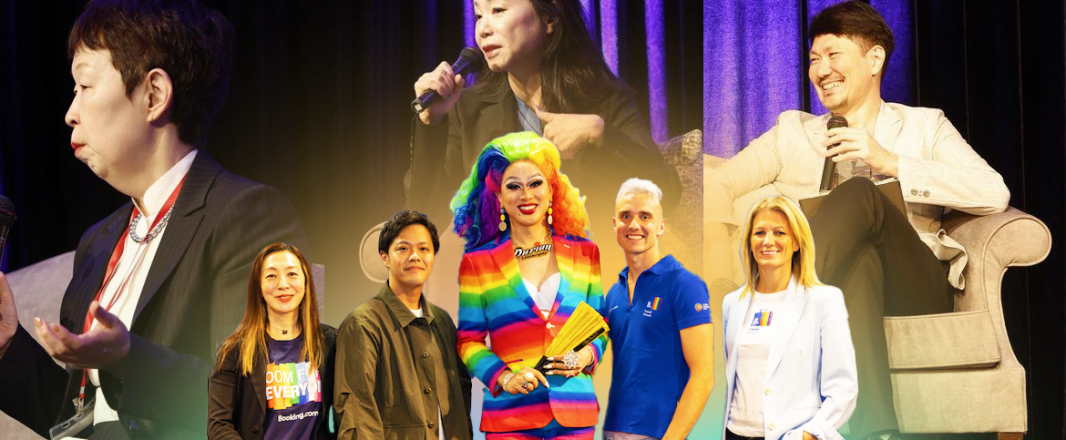
Laura Houldsworth, managing director of Booking.com, Asia Pacific (extreme right), at the Tokyo launch of “Travel Proud”. With Dorian Rolobridgida (centre): “When accommodation facilities show consideration rather than restraint to LGBTQ+ individuals, it makes the travel experience wonderful.”
Japan, first market in APAC, to become “Travel Proud” by Booking.com
The face of Japanese travel is also taking on more hues with the launch of Booking.com’s “Travel Proud” programme in Japan in April, the first of its kind in the Asia-Pacific region to be offered in a local language.

Akimi Takemura: “It is very important for us in the industry to be welcoming wherever they’re coming from, who they love and which identity they have – it doesn’t matter.”
Akimi Takemura, Regional Director, North Asia, Booking.com, speaking at WiT Japan & North Asia, said that travel inclusion is one of the key themes for its Japan business. “It is very important for us in the industry to be welcoming wherever they’re coming from, who they love and which identity they have – it doesn’t matter,” she said.
She noted that with Japan expecting 33.1m tourists to visit in 2024 alone, it was important to welcome everyone equally. According to a recent survey by Booking.com, 58% of LGBTQ+ travelers have experienced discrimination while traveling. Additionally, 32% reported having to change their behavior to avoid scrutiny or discomfort. 80% of respondents expressed the importance of considering their safety, well-being, and happiness when choosing travel destinations.
The “Travel Proud” programme is aimed at learning about LGBTQ+ individuals for partner facilities. According to a survey conducted by Booking.com in 2023 targeting 11,555 LGBTQ+ travelers from 27 countries worldwide, including Japan, 60% of Japanese LGBTQ+ travelers responded that they need to consider their safety and well-being when choosing a destination.
This number has increased significantly from 48% the previous year and is approaching the global average of 80%. These survey results suggest an increased awareness among Japanese LGBTQ+ travelers and a growing demand for safe and comfortable travel experiences.
At the press conference to launch the programme in April was Dorian Rolobridgida, an LGBTQ+ individual who is also active as a drag queen while maintaining their own axis, who said, “For me, travel is like washing the soul. Also, I think travel experiences are like nourishment for the soul. My partner is a transgender man. Especially when traveling abroad, we often feel inconvenienced by the difference between the gender on our passport and our appearance. When accommodation facilities show consideration rather than restraint to LGBTQ+ individuals, it makes the travel experience wonderful.”
Booking.com’s “Proud Hospitality” training and “Travel Proud” badge were launched in 2021. Currently, the training is available not only in Japanese but also in English, Italian, French, Spanish, Brazilian Portuguese, and German. There are currently over 65,000 Proud Certified certifications obtained by partner accommodations in more than 12,000 cities across 120 countries and regions.