
At Schiphol these days, they still give you free WiFi for an hour, but on the condition that you have to complete a survey. If you don’t wish to do that, then you can pay for premium access.
It’s a fair exchange, I reckon. You shouldn’t get something for nothing and it is clear that travel companies in Europe, like everywhere else, now see customer data as an asset to be mined, cleaned and executed upon.
At Phocuswright Europe held last week in Amsterdam, president Simon Lehmann spoke of big changes happening in travel distribution on the continent. By 2020, all bookings will come from mobile, he said, with the current figure at 22%. Close to 60% of all online air bookings are direct and for the first time, hosts are now a relevant part of the travel offer.
“We haven’t seen such a revolution since low cost airlines,” he said, and he asked the burning question, “Will the EU have the power to reduce the power of Google and ITA?”
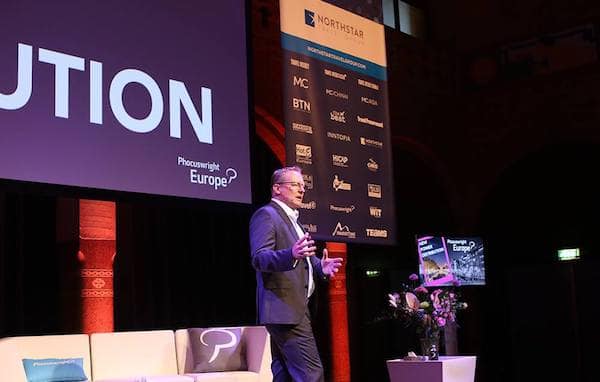
Simon Lehmann at the opening of Phocuswright Europe (image credit: Phocuswright)
Unlike Asia, where markets like China, South Korea and Japan have other search powers, Europe’s pretty dominated by Google and the concern over the rising power of this American behemoth in travel distribution was raised repeatedly in Amsterdam.
With it declaring itself an AI first company and the fact that 20% of all mobile searches are now on voice (heard at Phocuswright from a Google executive), it is clear there is no slowing down of the march of Google into travel.
In his opening (watch video here), Lehmann offered an optimistic view, saying, “Monopolies have never been sustainable and the new customer will remain in power and shape the future of distribution” but you have to wonder, in the land of scale, will consumer choices be limited by default as the big gets bigger and the small gets nicher (if there’s such a word), and the middle gets squeezed out of the food chain?
Here’s the first take of the key takeaways from Phocuswright Europe. Part 2 next week.
Don’t give me opinions, give me data and let’s test it
Booking.com may be expanding into Experiences – the product is now available in Dubai, London, Paris and Rome after successful testing in Amsterdam – but it remains focused on keeping the customer at the centre of all innovation.
Peter Verhoeven, responsible for Europe, Middle East and Africa, spent a bit of time speaking about the company’s culture of innovation. “How do you build an organisation where data-driven decisions are valued?”
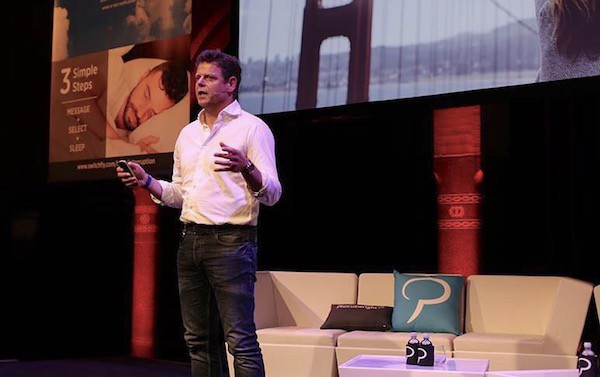
Peter Verhoeven: “There is appetite for vacation rentals.” (Image credit: Phocuswright)
That means testing everything. “AB testing is not something you do, it’s a culture. Your opinion is worth very little especially if you try and push your opinion as a hypothesis.”
Its growth is impressive – it now books 1.4 million room nights every 24 hours and of its 1.2 million properties, 650,000 are private apartments. “There is appetite for vacation rentals,” he said.
Four things currently obsess the company – new marketing channels, mobile payments, messaging platforms and machine learning/Artificial Intelligence (AI). As in Asia, Africa is mobile only; it is figuring out how to be relevant in voice search and it is “training the bot”.
“We are in the early stages of seeing how the AI can scale.”
C is for Customer and Commitment, not Channel
In the US, while the number of people booking on brand.com is growing faster than OTAs in the last six months, the same is not true for the rest of the world, said Guillaume de Marcillac, co-CEO of Fastbooking.
“Yes, direct bookings are growing and yes, meta can be good for hoteliers but OTAs and indirect distribution continue to grow faster than direct – that’s two-thirds of the world vs the US,” he said.
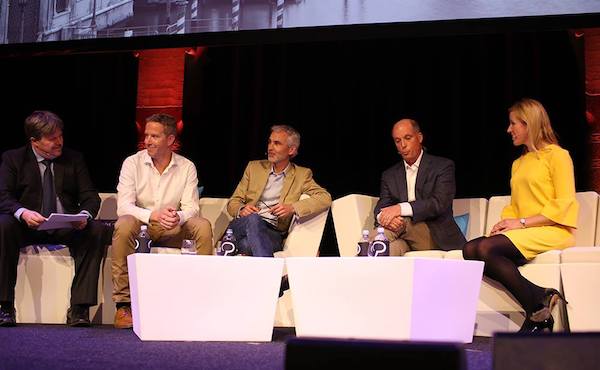
Talking about the ‘C’ factor: Fastbooking’s Lennert de Jong (2nd left) & citizenM’s Guillaume de Marcillac (3rd left)- (Image credit: Phocuswright)
citizenM was hailed as the model citizen, as it were, when it came to getting its guests to book direct, and de Marcillac hailed its “agility and innovation”, saying there’s no reason why smaller companies cannot execute better.
Lennert De Jong, CMO, had pretty strong views on how it makes that happen. “We don’t want to give people cash to come back to us, we want them to come back for the experience.”
And as for which channels they book on, he said, “It should not be about the channel, it’s how to get people committed toward the product we are selling. If you haven’t invested in technology, if you haven’t differentiated, then you can’t be surprised if you are commoditised.”
“The most profitable customer is the business traveller frequently travelling to our cities, and they come through GDS or direct,” he said, and added, “Averages are killing our industry, averages make you average.”
De Marcillac said there’s no doubt that Google is now the number one meta-search company in travel in the world, adding “the TripAdvisor days are behind us”.
Lessons from Lola
Paul English, co-founder of Kayak, and now working on his new startup, Lola, the AI-enabled human travel agent service, disclosed plans for a new version that will be focused around frequent business travellers.
An early mover in the world of AI, English was honest about the challenges of startup and the reasons for this pivot. “People need duty of care and there were lots of last minute changes and that was causing me to spend time with a lot of SMEs.
“There are things humans can do that bots cannot, especially in high stress situations. With chatbots, if you do verticals and narrow, it works well. Open-ended, it’s hard.”
Paul English (right): “The thing I focus on is recruiting.” (Image credit: Phocuswright)
He said that the people who really like Lola are people who travel a lot. “If you travel every week, it works really well, Lola knows your preferences and it’s like having an executive assistant who knows you really well.”
And he believes there’s a better way of doing things from the TMCs and other apps “put in place by the finance department that’s different from what travellers want”.
“What do they want? That’s what I am thinking about,” he said,adding, “Business travellers are happy to pay for subscription and we will add some form of subscription to the model.”
English, whose life is explored in the book by Tracy Kidder, “A Truck Full of Money”, said that focus is very important when building a company. With Kayak, he and Steve Hafner wanted to build a company people could trust, which is why they resisted adding bookings on the site in the early days.
Citing the example of TripAdvisor which he called an amazing company, he said. “If you’re known for a particular thing, it’s very difficult to change your identity. People know it as research, not booking and you can’t take millions of customers and change them.”
Calling himself a product guy who’s better at the early innovation stage – he started five companies before Lola – he said, “The thing I focus on is recruiting” and added, “Whatever time you are spending on recruiting, double it.”
To English, success is a double-edged sword. “There is a part of it that feels awful, the stupid success is like an elephant that blocks my view and everyone wants something from you, that can be annoying.”
• Featured image credit (Amsterdam): Yeoh Siew Hoon