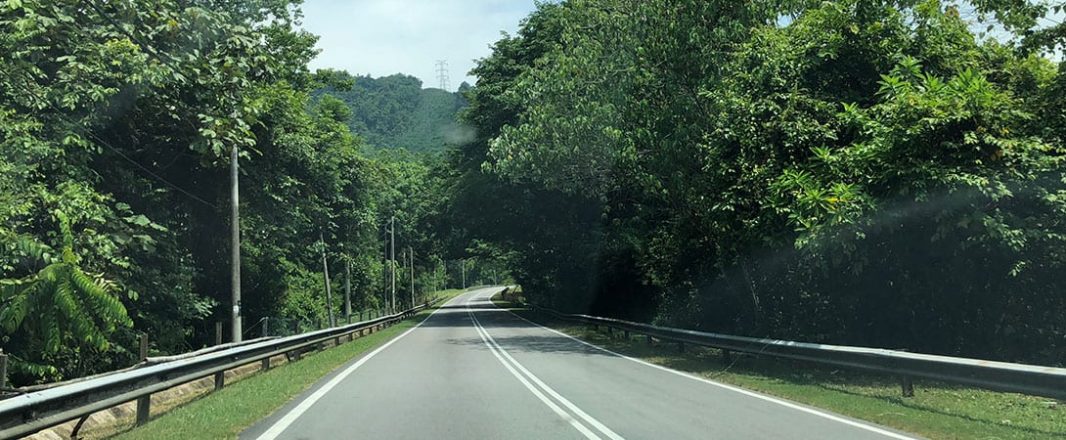
Driving along the highway that cuts into Kuantan, Pahang, on the Malaysian east coast, my mind casts back to the first ever travel conference I covered as a rookie in the world of travel trade journalism.
The speaker was Mahathir Mohamad, then-Prime Minister who, in this year’s general elections, came back to power in an almost superhero-like fashion, ousting his own prodigy, and giving rise to the belief that 90s could be the new 60s.
In that speech, he spoke of how idyllic images, loved by tourists, such as that of a fisherman sleeping on a hammock under a coconut tree, do not show his empty belly or hopes of a brighter future for his children, and how Malaysia was therefore hellbent on pursuing progress and prosperity for its people.

The images of the Malaysian East Coast remain idyllic. A mother and child enjoying the early morning on a deserted beach in Trengganu.
Fast forward more than 20 years later, the images of the Malaysian East Coast remain idyllic. Stretches of empty golden beaches, small villages with their well-kept, colourful houses shaded by coconut trees, fishing boats bobbing on the shores.
I am not too sure of the empty bellies today – since then, the east coast has found new riches in its forests (timber, oil palm) and oil, evident from the denuded tracts of forest and oil refineries burning along the coast of Trengganu.

We started in Kuala Lumpur and ended in Penang, covering more than 1,200km over six days at a leisurely pace.
But in many ways, this road trip on the Malaysian east coast – we covered 1,200 km over six days, starting in Kuala Lumpur and ending in Penang – felt a bit like a time capsule. From a traveller’s perspective, not that much has changed really since the first trip I did right after school.
Even Dr Mahathir has come full circle and is saying something similar about being hellbent on pursuing progress and prosperity for everyone, not just the few who got very rich the last 20 years.
The stretch from Kuantan (Pahang) through Kuala Trengganu (Trengganu) to Kota Baru (Kelantan) feels familiar. We drive through mountain ranges, palm oil and rubber plantations, villages, coastal scenery, local markets – it’s as quiet as I remember it.
There’s not a lot of evidence of tourism having impacted daily lives in a major way. I find this to be somewhat reassuring – mass tourism has changed the face of so many places in South-east Asia – from Bali to Phuket and Penang – that it’s nice to be in a place where life remains local, grounded and real.
Tourism exists in pockets, clustered around the resorts and hotels. Other than the start and end point, we had no fixed plan over the six days. We didn’t know where we would stay.
Armed with our mobiles, we were confident we’d make do. And here’s the thing – while the place hasn’t changed, the way we travel has. On my first trip, it was, let’s go get lost. Now, it’s let go find.
Before the Internet, travel itself was the act of leaving your comfort zone. Today, you travel within the bubble wrap of technology and you have to want to make a concerted effort to get out of it if you want to be more than a tourist. You rarely get lost with maps, other people tell you where to stay and eat, and what to see.

Occasionally it’s good to dump Waze, get lost and wander around a fishing village such as this.
Waze was our most constant companion. Even if we wanted to go analog, we couldn’t. We couldn’t find a printed map anywhere. We probably ended up talking more to Waze than to ourselves, he’s easier to talk to, doesn’t answer back when we call him “stupid”, which happened a lot. Funny how we humans have a predilection to always blame someone else for our problems even if it’s an OS.
Waze is way smart though. An Israeli startup acquired by Google, it’s the preferred navigation app in Malaysia and because it works on crowd sourcing, with such high usage, it is as close to a travel finder/trip planner as you can get.
It tells you where the jams are, tells you who else is using Waze around you and allows you to chat to one another if you choose to and tells you places around you. It is hyper local. You can see where it could go the next stage with personalisation and recommendations, with machine learning and data.
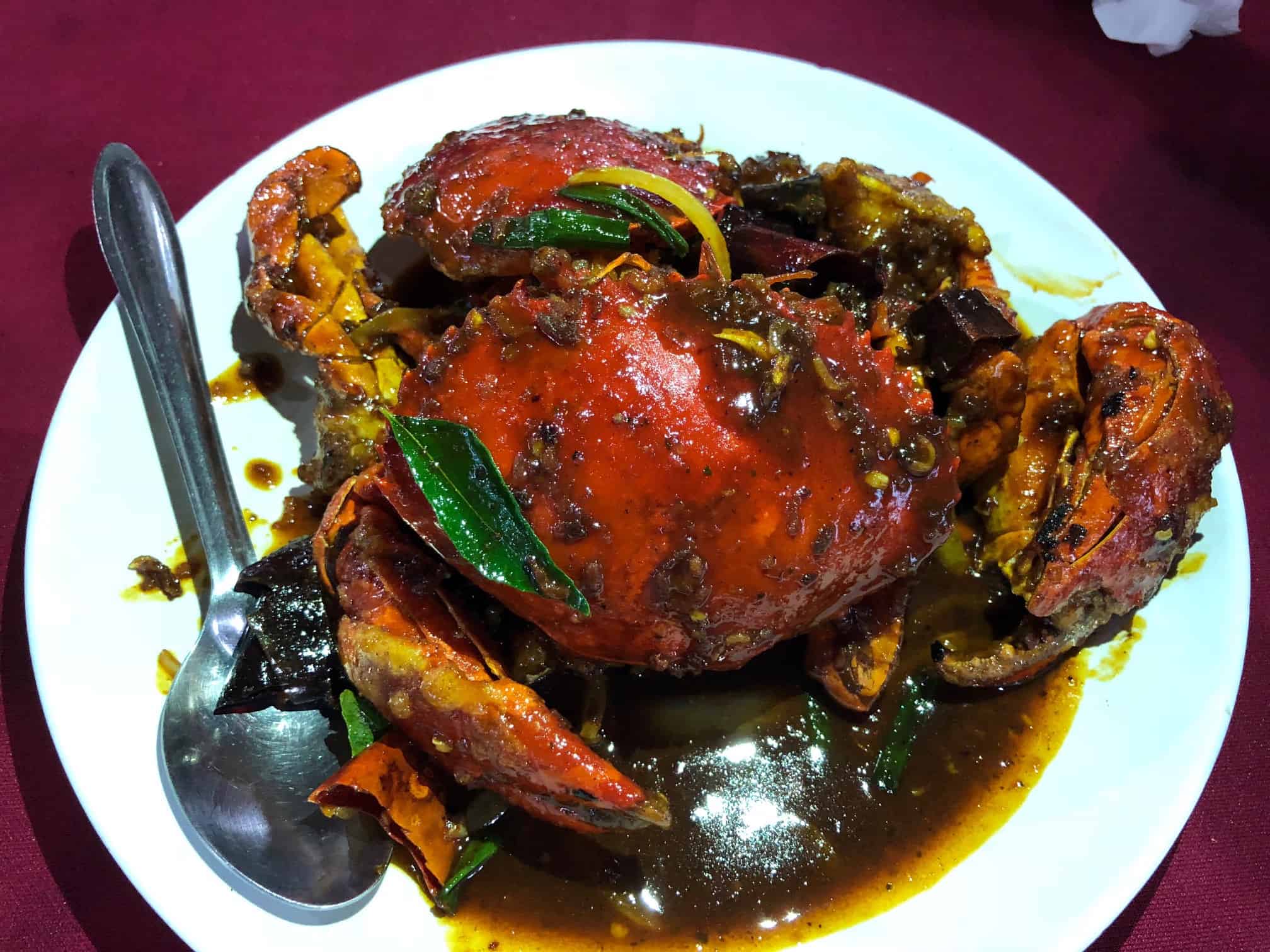
Crabs fried with fragrant curry leaves – there’s strong Thai influences in the food in Kelantan. This one at Chiengmai Restaurant in Wakaf Bahru, a short drive outside Kota Bahru, which has a cluster of Thai restaurants.
We booked all our hotels on Booking.com while on the road or sitting in a café or bar, just a few hours before arrival. Couple of clicks (search, read reviews, book) and you’re done. Hotel direct is hard, even if you know in advance the hotel you wish to book, which we didn’t.
For places to eat, we relied on our well-honed Malaysian senses and Waze. Somehow you know the places to avoid, the ones that will be good and if unsure, check the local blogs. TripAdvisor had limited use in these local places. Lonely Planet was much more useful in “things to do”, guiding us to streets with street art and markets. Waze helped with the last mile.
In small Malaysian towns, you will always find a local Chinese, Malay or Indian restaurant that’s a favourite – and we were never disappointed with the food along the way, from seafood at Pak Su (Beserah, Kuantan), Malay curries at Hover Restaurant (Kota Bahru), Thai at Chiengmai (Wakaf Bahru, outside Kota Bahru) and noodles at various coffee shops along the way.
The best thing to do is get off the main highway and use the coastal road. That way, you get a sense of the rural life that still rules Malaysia with its rice fields, fruit orchards (durian season being in full swing, this is the best time to visit Malaysia if you hanker after the fruit) and vegetable farms.
You also get a sense of the stretches of golden, sandy beaches that characterise the east coast, and its outlying islands popular with divers. The beaches are empty save for a few cows. On one beach popular with surfers, there’s one lone bar and two fellow travellers. There are not many places in Southeast Asia where you can have such solitude on a beautiful day on a beautiful beach.

Golden, sandy beaches that are so much a part of the east coast.
It’s also interesting to see how little the hotel landscape has changed in the last two decades, while other destinations in South-east Asia have been building and developing like there’s no tomorrow.
The new gem we found was the Mangala Resort & Spa in Pahang. Situated about 26km from Kuantan, it’s a former tin mine site converted into an eco-resort by property tycoon, Datuk Franky Chua. Opened in 2016, taking over 15 years to create, its villas are spread over 60 acres of wetlands and forest. Seclusion, nature, space.

One of Mangala Resort & Spa’s villa
We revisited an old gem, Tanjong Jara Beach Resort, for dessert. Built by the state government in the early 80s, it was one of the first resorts in South-east Asia to embrace local architectural styles and won awards in its early days. Then time and neglect took their toll until YTL Resorts took over and now it’s the resort of choice on this coast, its rooms fetching well over RM1,000. If you like your hotel traditional and luxury, this is for you.
Away from hotels, we discovered a couple of new gems.
Kuala Trengganu’s Chinatown lived up to its billing (in Lonely Planet) of being one of the most interesting Chinatowns in Malaysia. Clean streets, street and wall art, creative touches that were respectful, not kitschy, and great local food (of course).

Kuala Trengganu’s Chinatown charms with its colourful street and wall art and sense of local life and pride.
The Belum Rainforest – midway on the East-West Highway between Kota Bahru and Penang – and a good point to stop for the night, otherwise it’d be a seven to eight hour drive. Scenic lakes, ancient rainforest, nature trails – the resort there is better geared for groups than individuals and could do with better customer service training but its setting in the rainforest is a winner. This is the most scenic part of the road trip where you drive past lakes, valleys and mountain ranges.

In the vicinity of the Belum Rainforest is Perak’s Lake District. A good place to stop for a picnic.
As we made our way towards Penang, our final destination, I realised that even as the way we travel has changed, the spirit of why we travel has not. Even if it’s to retrace past journeys, it’s always with the intent of of discovery and experiences – and on those two counts, this trip scored beyond expectations.