

On the day I was to fly out from Phoenix to San Francisco came news of the “bomb cyclone” that battered the Pacific Northwest and Northern California, causing power outages, downing trees and power lines, and tragically killing two people in Washington State.
It resulted in flight cancellations to the West Coast. My United Airlines flight out of “America’s friendliest airport” was delayed by several hours. I was fortunate I did not have an onward connection to Singapore – wisely, I had felt it too tight with the timings and experience had taught me not to add unnecessary stress in my life. I had booked an overnight at the Grand Hyatt at SFO – why not have a good night’s sleep before the long trek home, I thought?
I felt sorry for all the travellers that were affected. One woman rushing to catch her onward flight moaned, “This is the worst day of my life.”
At the Phocuswright conference in Phoenix, Arizona, themed “The New Age(nts)”, there was much talk about making travellers happy with smart AI agents as their travel companions, fancy AI trip planning and recommendation tools, AI agents that promise to deliver us from laborious tasks and AI-driven tech stacks and digital identity wallets that would finally deliver the frictionless experience travellers dream about.
On the ground, SAM, my digital travel assistant from FCM, notified me of the flight delay but beyond that, wasn’t of much use. Knowing I had an onward flight to Singapore the next morning, could he have, at that point, offered me options in case of any other unexpected event, given the circumstances of the day. The United bot did slightly better. With the delay it gave me rebooking options – but there weren’t any other flights anyway, so that was an offer too far.
Little did I know then this was only the beginning of my problems. After spending a comfortable night at Grand Hyatt at SFO, sleeping atop an intersection of freeways that made me feel I was in a sci-fi movie, I turned up for the 9.40AM SQ33 and the drama began. First it was delayed by two hours due to “technical issues with the engine” – nothing to do with the weather – then retimed to 3PM. Then at the boarding gate, we were told it had been cancelled and re-timed to the following day, 4.40PM, and we would be given hotel and meal vouchers (pictured). I like that the language here is more human – for “distressed” passengers.
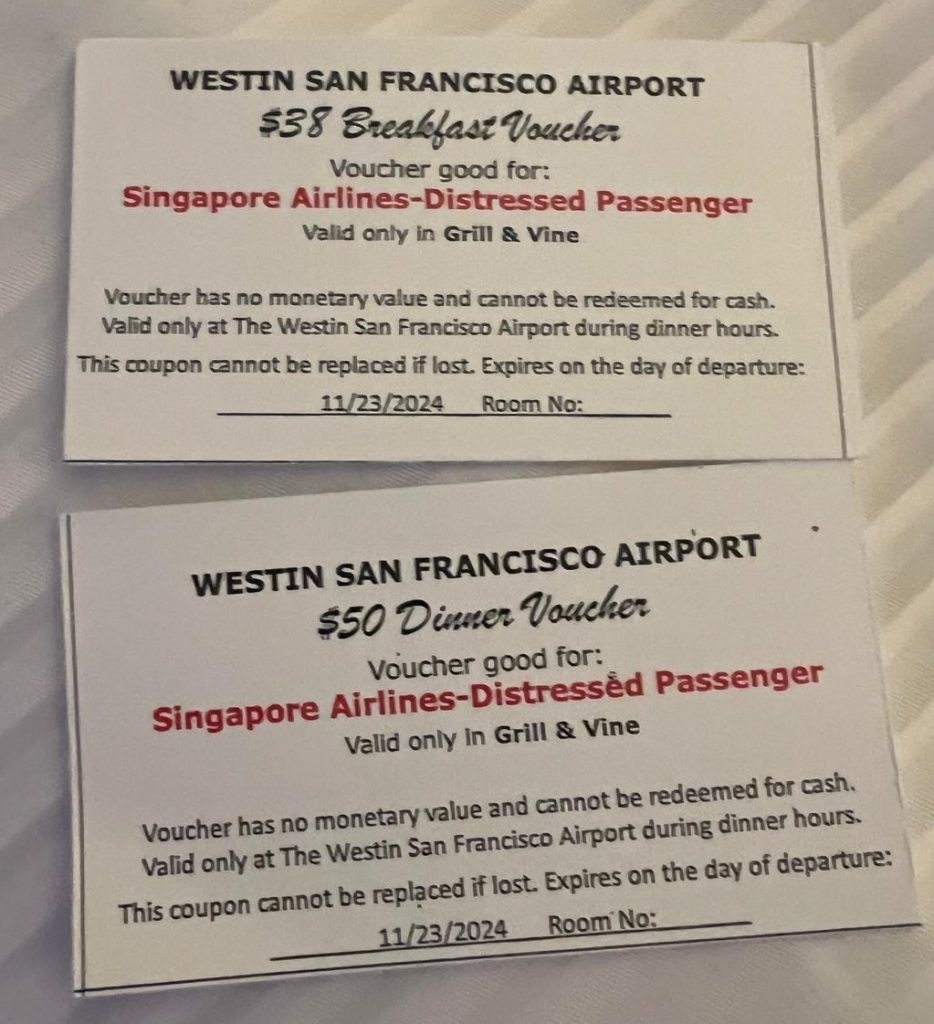
Poor Sam, he could hardly keep up. I found out more about what was happening on the ground than him. Of course, Sam has his limitations because he can only be as good as our broken travel systems allow him to be but I thought at least I’d get a call from a human agent to ask if I needed help – in the end, I ended up calling FCM’s “after hours” service for assistance.
As for how I finally made it out of San Francisco, it’s at the end of the article.
The two days of disruptions brought home to me the reality that much as we talk about shiny new things that will take us to the promised land, travel disruptions and legacy infrastructure are the real things we need to work on.
Here are my key takeaways from Phocuswright 2024.
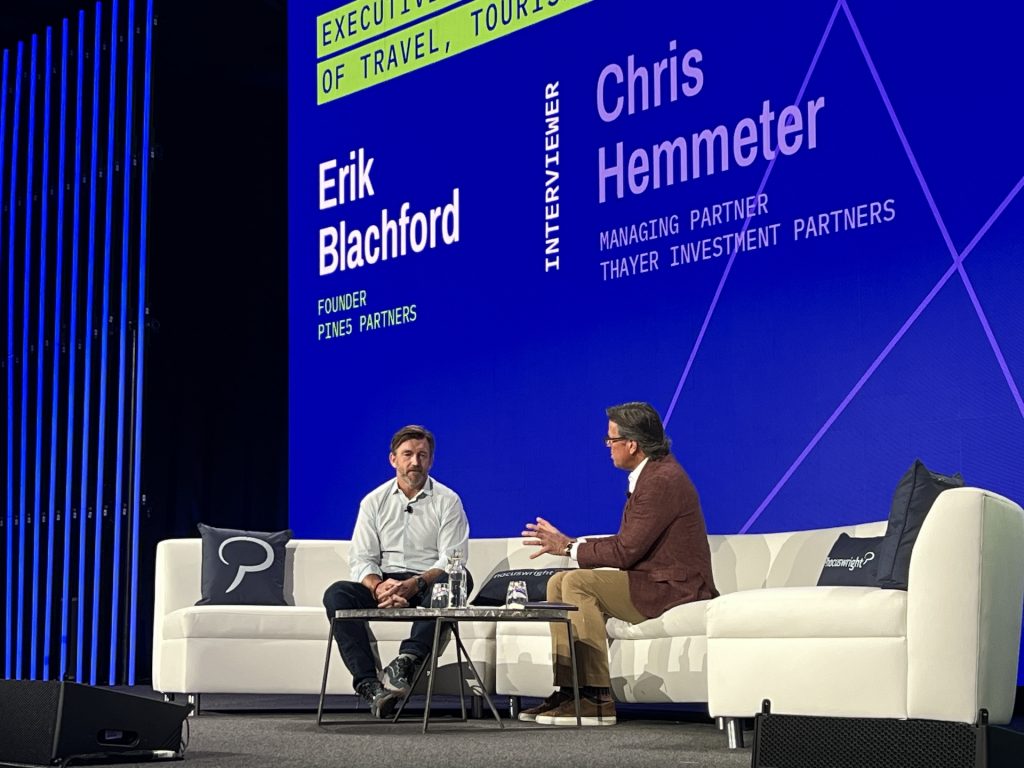
Eric Blachford (left) and Chris Hemmeter: “Going out in nature is the best way to understand what you are going to lose. You don’t understand the power of flood waters if you haven’t been on a river.”
1. Amid AI Buzz, Climate Change Needs Immediate Attention
When travel industry veteran Eric Blachford was asked by Thayer Ventures’ Chris Hemmeter if he was concerned that with so much energy being spent on AI, that climate change had been pushed to the back, he replied, “It hasn’t slipped, it’s always been in the back.”
Blachford, who in 1995 helped establish Expedia within Microsoft and became CEO of the online travel agency in 2003, reminded the audience that “we’re going to go through the 1.5 degree rise in temperature”.
Known for his love of outdoors and nature, he founded Blachford Capital LLC in 2021 which has invested in several outdoor and nature businesses such as Hipcamp and a summer camp in Montreal. “Going out in nature is the best way to understand what you are going to lose. You don’t understand the power of flood waters if you haven’t been on a river.”
Meanwhile, he said travel would go through pains brought on by regulations. He mentioned the European Green Claims Regulations. “This requires tour operators to report emissions on the ground including people coming in. Once we start collecting all that data, we are going to look like the bad guys. There will be negative consequences if we don’t get lighter travel emissions.”
As such, he believes people will travel closer to home, stay in more camps and take more road trips. He said certain destinations will become out of bounds to certain kinds of travellers and people would think twice about attending conferences such as these.
“Over the next to five years, we will see the release of super intelligence when machines will be better than combined human intelligence and I am hopeful that AI will model the climate systems in a way that we can’t.”
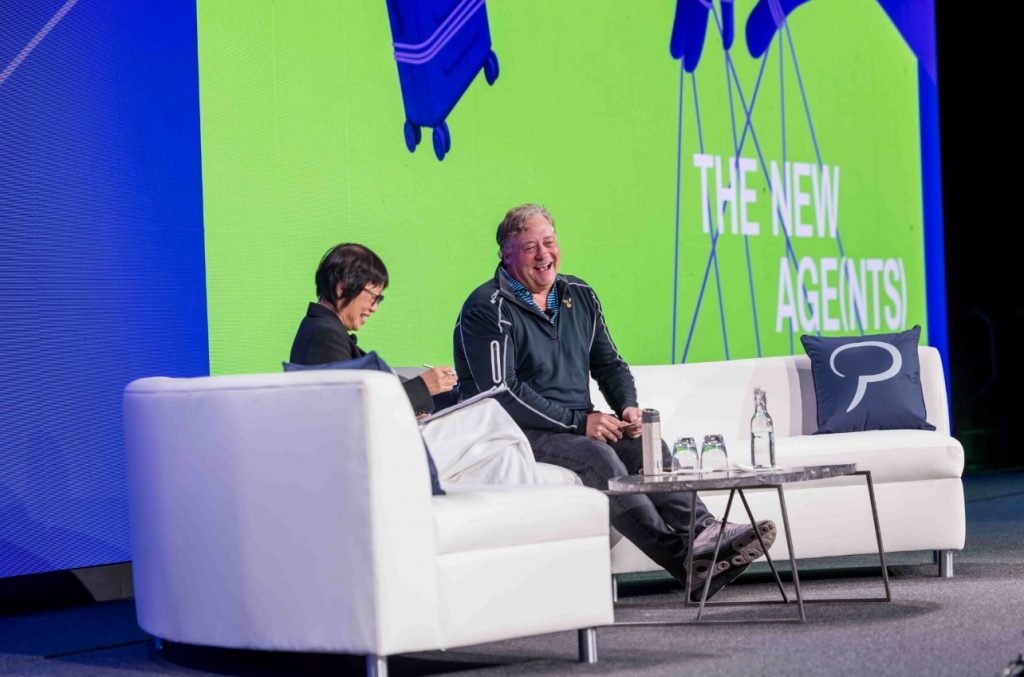
Rob Rosenstein: Focus on real problems and be a helpful founder, if you’re staying on.
2. The Best of Times and The Worst of Times for Entrepreneurs
Depending who you listen to, these are either the best of times or the most dangerous time to be a startup. The former camp believes disruptive times create opportunities while the latter believes with so many unknowns – such as will your business model be even relevant in six months – the current environment is littered with risks.
Rod Cuthbert, founder of Viator, during his Hall of Fame induction challenged that most of the pioneers in online travel back then would not make it now if they were given funding, a notion seasoned entrepreneurs Rob Rosenstein, co-founder of Agoda and Steve Hafner, co-founder of KAYAK, disagreed with during their interviews with me on Center Stage.
Rosenstein said he’d make sure he picked the right startup and made it work. Hafner agreed, adding though it wouldn’t be a travel startup that he’d do – “travel’s done for me” – but perhaps a local bar.
For these two founders, who have remained with Booking Holdings, the company that acquired their businesses, it’s more about the fundamentals of running a startup. Rosenstein said some founders can get too fixated on product without thinking enough about the go-to-market strategy. At the same time, he said startups should focus on fixing real problems – at the bottom end of the funnel – rather than at the “sexy” planning and inspiration stage where everyone seems to be now, with AI.
Hafner is a proponent of “finding the right team, and letting them execute”, saying that his superpower was not necessarily in the hiring but in creating the environment in which smart people thrive.
Rosenstein, who started Agoda in 2005 and sold it in 2007, said he had no regrets about selling that early “because we didn’t know what was coming”. True enough, the global financial crisis happened in 2008. His earnout was till 2011, and he stayed on as CEO till 2018 before becoming chairman, a position he holds today.
What kind of environment encourages founders to stay on and is that necessarily a good thing for the acquirer, I asked Rosenstein. His answer – environments where the founder has autonomy, and is aligned with the company’s goals. In other words, a “helpful founder” – founders who help with the growth, and not get in the way.
Meanwhile, Blachford, likening “today’s moment filled with AI” to the onset of the internet in the early nineties, said, “Right now is the time to be in the mix.”
“If any of you are working for a travel company who says, AI’s not a big deal, leave your job. You can’t stop it, the genie’s out of the bottle.”
The best thing to do, he said, is “be a student, keep track, experiment” and to not “put your head in the sand and sort of wait for a couple of years to see how it turns out”.
He also cautioned it was a dangerous time for entrepreneurs because they can get stuck and committed to their idea, and not “pivot off of it and move on”.
Blachford advised flexibility, because of so much global uncertainty. “It’s easy to imagine something six months from now that’s completely unpredictable sitting right here. You just don’t want people to feel bad about that, and stick with something that the circumstances changed.

Steve Hafner showing us what baby KAYAK looked like 20 years ago.
3. A Multiverse of Agents: Catalyst For Change
Imagine a world where each of us has a super agent, or actually a multi-verse of agents each specialised in a certain area, doing things like “book my flight”, “clear my mail” or “take the kids to school” – well, maybe that’s a stretch but maybe not with the numbers of Waymo I saw in San Francisco where the humans are seated in the back seat and mostly taking selfies.
I asked KAYAK’s Steve Hafner what he’d want his super agent to do most and he said, “Clear my mail. I’d like to not receive so much stuff in my mail box. Maybe it can kill off the US Postal Office.”
He also shared an image of what baby KAYAK looked like 20 years ago and remarked, with some pride, that “we’re still around while four or five airlines aren’t anymore”.
Hafner is a believer in continous product innovation and KAYAK, which is going all in on AI as well, has a chatbot for travel tips and find flights with just a screenshot. PriceCheck lets users check if they found the best price just by taking a screenshot of flight information they found somewhere else.
Hafner also spoke of KAYAK’s move into corporate travel with chatbot services, although he admitted it’s a challenging space due to the more structured and compliance-driven nature of the sector.
At Phocuswright, we heard about Otto, the agent for business travel, from founder Michael Gulmann. He’s raised $6m in a seed round from heavy hitters in corporate travel including Madrona Ventures with travel management company Direct Travel and angels such as Blachford, Barney Harford, former CEO of Orbitz and Hugh Crean, former CEO of Farecast, also participating.
Gulmann said Otto, in alpha mode, is limited to booking mode currently. Otto wants to create a travel assistant to plan, book and support business travellers during a trip and the idea is for Otto to “free up all the highly skilled people to do all the complex things”, he said. It is integrating the technology with other suppliers in the space including Direct Travel and Spotnana.
Then there’s Flockx, described as your AI social sidekick, which wants to address “the epidemic of loneliness” by gathering them around like-minded people and events. CTO Mark Losey said that “this agent will make purchases for you” and “get you off your screens into events”.
Observed Blachford, “The outlines of a world where everyone is represented by an agent is becoming clear but it is difficult to understand what that means in interaction in every sector. But it is catalyst for revamping the whole tech stack, from GDSes to PMSes. We have companies protecting and managing inventory, how will that change? The yield management tools we are using are quite sophisticated now, but they will feel like toys in the next few years.
“The agent world has legs and is real,” he said, adding, “the economics of distribution do not favour a monolithic system”.
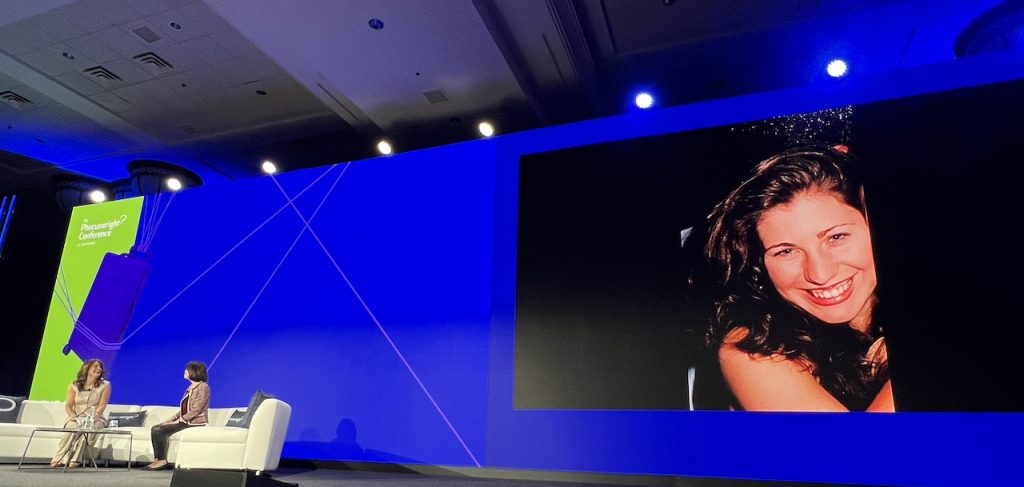
Expedia Group’s CEO Ariane Gorin sharing what she was doing 30 years ago, and what she looked like.
4. It’s a Big World, Room for Everyone
That was the clear message from Ariane Gorin, CEO of Expedia Group, who said that while AI was making everything new again, one fundamental will not change. “Travellers are going to choose where they want to book,” she said, which means everyone, from big or small, will have their opportunity and it’s up to each to find their lane.
On the part of Expedia, it wants to be everywhere travellers want to be, bringing in new customers, whether they are buying from banks and credit card companies or its Travel Shops, of which there are now 150, and where it’s learnt that “the rate of saving something from the Travel Shop onto the Trip Board is three times higher”.
“Travellers will find new ways of shopping and someone needs to give travellers confidence in booking. There’s a lot of complexity even if the front end looks easy,” she said, adding, “I am a big believer in building bridges.”
It’s also eager to try new things for example its latest partnership with Microsoft where if you book on Bing, you earn Microsoft rewards and One Key cash. “This is the first time we’re doing this, it will be an interesting test,” said Gorin.
The company is using AI across all areas – review summaries, property information, customer service, trip planning, marketing, and B2B tools. “It is going to be everywhere, we will test it everywhere. Some will work, some won’t,” Gorin said, noting that with its Romi chatbot, “people seem to want to use it more for trip planning, budget travel, less so for communications”.
Six months into the new job as CEO, she said the hardest part has been that “I changed everything. I turned 50, changed jobs, changed country, became an empty nester”. On the job, she’s had to learn how to leave aside things she used to do and “to focus on things where only I can have an impact.”
5. The Reality is, Big Still Rules
All said and done though, it is still the land of giants. In “Street Talk”, the session where BTG’s Jake Fuller interviewed Naved Khan of B. Riley Securities, Mark Mahaney of Evercore, the three analysts noted that despite the passing of the years, the big three OTAs – Expedia, Priceline and Airbnb – still rule, and they don’t see any “AI dislocation” happening where some new names will emerge in the top three in the forseeable future.
This shows they have built highly competitive moats around their business and they will continue to find ways to do so. If anything, they believe, AI will give these giants more power with their scale and resource.
Mahaney was particularly curious about Airbnb’s new co-hosting service, launched in October, enabling hosts to hire other hosts to help them manage their listing and property.
At its launch, Airbnb’s global head of policy and communications, Jay Carney, “We’ve found that over 40% of hosts said they would host more than they do currently if they had help. It’s a great way for us to increase supply, improve the hosting experience overall for more hosts, lifting quality in general … and the co-host brings all this expertise to it so you’re going to enhance the experience for guests, so it’s a great flywheel for us.”
Said Mahaney, “I am interested to see how this plays out and how it will help scale Airbnb.”
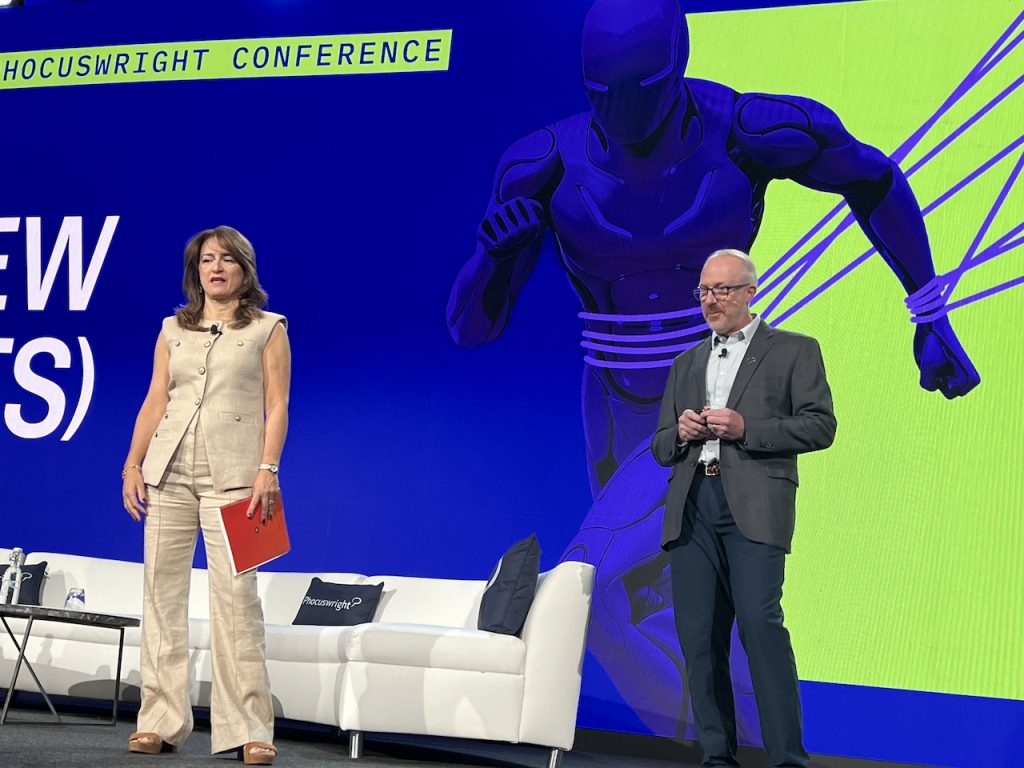
Mitra Sorrells and Pete Comeau: Flashback moments as they marked Phocuswright’s 30th birthday and looking into the future
6. Good News: Plenty of Room for Growth
At their opening, Mitra Sorrels, senior vice president, content (left) and Pete Comeau, managing director of Phocuswright, tracked the last 30 years in travel to mark Phocuswright’s 30th anniversary. Back then, the biggest challenges listed in its first Yearbook were “customer acquisition, service and retention, fierce competition, influx in new players, rising marketing and technology costs”.
“Those haven’t changed,” said Comeau.
What’s changed is market size. The global travel market is projected to grow to $1.8 trillion by 2026, with online making up two-thirds of all bookings, from three percent in 1999. Europe and APAC will lead the way, with 69% of their bookings coming from online channels.
And while suppliers lead online – 61% of gross bookings online were made via supplier websits and apps in 2023 – OTAs lead the hotel segment, representing 63% of gross bookings.
Phocuswright’s first conference was in 1977 when the theme was “The future belongs to those with the vision to see it”.
Well, at this moment, the vision is unclear because there are also many unknowns. Climate change, wars and conflict, political upheavals, technological disruption, generational shift in travellers – you name it, it’s all here – and we all have to learn to be agile and manouevre our way.
It was interesting watching the different reactions of my fellow “distressed” travellers. Some drank their way through it, some tried to find solutions to their specific problems, some ranted at the staff, whom I felt sorry for – kudos to the team who kept their cool and tried to help everyone as best as they could.
At the end of the day, when it comes to incidents like these, it takes humans to comfort humans. Bots can only inform and that is useful. “Somehow I feel better when I am being communicated with, to be notified what’s happening,” said a fellow passenger.
In this case, between the agents – SAM, United and SIA – I have to give it to United – its notifications are prompt and frequent and its language even has a bit of humour. When it came to human touch though, I give it to SIA which was the one who eventually fixed my problem, but not before I spoke to a few humans to make it happen – to reticket me on United to Seoul, without having to pay S$21,000 which FCM had quoted me.
See you in Seoul, where WiT Seoul starts tomorrow, November 26.