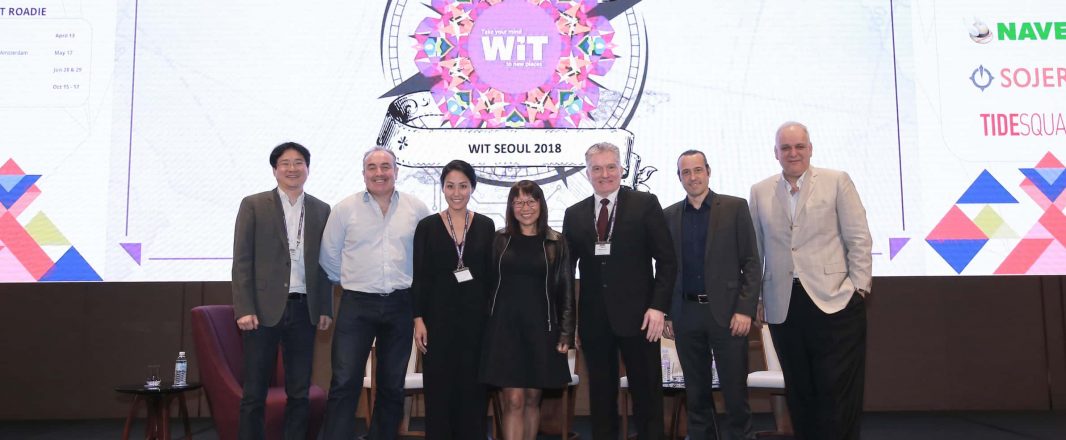
There was a time when I visited Tokyo and I thought I had landed in a science fiction novel. Today I get that same feeling when I visit Seoul.
Its citizens are more attached to their smartphones than anywhere else – by age 12, 72% of South Koreans own a smartphone and they spend 4.5 hours a day on it. Everywhere you go, you tap into wifi like it’s air.
You see young girls from across Asia walking around the city with bandages on parts of their faces, evidence that they’ve come to visit the plastic surgery capital of the world. Augmentation to the human form is as natural here as cherry blossoms blooming in spring.
This time last year, when we held our second WIT Seoul, relations between North and South were strained, with threats of a possible nuclear attack.
This time round, things have calmed down. Last weekend, there was a historic flight from Gimpo to Pyongyang as part of diplomatic attempts to build a bridge between the two worlds.
The third WIT Seoul, held at Seoul Dragon City, similarly built a bridge between South Korea’s online and offline travel industry, attracting a record attendance of more than 300 delegates, comprising digital travel brands as well as traditional players such as Korean Air, Hana Tour and KATA (Korea Association of Travel Agents).
The online travel space, which has grown despite political hiccups, is finally attracting the attention of traditional players and WIT Seoul was a good reflection of the blurring of lines, with speakers such as Korean Air, Hana Tour and KATA (Korea Association of Travel Agents) taking to the stage.
Here’s a list of nine key trends that are driving change in South Korean travel.

From left, Hawaiian Airlines’ Theo Panagiotoulias, AccorHotels’ Vincent Lelay and Tidesquare’s Min Yoon – the drop in Chinese inbound has forced the industry to diversify
- Every crisis creates an opportunity
South Korea’s inbound is still recovering from soured relations with China which saw a ban on Chinese tour groups to the country last year. Arrivals for the year dropped from 17.2m to 13.3m, bringing it back to 2015 levels – the 4m cannot be easily replaced – but it forced the inbound sector to diversify.
The Korea National Tourism Organisation has launched a new “Imagine Your Korea” campaign aimed at other markets such as South-east Asia. There’s also been a rise in “hocance” (staycations) as brands turned their attention to the domestic market to pick up the slack.
AccorHotels’ vice president operations for South Korea, Vincent Lelay, said he was taken aback by the appetite for “hocance” among Koreans and “we are adapting our weekend offers for family, couples and adolescents”. AccorHotels recently opened its four hotels and convention centre within Seoul Dragon City. Described as Korea’s first lifestyle hotel-plex, it comprises Ibis Styles, Novotel Ambassador, Novotel Ambassador Suites and Mercure Ambassador.
- Outbound is where the won is
The drop in inbound from China forced low cost airlines to find new destinations and, as a result, more South Koreans found themselves able to fly to places further afield. About 25 million Koreans travelled abroad in 2017, an impressive number for a country of 52m. Of these, 7m travelled to Japan.
It has also benefitted Hawaiian Airlines and senior vice president, global sales & alliances, Theo Panagiotoulias, said the biggest market for its Honolulu service was single women aged from 25-40, proving once again that women have the appetite and spending power in travel.
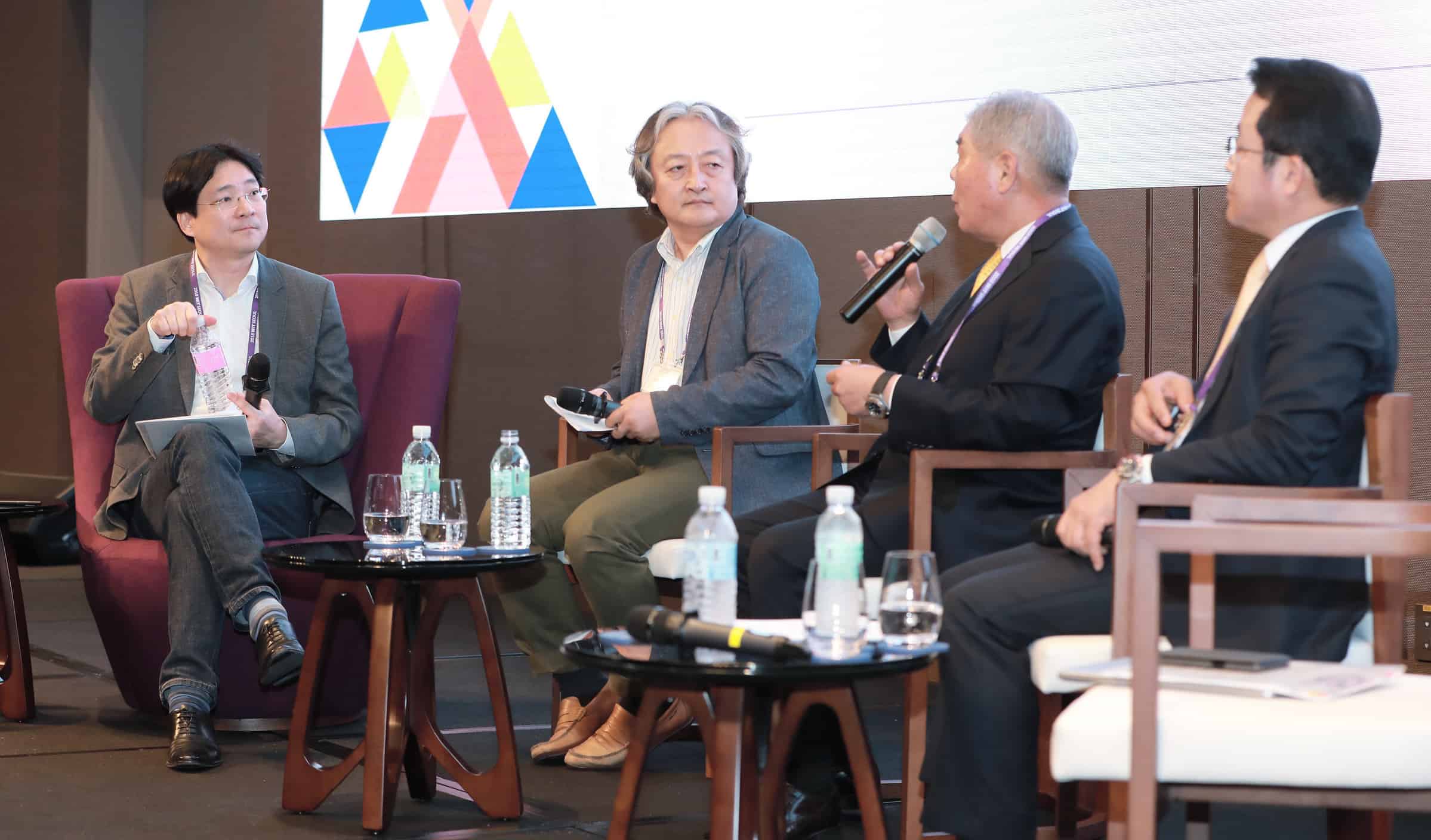
From left, Tidesquare’s Min Yoon discussing the blurring of offline and online with Interpark’s Sang Kyu Lee, KATA’s Moo Seung Yang and Hana Tour’s Jin Kook Kim.
- The “perfect storm” is approaching as global elephants enter and local giants stir
While the drop in inbound affected the traditional travel sector, online grew, with global OTAs and meta-searches increasing their penetration and new entrants such as Naver, the country’s leading search engine, and Kakao, the country’s leading messaging service, deepening their reach into travel.
Min Yoon, CEO of Tidesquare, likened the situation to “the eye of a storm where everything seems to be very calm but we know the perfect storm is coming”.
“New entrants are leading the Korean travel industry growth including meta search, e-commerce marketplaces such as eBay, and mega IT companies such as Naver and Kakao,” he said.
Sang Kyu Lee, CEO of Interpark, the 23-year-old ecommerce giant warned that while companies like Kakao and Naver may now be seen to be partners, they will become formidable competitors. He also singled out Airbnb as another potential threat to traditional travel brands, signaling an awakening of Korean giants to the disruption being caused by the sharing economy.
“A lot of new startups will emerge and many new market leaders will emerge. A service using AI will be commercialized,” he predicted.
Jin Kook Kim, president of Hana Tour, said the online segment in travel will explode in the next few years, driven by more LCC activity, and his company was investing in tech and transformation.
Lelay observed that online hotel bookings were growing very fast with key global players entering local markets as they increase their worldwide dominance. He said, “There is a need for more hotel rate transparency and parity.”
Hawaiian Airlines’ Panagiotoulias said that more than 50% of bookings were now being transacted on the web and that “mobile capabilities are now a prerequisite for long term success”.
- Mobile-only world is fast approaching
Brandon Son, Director, Market Management (South Korea), Expedia, said the new generation of South Koreans growing up with smartphones from age 12 will know only the mobile device.
As a group, Expedia has seen a 40% increase in app downloads to 250m. In South Korea, its top 3 mobile feeder countries are Japan, Hong Kong and US but the fastest three growing mobile feeder markets are the Philippines, Brazil and Thailand. What it’s also learnt that is mobile deals drive conversions (7 in 10) and that mobile booking windows are on the rise – from 8 to 11 days (domestic) and 30 to 33 (international) between 2014 and 2017.
Lelay said that 50% of domestic direct bookings in South Korea from AH.com are done via its mobile app and “there is a huge potential for us to grow loyalty member and mobile users – there are 55 million mobile users for 52 million population”.
Interestingly, Hostelworld, for whom South Korea is its ninth largest market globally and its largest in Asia, sees higher conversions on PC than on mobile.
Yunha Lee, who joined the group as Social Media and Contents Executive a year ago, said internationally, the group sees 50% bookings on mobile but in South Korea, it’s 60% PC. “Young Koreans are more precise in what they want to see – eg map view and photos – which are clearer on PC,” she said.
However, the brand is investing in mobile with features such as “speak the word” – a translation feature for 19 languages – and concierge services around tours & activities.
- It’s time for women to have a meaningful voice in travel
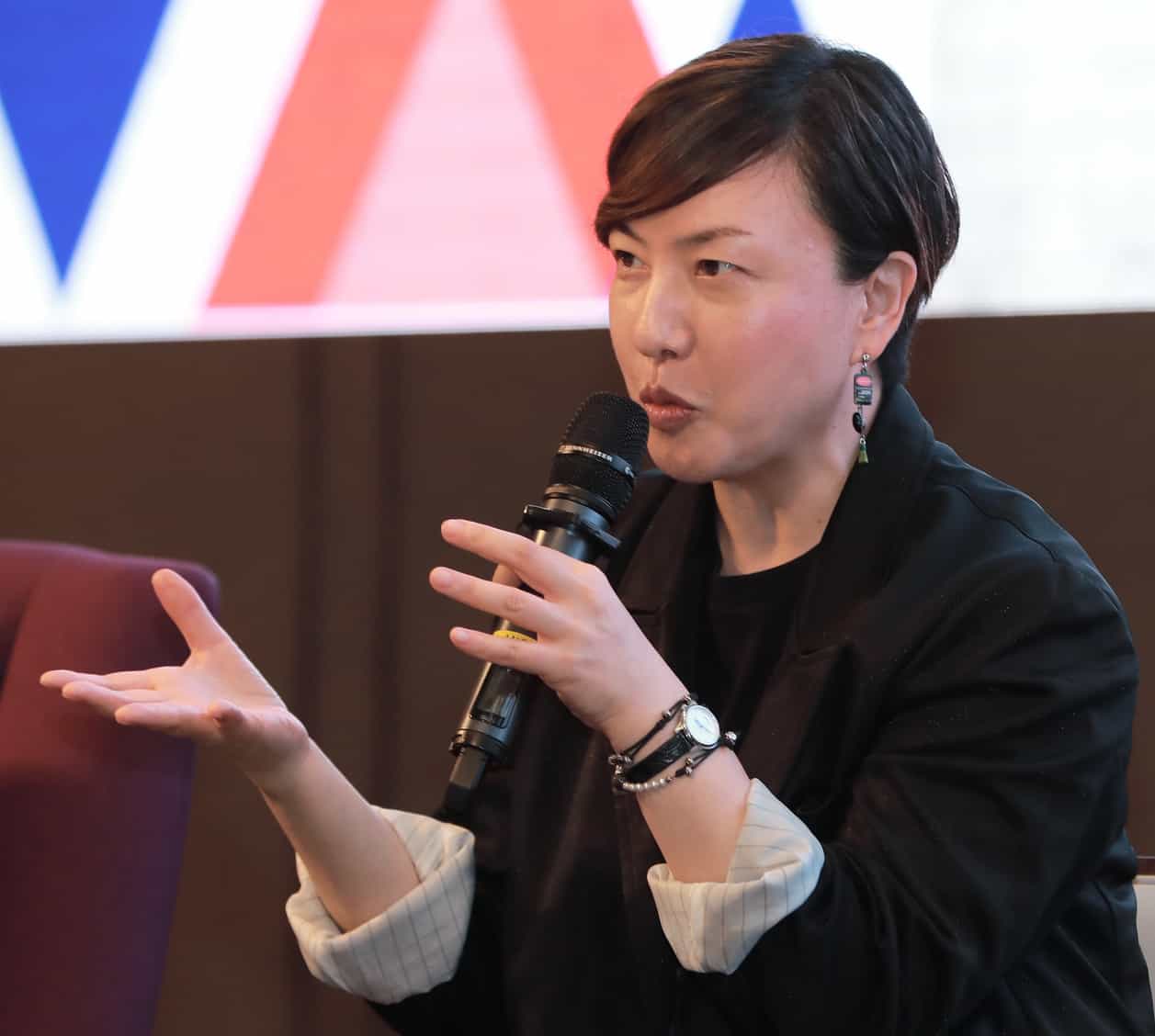
Naree Lee: “We are starting to make noise about gender equality.”
Other than being big travellers, women in South Korea are making their voices heard in a country where there’s huge gender inequality, said Naree Lee, a journalist turned entrepreneur.
“Women are paid 55-60% lower than men and only two percent of board executives are women,” she said. “Women make up 55% of all independent, single travellers and it’s time for women to have a meaningful voice in travel.”
Lee, who’s been an active advisor to startups in South Korea through D.Camp (Banks Foundation for Young Entrepreneurs), is building a platform for women called Plannery. Her new startup, she said, is a planned membership model for women to collaborate and network, and raise the profile of women executives in leadership.
“We are starting to make noise about gender equality,” she said.
- Growing appetite for new and alternative types of accommodation
Sul Bi Lee, general manager of M Social, Singapore, who’s spent the last eight years in Singapore, talked about her hotel’s experience with robots which deliver room service, mingle with guests and usher people to the restaurant.

Sul Bi Lee, M Social, Singapore: Experimenting with robots and teaching them how to make eggs.
It is also experimenting with a Singapore-made robot which fries eggs. “It’s gone from sunny side up, to making omelettes, to making omelettes with condiments,” she said. “We are wondering what it can do next.”
M Social, which opened June 2016, is the Millennium & Copthorne brand that is influenced by Philip Starck’s redesign of hospitality. The hotel is positioned as a creative, communal and innovative brand, and is the first M Social. The second opened in New Zealand in November 2017 with more in the pipeline.
It is exactly the kind of brand Injin Kim, Director of Asset Management, CDL Hotels Korea, and popular hospitality blogger, said would work in the local market. He cited properties like the Ace hotels in Portland and New York City that were more about communal and lifestyle spaces than the traditional hotel.
Lelay said AccorHotels was looking at introducing its new hotel concepts such as So Sofitel, 25 hours, Mama Shelter, Joe & Joe into South Korea.
South Koreans are clearly displaying a strong appetite for hostel stays, as evidenced by Hostelworld’s growth and Yunha Lee said the increase in low cost flights to South-east Asia saw Koreans booking hostel stays in Vietnam, the Philippines and Indonesia.
She said that although there was more education needed around the hostel experience, budget-conscious and value-seeking young South Koreans were growing more comfortable with the segment.
Indeed, in 2017, South Koreans formed 66% of the 1.8m travellers who made use of some 37,000 Airbnb listings in the country, according to data released by Airbnb. These numbers are bound to make hoteliers sit up and take notice because it means Airbnb is also making a dent in the huge domestic and growing hocance markets.
Tidesquare’s Min Yoon said no local player had yet emerged in the growing private accommodation sector. His company acquired Bnb Hero, a startup offering alternative stays, which has been struggling but he feels the tide is turning.
- The next battle for air – low cost longhaul and trans-Pacific
Last week, the South Korean government approved the trans-Pacific joint venture network partnership between Korean Air and Delta Airlines, giving it the clearance to proceed.

Korean Air’s Keehong Woo who’s spent more than three decades with the airline, recalling his first flight and how his baggage did not arrive with him
Keehong Woo, Representative Director & Executive Vice President, Korean Air, a key player in the negotiations which took seven years, said the partnership could be effected as early as next month. The joint venture will give passengers seamless connections to 290 destinations in the Americas, and 80 across Asia.
Calling it a breakthrough, Woo said this would enable Korean Air to compete against the other two alliances on the trans-Pacific – United and ANA, and American and Japan Airlines.
Woo, who’s been with Korean Air since 1987, talked about an airline which is trying to transform itself digitally. In 2014, he led the airline’s host system switch to Amadeus’ Altea and he was also responsible for its new global website. “We used to have one website for South Korea and one for North America but now it’s fully integrated,” he said.
This means a more efficient distribution system although he said GDS fees still cost the airline more than $100m a year. “We have to find ways to cut that down.”
He said Korean Air still had more work to do on its online distribution and retailing – up to 50% of its bookings come through the web (brand.com as well as third party) – and ancillaries which, at the moment, is “practically zero”.
He noted that competition was everywhere, not only from low cost airlines which are going longhaul (Korean Air’s own low cost subsidiary Jin Air flies to Honolulu) but from carriers such as Emirates which are offering “low cost” fares as well, he jested.
He said every player in the travel ecosystem had to adapt to the changing market. Local travel agents had to automate and embrace technology, and global OTAs had to find ways to get into unpublished fares in the local market.
- Tours & activities power on with startups finding their own niche
The funding coming into tours & activities was welcomed by three WIT alumni startups who are seeing good growth in their business and each seems to have found their niche.
Voyagin, which raised US$1m and then was acquired by Rakuten for an undisclosed amount, has found a good and profitable niche in featuring 240 Michelin-starred restaurants in Japan. “These places are hard to find for foreign travellers and they need help with reservations handling, which we help them with,” said Masashi Takahashi, co-founder and CEO, Voyagin, Its best-selling activity is the Robot show in Tokyo and it sells about 100 tickets a day to the performance.
Korea-based MyRealTrip, which has raised $12m since startup in 2013, launched three new categories (accommodation, B&B, Airtel) in just a year, and flights will be launched in May, said founder and CEO Donggun Lee. Its best-selling activity is the Osaka Amazing Pass, followed by the Vatican tour in Rome. Lee said the company focused on collecting reviews the past year and to date, has amassed 180,000 reviews, the largest collection of reviews on a Korean tour & activity site.
Singapore-based BeMyGuest, which has raised S$11.5m, is seeing a trend in which close to 50% of bookings are now made within 24 hours (38% for same day and 8% for next day), and 91% of bookings made through BeMyGuest’s distribution partners had instant confirmation in 2017. Its best-selling activity is the Sentosa Luge, in Singapore.
All welcomed the increased funding that’s coming into the sector although Takahashi voiced concerns that a price war may ensue as new entrants chase unprofitable growth.
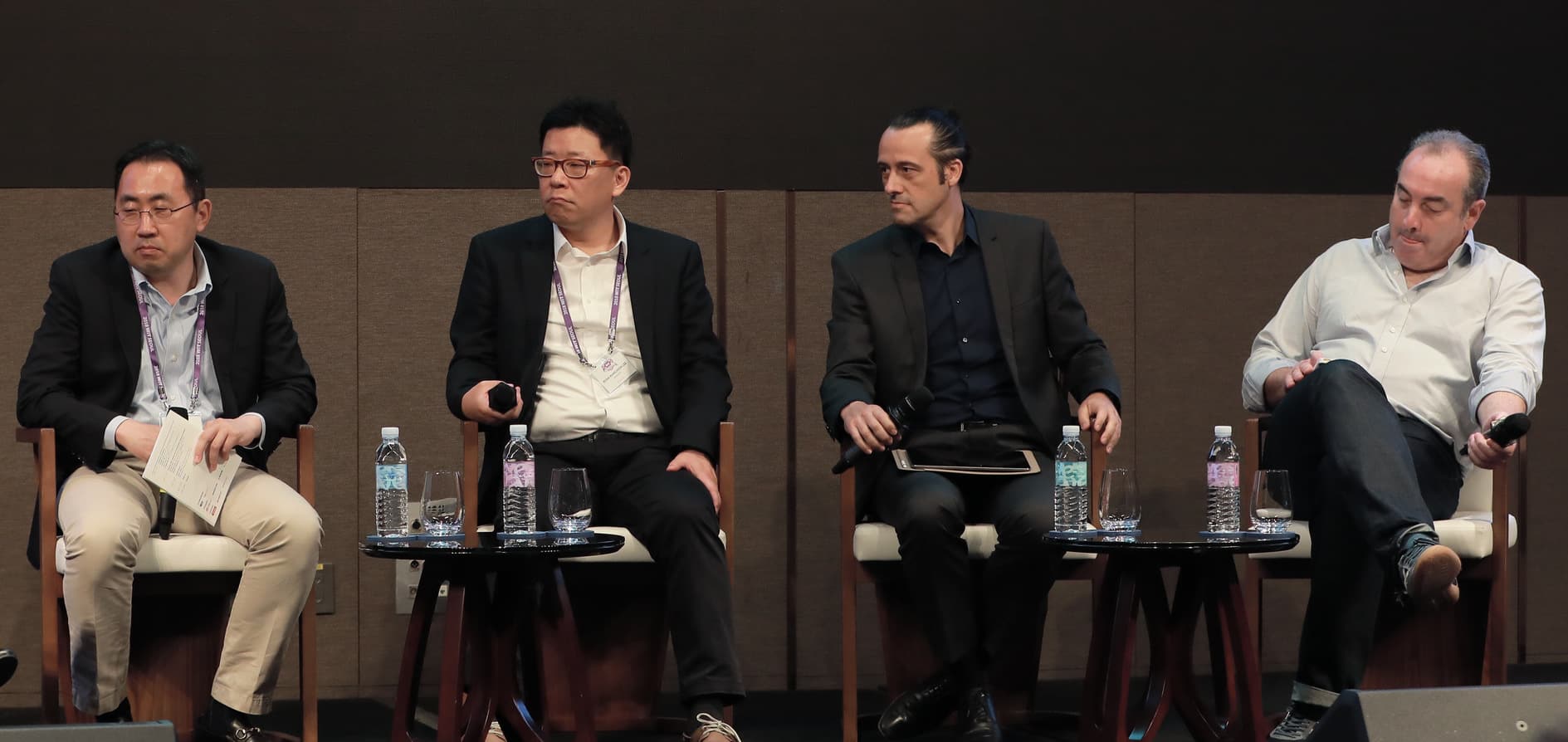
From left, McKinsey Korea’s Jun Shin, Dunamu’s Ryan Lee, Amadeus’ Sebastian Gibergues and Agoda’s Timothy Hughes: Staying paranoid and betting on the next big thing
- Taking bets on new tech and watching new enemies
So what’s the next better thing in travel? Jun Shin of McKinsey Korea cited AI and IOT (Internet of Things) as two new tech that was occupying the attention of CEOs he spoke to and he picked Amazon as travel’s potential out-of-box enemy.
Ryan Lee, chief investment officer of Dunamu Inc, said the power of having masses of data and having the ability to analyse it cannot be underestimated which is why companies like Amazon must be watched.
Timothy Hughes, vice president, corporate development of Agoda said any company that’s tried five times to get into travel and keeps trying “must be watched”.
Dunamu is reported to be betting $100m on blockchain startups and Lee, who used to run travel for Tmon, the marketplace giant, said this could be the next disruption in terms of adding another layer to the Internet.
Both Shin and Lee said the future would favour the big and those with scale, but Hughes, vice president, corporate development of Agoda said “we must remember travel is huge and there will be plenty of room for everyone”.
Truth though is, it’s getting hyper competitive and Hughes said he was paranoid about everyone. For him, he’s excited about a “blend of screen and voice”, something we haven’t seen yet.
Sebastian Gibergues, head of leisure and online travel at Amadeus IT Group, said he was watching Ctrip with interest because its recent acquisitions of Skyscanner and Trip.com make it a global player with massive engineering resources in China, which was setting the pace in innovation.
You do not need to read science fiction novels to know that there’s a tectonic shift happening in travel, even in a market as closed as South Korea has been. There’s no Grab or Uber there. Google is not king here, Naver is. Whatsapp is more like Whatsthat.
But travel, by its very nature, will lead the way in building the bridge between global and local. And within South Korea, the combined forces of global giants, local ecommerce powerhouses and new startups will force that change.