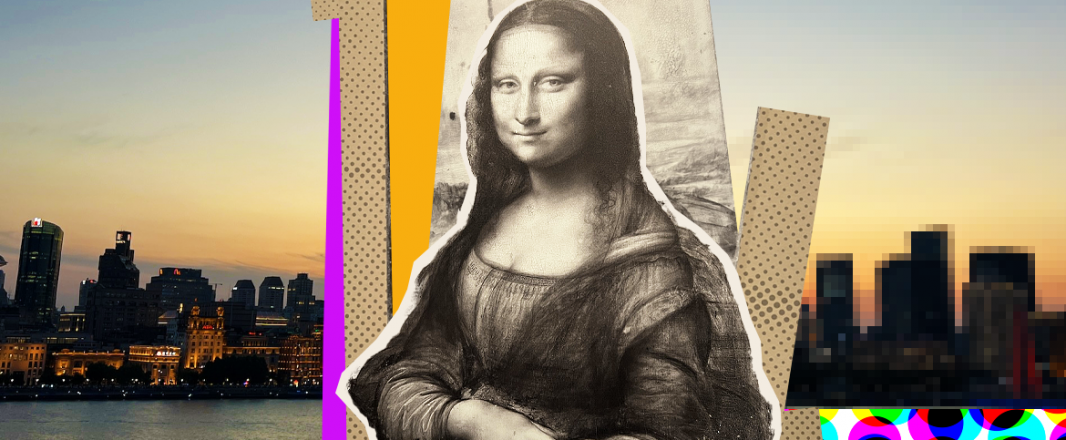
The last time I was in Shanghai was in October 2019, when I attended Trip.com Group’s 20th anniversary party. I recall it felt like a rock concert, almost like a coming out party as the group declared its ambitions to grow into a global giant as well as be the champion for Chinese inbound.
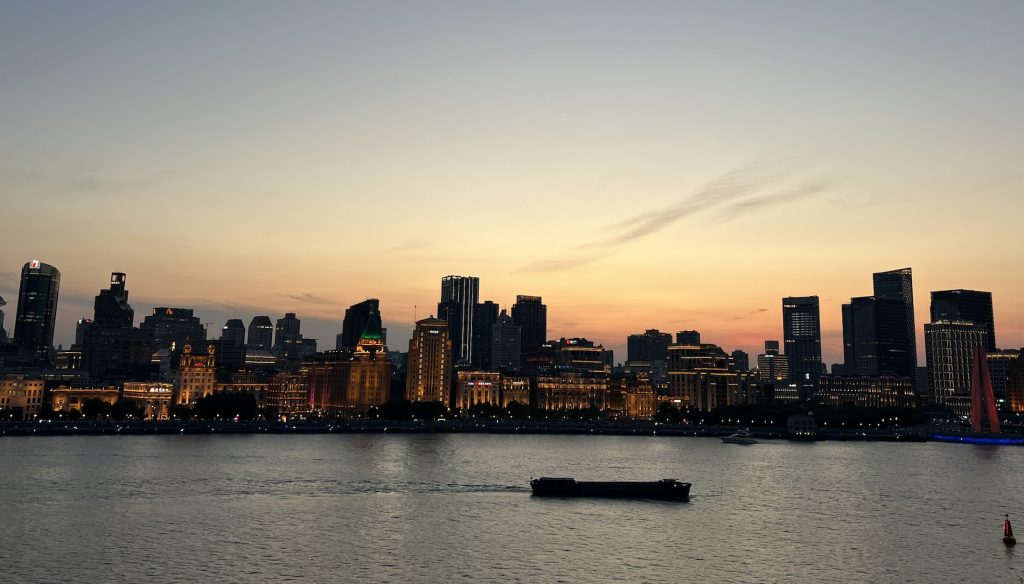
Well, we all know what happened after that and so it was with a sense of anticipation as well as déjà vu that I returned to Shanghai this week to attend the group’s Airline Global Conference as well as its Envision 2024 Global Partners Conference.
Listen to the episode here
Firstly, I am pleased to report at how easy arrival into China is these days. As a Malaysian, I no longer require a visa. At immigration, you do a fingerprint check and receive a piece of paper which you hand to the officer and you’re through.
In less than an hour, I am checking into my hotel, Shangri-La Pudong, the same establishment I stayed during my last visit. It’s like nothing’s changed. It smells the same – that Shangri-La scent, piano tinkling in the lobby lounge, lots of staff to help you if you need it.
Coming from Singapore, with its distinct lack of staff, it is rather nice to be welcomed by a bevy of smiling humans – after all, it is said that today, the new luxury is human interaction – for those who want it of course.
The whole Pudong area is so built-up now that one forgets it used to be rice fields here, just over 20 years ago. A whole strip of bars and restaurants has opened up across the hotel and one night, I sat out at Don Quixote, sipping sangria while listening to a guitarist strumming Spanish love ballads. “Is that a real musician or is that canned?” asked my friend.
Yes, I know it’s hard to tell real from fake these days.
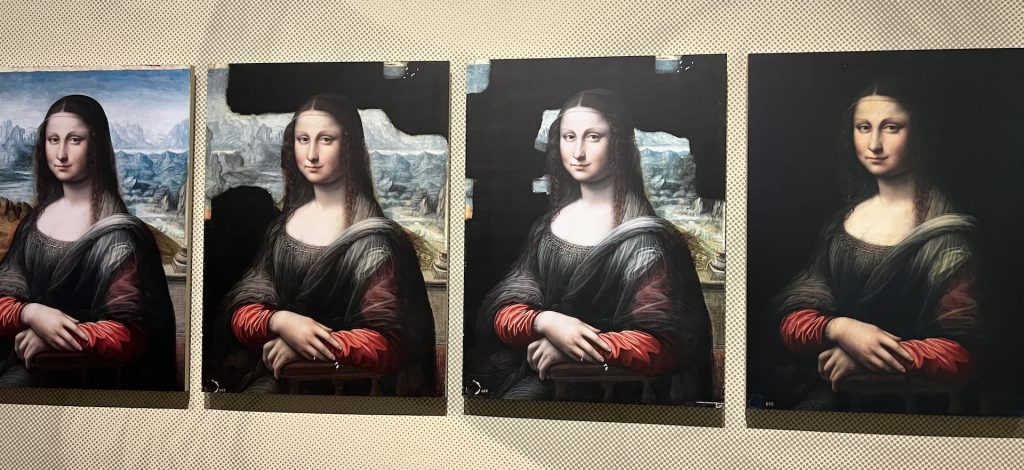
The different renditions of “Mona Lisa”
During the Trip.com Airline Conference cocktail party held on the rooftop of the Museum of Art Pudong (MAP), I took the opportunity to go on a tour of the museum, opened in 2021, and the guide showed me “a real copy” of the Mona Lisa. It is part of an exhibition called “Ages of Splendor: A History of Spain in the Museo del Prado” and one of the exhibits “In Focus”, features the Prado’s Mona Lisa, “which is believed to be the earliest known studio copy of Leonardo’s masterpiece”. Apparently, they had to do all kinds of investigative work to determine if it was “a real copy” with X-ray imaging and other technology.
Honestly, I couldn’t tell one from the other, and it felt weird to have that enigmatic smile following me everywhere I went.
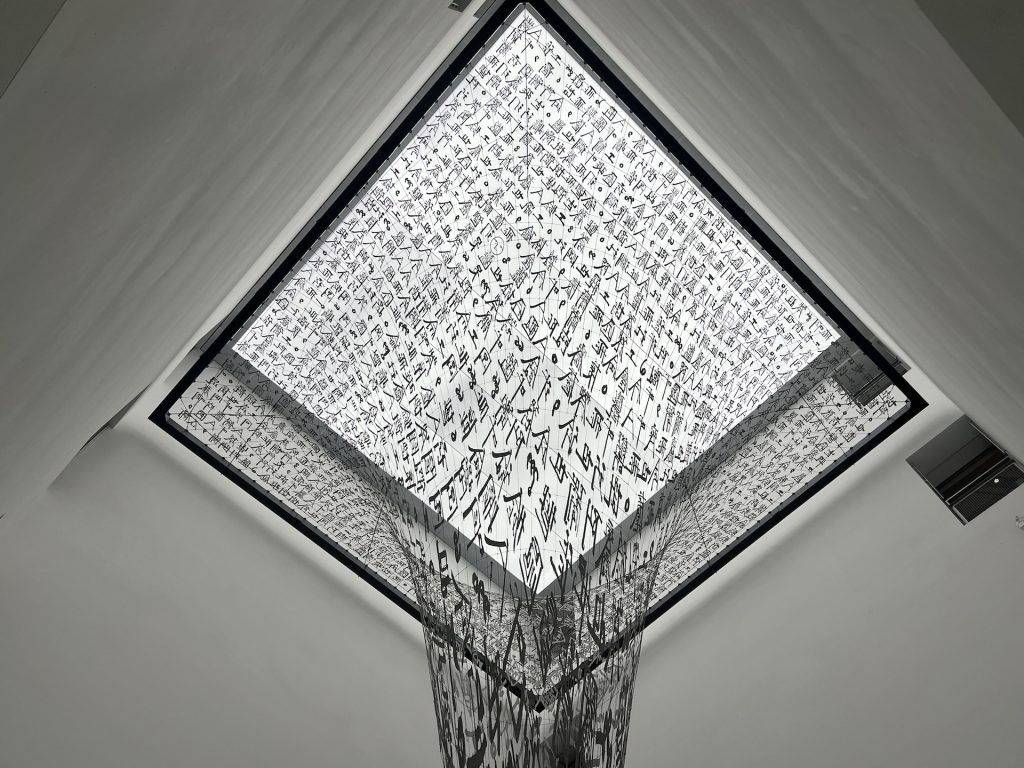
Xu Bing’s “Gravitational Arena”
Another exhibition, “Gravitational Arena”, features the work of contemporary Chinese artist Xu Bing, who’s known for his work with “language and semiotics, the study of signs, symbols, and their interpretations”.
Xu has created a 1,600 metal “Square Word Calligraphy” installation, which is situated in a space offering views through windows across multiple floors, so that when you walk around it, and climb different floors, you get different perspectives on the words, symbols and characters, and wonder what they all mean.
The guide, Fiona, told us the artist has created a completely new language with the installation by mixing English with Chinese, and symbols and characters. I loved the inventiveness and intricacy of the work, and how it forces you to look at it from different perspectives – that’s what travel does too, by the way.
Explains Xu, “The form and mirror reflection of the artwork resemble the ‘wormhole model’, while the term ‘arena’ hints at the theatrical experience when viewed from varying perspectives on different floors. By modeling the entanglement of matter in the universe, I aim for this piece to provoke contemplation on the tensions, interactions, and wrestling-like relationships among different civilizations.”
At the Trip.com Envision 2024 conference, chairman James Liang alluded to similar “tensions, interactions and wrestling-like relationships” between human and machines in the age of AI and said he had coined a new word to describe a new philosophy in travel – “innovationism”.
“I typed the word into ChatGPT and it couldn’t find the word, and so it must be new,” quipped Liang, who is described as “a scholar of demographics, entrepreneurship, and innovation research” and has authored several books on related subjects.
He said the pandemic as well as the acceleration of tech has given rise to new questions for humanity and to ask about “the meaning of life” which he said, “is to pursue innovation and heritage for the long-term prosperity of humanity”.
He said innovation is important both philosophically and financially, and travel promotes as well as needs innovation. “Travel is the most inclusive, collaborative, social interaction there is,” he said.
Well, you certainly felt it at the Trip.com event – the W Shanghai was packed to the brim with the thousands of partners who had flown in from around the world to celebrate the return of travel with Trip.com on its homeground.
And somehow this year’s show felt less like a rock concert, less loud, less hard sell but more theatrical – with an actor introducing each speaker as though in a play; more imaginative – having partners appear on a “rotating” stage; and with one clear message. That no matter from what perspective you may look at it, while its chairman is questioning the “meaning of life”, its executives are serious about executing on the “meaning of business” in their respective verticals – with one common goal – to build the world’s No 1 OTA whether that be in flights or hotels. (See related article)
I think everyone who attended felt Trip’s Gravitational Pull.