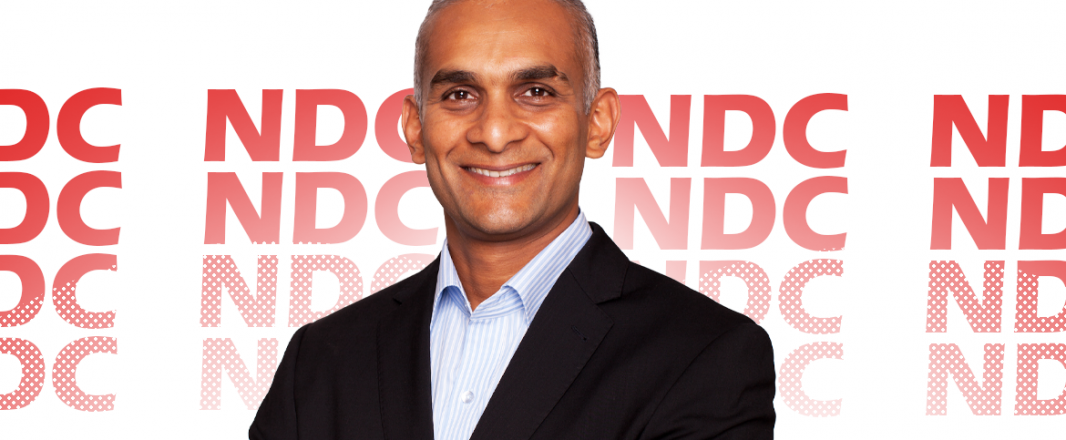
Sabre’s Mendis on NDC’s momentum, painful transition to new world, AI innovation
For the last eight years or so ever since it was first introduced into the airline vocabulary, the acronym “NDC” has been percolating away in the background, and now, post-pandemic, it looks like it’s coming to a boil.
It’s certainly come to dominate the headlines. American Airlines was the first to fan the flames when it announced that April 3 would be the day it begins to “offer our best available third-party public channel content only through NDC connections”, sparking objections from the American Society of Travel Advisors.
In Asia, Singapore Airlines is leading the charge – in May, The Beat newsletter reported that it has “ratcheted up its actions to further make content and pricing available in EDIFACT-connected channels less attractive than that in New Distribution Capability-based and direct channels”.
Then, Air Canada and Sabre announced an agreement to extend the airline’s NDC-piped content to the latter’s subscribers. “The announcement comes a day before Air Canada launches a new agency commercial program, announced in April, which includes an EDIFACT surcharge, NDC-based content benefits and a financial incentive option for agencies,” reported The Beat.
Is it “go NDC or go home” time?

Roshan Mendis: “We have come out of the most dislocative event – certainly in travel in the history of the world – into this big change in consumer habits and patterns and the willingness and desire for travel suppliers to cater to that, and it’s moving at a rapid pace.”
Has NDC’s time finally come? Is it now time for intermediaries in the airline distribution value chain to act or risk being left not just behind but out of the game completely? Is this a historic moment in time when the rules of airline distribution are being rewritten?
I often find myself wondering if as a journalist, I am over-dramatising the issue and so I asked Roshan Mendis, Sabre’s Executive Vice President and Chief Commercial Officer, Travel Solutions, who’s been in travel distribution for 27 years, how he felt.
He quoted Bill Gates back at me – “We always overestimate the change that will occur in the next two years and underestimate the change that will occur in the next 10. Don’t let yourself be lulled into inaction.”
He said that, coming out of the pandemic, it certainly feels like 10 years of change have been bottled into one or two years.
“We have come out of the most dislocative event – certainly in travel in the history of the world – into this big change in consumer habits and patterns and the willingness and desire for travel suppliers to cater to that, and it’s moving at a rapid pace.
“So there are reasons to think that critical mass is building. There’s a whole host of other things in the infrastructure that needs to change but technology is moving incredibly quickly – AI and Large Language models – which are further accelerating those trends.
“The change in consumer behaviour is palpable. The reality is, the rule book has been rewritten over and over again – corporate booking tools, OTAs, metasearch, airline direct, NDC – and the participants that are running tried and tested businesses today have adapted to change and figured out a way to thrive – but yes, rules are being rewritten rather rapidly now.”
The A-Z of NDC, when will we know we have arrived?
So if you liken the NDC journey to the alphabet – could we say we are now at C and when will we get to the Z part, I asked Mendis.
First, he said, the percentage of transactions going through NDC now is “very small, single digit percentage”.
“There is a maximum velocity for NDC, you can’t make it go faster than a certain speed. There are so many participants – airlines, GDSes, corporate booking tools, travel agencies, corporations – all have to be convinced and have the bandwidth and investment to change their processes to adopt NDC.
“At the same time, we all have our business agendas to run and getting to the same speed is difficult.”
Does that mean you’re only as strong as your weakest link, I asked? He replied, “You’re only as quick as your slowest adopting partner – and every partner is incentivized not to be left behind.”
Having said that, he stressed, “NDC is real, it will grow. There is no reason to hold back the tide – it has compelling value to the airlines and customer. Currently, the ultimate traveller experience and how it will change because of NDC is still not obvious. If you make an EDIFACT or NDC booking now as a consumer, you won’t know the difference.”
How will I know then, that I have arrived at Destination Z, I asked.
“If you look at other e-commerce led industries – when you start booking an experience, they seem to know you, your likes and dislikes, they have a record of what you chose and did the last time, with permission, there is some element of anticipating, predicting, and presenting in a compelling way – when you see that, you say, huh, that’s different.”
As for when that will happen, Mendis declined to predict but reiterated Bill Gates’ quotes – in other words, it could be sooner than you think, so better act now if you haven’t yet.
Are travel agents fearful, anxious, excited?
I asked him what kind of feedback he’s getting from travel agents with all the recent developments on NDC? Are they fearful? Anxious? Excited?
“The agents are saying, the tech portion is getting more and more complex and they are not tech companies, so they depend on us to make sense of these new tech paradigms. They want us to solve it, normalize it, standardize it, to provide them with a set of solutions to force the least amount of disturbance.”
But isn’t Sabre more beholden to its airline customers such as American? Does it naturally prioritise airline needs over agents’ needs, especially when NDC will give airlines more direct retailing power?
Said Mendis, “Distribution is still the largest component of our business and we continue to invest in it. That’s always been the case. Airlines have their own distribution strategies. We are not the ones to dictate those terms, we just want to be the best tech provider that facilitates their objectives.
“Our job is to help airlines distribute their products and services in the most effective way they want, through whatever channels. And we help agencies with the most efficient distribution mechanism.”
What’s the opportunity for travel agents if they don’t subscribe to NDC? Is there life without NDC, I wondered.
“I don’t know of any big thriving travel agencies who are refusing to subscribe to NDC, everyone wants a smooth reasonable transition to the new world. Yes, there are competing priorities – investment funds, manpower shortage. If you are a large agency that’s been around a long time, you will have a large set of processes that need to be adapted. But if you are a new agency, with new funding and tech jobs, then it’s lower impact.
“I’d say without exception to all industry participants – NDC is real, get onboard and find the quickest, most reasonable path for yourselves.”
Transition creates innovation, what about servicing?
Yet, it is precisely at this moment of transition that creates opportunities for startups, new and old, to come in with a new approach or new tools to help smoothen the journey.
Last week, Carlson Wagonlit (CWT) announced a “strategic partnership” with Spotnana through which the mega travel management company will go to market with “a new technology-led global travel solution for customers built on top of Spotnana’s modern infrastructure”, reported The Beat.
It was a partnership hailed by Spotnana CRO Sarosh Waghmar. “Many of the corporations we have been talking to over the past few years have been looking for a travel management company with CWT’s global scale and depth of service offerings to adopt our platform.”
New startups like Spotnana could prove disruptive to the legacy GDS model, and established B2B flight startups are also hunkering down on developing tech tools and solutions to help ease the transition for OTAs and other intermediaries.
While integrations and connectivity has emerged as one of the biggest challenges in the NDC journey , the issue of servicing has become a burning issue as well – who is responsible for servicing an NDC booking – the airline or the travel agent?
Said Mendis, “Shopping, booking and servicing via NDC will eventually be better than what it has been. We are at the early innings of a very long game. As it gets adopted, the full set of shopping, booking and servicing will not be available from day one.
“We are going through a phase where the capability set that exists in EDIFACT format is not fully available in NDC – and one issue is servicing; exchanging of multi-airline tickets, connecting different segments. In that phase, in this long, partial transition to a new world, we will run into these challenges.
“To that extent, if airlines want to go faster, they will have to take some of the burden that was taken by intermediaries and they will have to absorb that capability themselves.”
Sabre and AI – partnership with Google paying off
Sabre’s stock has recently taken a beating with some analysts pretty down on it while others point to the opportunity that AI will give companies like Sabre to leap ahead – let’s say it’s a mixed report card. What should analysts be saying about Sabre’s AI innovations, I asked.
“We signed the partnership with Google before the pandemic hit the western world. We determined that we would keep our pedal to the metal. More than 85% of our traffic is now on Google Cloud Platform. The innovations we have been working on the last two years are coming out to market now.
“Our first products, Sabre Travel AI, infused with Google AI, Machine Learning have been adopted by GOL Linhas Aereas (Brazil’s largest domestic airline). They are the hottest set of products demanded by customers. They allow airlines to change offers, pricing, discounts on general airfares and ancillaries in the smartest possible way.
“We are at the beginning of this and we look forward to more products. They are cloud-native and so are easy to deploy. We are excited that Bard will be incorporated into our products and it will revolutionise the way products are sold. So analysts should rate us highly.”
He said AI would benefit suppliers and intermediaries in different ways. “Given the early stage, one of the ways in which suppliers will use it is to price recognise customers, compelling offers, inspire travel, give them the ability to give a life-like experience of a destination – the possibilities are endless.
“Intermediaries can also use it to inspire travel, and serve more customers quicker, and provide a human-type experience via tech. Manpower is scarce, intermediaries have struggled to bring agents back.”
Right now, AI is being used as plug-ins or features. Can he imagine a day when a native AI-travel startup could emerge?
“I can imagine a travel company that serves travellers effectively – who have very little certainty and idea of where they want to go – they are only certain of the experience, time, budgets but they are flexible.
“I don’t know of a travel company that caters to that customer in a really good way. If AI lives up to its promise, I can imagine an AI-powered travel company that inspires and fulfils travel in very certain ways using the traveller’s desires vs being fixated on Paris, Sydney or Hong Kong.”
Note: Roshan Mendis will be speaking at WiT Singapore, Oct 2-4.