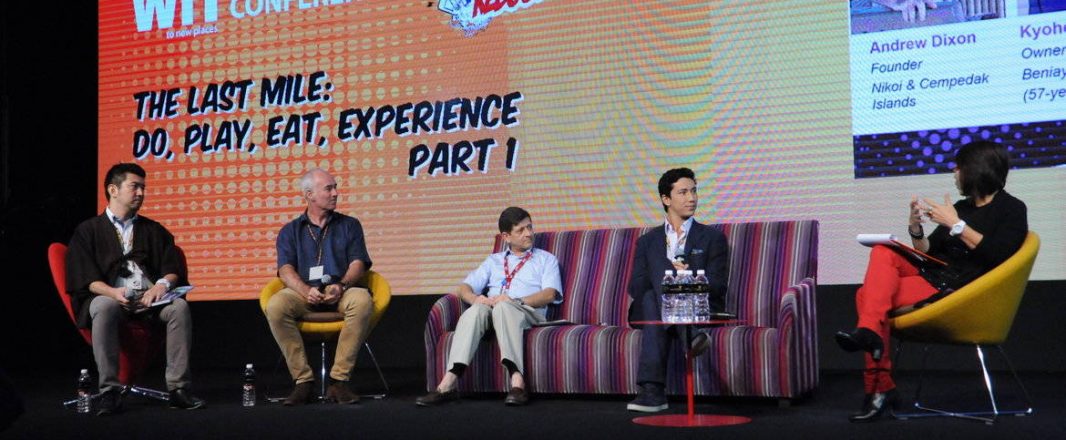
By Mar Pages, luxury travel writer
Travel experience is the new buzzword. At the final day of the WIT conference, we heard from a wide spectrum of businesses involved in creating unique experiences. At one end, the larger travel OTAs and, at the other, the hoteliers and food experts who are trying to move away from the commoditization of travel into providing a more personal and personalized experience.
In post earthquake Nepal, Tiger Lodge’s MD, Marcus Cotton, said, “Nepal is so used to natural disasters that the travel industry just carries on.” “What we worry about is how to stay competitive”, he added, referring to the lodge’s struggles stacking up against larger and more generic offerings shown in travel aggregators search results next to his authentic Nepali-village style lodge.
“We would like the OTAs to be able to list niche properties against other niche properties, so that our $400 a night lodge can properly compare with a similar accommodation and not with a $20 a night hostel,” he said. The Lodge devotes a part of its revenues to community and nature conservation efforts, from raising funds to build and maintain the local secondary school to programs to monitoring of the butterfly population
For Kyohei Yamamoto, a 3rd generation ryokan owner, the community is his staff, an essential element that allows him to provide a genuine Japanese hot spring experience. “Our staff don’t even speak English”, he proudly announces. “I always have my mobile phone with me so they can call me for any questions”. Travellers are looking for the real experiences and, for what would otherwise be an issue for a larger, commoditized chain, this becomes the ryokan’s strength when marketed and promoted intelligently.
The main selling proposition of such niche properties is usually their remote and isolated location – although that comes at a price. For Sangjay Choegyal, co-founder of Sri Lanka’s 8-bungalow Gal Oya Lodge, the location determined the reality of the lodge construction. “When we arrived at the property, we realized there was no electricity or phone signal so we replaced the contractors we had in mind with local artisans. We built the resort in 14 months entirely out of local materials.”
The word isolation cannot be clearer on the audience’s minds than with the picture of a private island. Andrew Nixon’s newest property, Cempedak, is being built entirely out of bamboo, and will be located close to his existing property, Nikoi, but targeting a new segment: couples. What sets Nikoi apart from all other island resorts is the strength of its word of mouth marketing. Almost all of the resort’s bookings are done via its independent booking site.
“We started with a functioning booking site and have managed to channel all our bookings without the need for a third party re-seller.” This surprising feat has been achieved, thanks to a great product. “If people like your product they are willing to go through a more cumbersome process to book,” he added. The resort regularly runs at full capacity.
But Nikoi is not the only property leveraging recommendations and word of mouth as a marketing channel. Social media is key for niche properties. Social media photos are “a powerful marketing tool”, adds Andrew.
For those without the benefit of being located a ferry away from Southeast Asia’s richest city, Singapore, “TripAdvisor is a large discovery channel”, said Marcus “We are very active on the platform replying to every comment.”
In a world where growth and expansion are common buzzwords, niche properties have to be clear about what they stand for. “You cannot make a niche product bigger, but you can add more niche products to the collection,” said Marcus. “Create a collection of sorts,” agreed Sangjay.
But how do owners and managers of niche properties use to evaluate their success?
Bottom line figures are not a fair measure of the success of such small products. Instead, the panelists agree that giving back to the community is key. For Kyohei, the community starts with the guests and the staff. Being such a small property, “We are like a family business”. Andrew focuses a lot on CSR and conservation efforts.
There seems to be an opportunity for the larger OTAs to create a channel for niche properties to be compared against peers and not against the more commoditized and larger options. The distribution power of the largest booking sites can help provide these niche, community-focused and personal properties the reach that their smaller teams cannot achieve.