“Being largely self-funded forces you to make tough choices”
TO raise venture capital or not to – that’s the question the two co-founders of HalalBooking, the UK-based search and booking website for halal-friendly travel, have wrestled with at various points of their eight-year startup journey, particularly now as it looks to expand its business beyond Europe.
Since founding in 2014, the business has been mainly self-funded with small ticket angel investors who are friends and customers, said CEO Elnur Seyidli. In April 2021, it took a $5 million convertible loan from five angel investors, which it called a pre-Series B convertible loan. Its plan then was to raise a further $15 million during the second quarter of 2021.
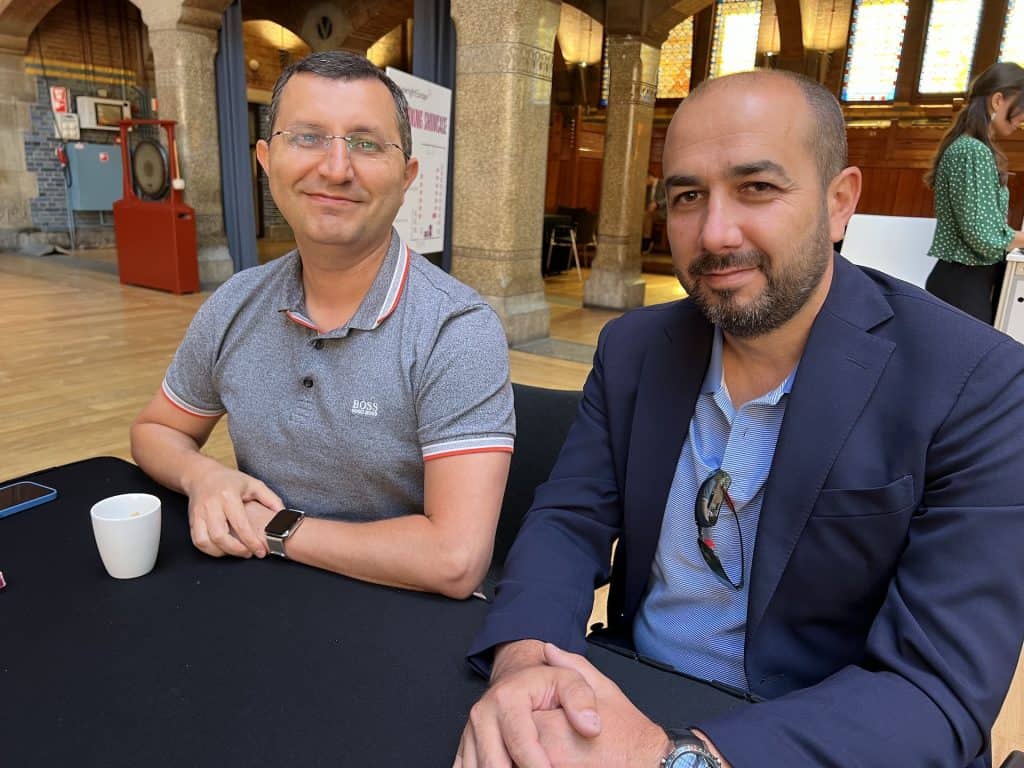
Co-founders, Elnur Seyidli (left) and Enver Cebi: “It gave us time to find our business model.”
But that has not materialised as “there were terms we couldn’t agree with”, said Seyidli. “As such, the loan is not converted yet as we have not yet had a Series B investment from a VC yet, so technically it is still a loan on our balance sheet, not equity shares. 92 percent of the cap table is still the founders’.”
The co-founders are still interested in pursuing a Series B “but it will need to be at least $20-$25 million to be worth it,” said Seyidli. “We are profit-making anyway so a small amount is not worth the hassle.”
He said a raise would give the company “growth acceleration” and allow it to achieve its $1 billion target earlier, by 2025, instead of 2027-2028. “We will achieve $1 billion target anyway, so it’s a question of speed.”
Asked if the pandemic had made fund raising harder, he replied, “I think there are two separate factors which make it difficult for us to agree with that statement. One, surely, it is tougher now to raise than pre-pandemic but it is getting easier again as the pandemic is ending. But we ourselves also have minimum terms and valuation expectations. We are very confident that sooner or later we will achieve the $1 billion target, thus we are not prepared to sacrifice too much on the terms and the valuation. So that filters out many VCs looking for a ‘bargain’.”
On being largely self-funded, without VC funding, he said, “We’re not sure if that’s a good or bad thing but it’s kept us focused on running the business profitably and it gave us time to find our business model”.
The original idea for the business came from COO Enver Cebi who was looking for a suitable holiday for his family. Even though he was working in the travel business in the UK, he found the process challenging. “Can you imagine the millions of Muslim struggling to find the right holiday for their families?” he said. “We found one resort in Turkey and when we went there, it was full of local people, and I thought, there must be a market for this in Europe.”
Cebi went to Seyidli, who was working in tech in the energy sector, with the idea and the two Turkish executives teamed up. “We started as a tour operator targeting the UK market but then we realised we needed more tech. So we thought, let’s build an accommodation OTA as accommodation is the biggest pain point in the halal market. We were crystallising the vision along the way.”
The model they eventually landed on is a “hybrid OTA” where it has direct contract with about 2,000 hotels while its partnerships with other OTAs give it access to another million hotels. “We are the merchant of record and we incorporate halal filters using our proprietary data,” said Seyidli.
They both agreed that the hardest part about getting started was the lack of serious funds but on hindsight, both also agree that the bootstrapping gave them the freedom to experiment and test models. “It helped us keep our focus as we didn’t have to worry about external shareholders,” said Seyidli.
“I suppose you could argue that if we had had VC funding, it would not have taken eight years but being largely self-funded forces you to be very efficient and you have to make tough choices. For example, in the past, we used to have flights. Then one day, we said no more flights. In one day, we lost 30-40 percent of our turnover, that was tough but it was the right decision to focus on accommodation.”
Today, the business covers accommodation in 100 countries and 80 percent of its customers come from north western Europe. Germany is their top source market with 20 percent of contributions, followed by Turkey and North Africa. Their top destinations are southern Europe, Mediterranean, Turkey, Dubai and the Maldives.
Both said the halal business bounced back fairly quickly from the pandemic, which saw it lose the UK market completely when it was in lockdown. “It’s a resilient market,” said Cebi. “It’s fully recovered now and the business grew despite certain markets being closed.”
In the first half of 2022, it recorded $30 million in sales, a 70 percent year-on-year growth on the first half of 2021. For 2021, the founders said total sales was $36 million, higher than pre-pandemic’s $31 million.
“Based on first half 2022, we are sure we will have sales of at least $60 million, maybe $70-80 million as we are accelerating. With 17 percent margin, even with $60 million sales, we will make a significant profit. Last year, with $36 million sales, we made almost $1 million net profit,” said Seyidli.
To make it through the pandemic, the co-founders took the bank loan and doubled down on tech, and increased its tech and engineering team. It went into the pandemic with 50 staff and today, it employs 70, with more than half in the UK and 45 percent are women. The co-founders say the business is cash positive.
Until last year, “we did not spend a penny on marketing”, said Seyidli, relying mostly on word of mouth. “This year, we are spending on lead acquisitions, working with brands that have a travel audience with halal intent.”
It also achieved a breakthrough partnership with Expedia and it also integrated with travel brands such as Hotelbeds and Agoda. It launched different payment terms including BNPL and offered different terms and conditions around cancellations. “There is appetite for more sophistication in cancellations,” said Seyidli. “This behaviour developed during the pandemic, people hesitating to pay in advance but are prepared to risk small amounts.”
He added, “We don’t have VC funding but we have healthy margins, so we are okay with being self-funded. This year, even though we have increased our staff numbers and marketing spend, we are still going to make a significant seven-digit profit. There is every reason to believe that we are likely to accelerate beyond our 1H2022 YoY growth rate, organically, without a Series B.”