The emergence of the consumer as an Info-Whore
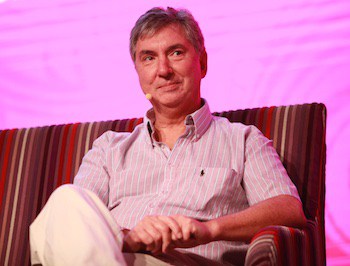
Timothy O’Neil-Dunne: We no longer have control over our identity.
From an old fashioned point of view, the world we live in today has evolved the very nature of Capitalism. Traditional business models that were founded on the basic concepts of profit from the sale of products and services have been swept away by the different models brought about by the enablement of the internet.
What enabled the internet to take such hold as the utility that it has become? The answer is the search engines. However, as with many businesses – the evolution of the search engine turned it from one of enablement as a Gateway to one of a Gatekeeper effectively metering the flow of information in and out.
A critical function of the search engine has become Meta data (literally data about data). So the change from the mere monitoring of behaviour to monetisation of personal data was not a leap. It has now become the driver of literally billions if not trillions worth of transactions and company values. That monetisation has taken the form of the selling not of products but our personal data.
Key elements in our own identity have now been lost and are a chattel to be bought and sold without our knowledge or control. For some this is a fair trade, for others this is an abhorrent travesty of justice and borders on criminal sale of our most personal and precious assets.
The erosion of trust has become a quandry for many. Do we trust less today than we did before and in who/what do we trust mostly? Empirical research is hard in this topic area. However Edelman the Public Relations company has been publishing their annual report, since 2001. Now in its 13th edition, it has itself evolved and is now global in scope. There are many interesting nuggets of information and observations that are contained in the study. It should be remembered that Edelman’s own mission is to provide opinion changing services for its clients. Thus it could be argued that the study is one written by the fox watching over the hen-house!
Here are some key observations from the study. First up – how do we feel about the regulation of business? Here is a snapshot of the consumers perception of government regulation. It can be concluded that we have a clear expectation that the government is watching out for us. Whether they are doing a good job or not is of course a matter of conjecture.
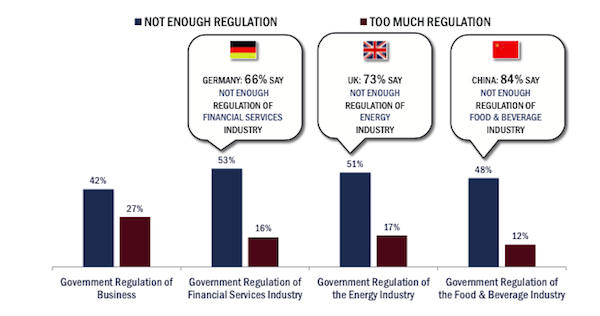
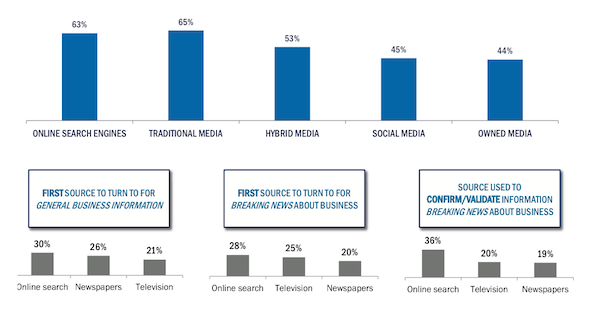
The level of trust by the consumer is driven by both perceived concepts and observations. When confronted with observable data we can make informed decisions. When that data is not so easily observed we rely on other sources such as word of mouth, social networks or independent sources – each of which of course has the propensity to be manipulated.
The further away it is from the consumer – the greater that possibility of manipulation. We can’t exactly look all our social “friends” on Facebook directly in the eye, especially since we have never met the majority of them in the flesh. Many of us from older generations will remember the concept of a “pen pal”, a trusted form of extending one’s circle of friends. Fast forward to today and we have so many “Friends” that we can hardly keep up. Since there has been this explosion of data and our access to it, we can no longer rely on our immediate personal circle of direct relationships. We need that extended circle out there on the web.
In travel we have a clear example of TripAdvisor as the place we can go to for “independent” opinion. However do we really trust it and is it truly independent? Perhaps the final question is, does it matter? Apparently not.
The expectation that there is “someone” watching over us and ensuring that only the best can happen to us has extended from the physical world to the information world. More than half of all consumers expect that the Government has the role to do just that.
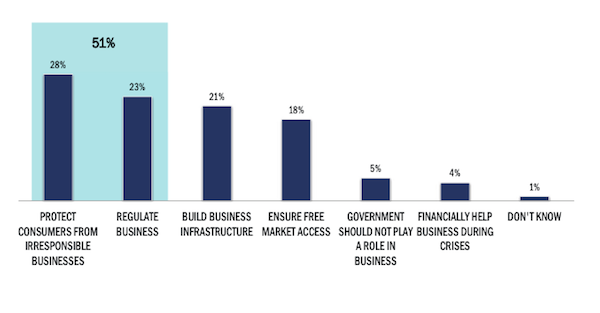 However as we have seen in so many examples – governments are not actually that good at this job. They are slow and generally reactive not proactive. Led by the USA, most governments have adopted a laissez-faire attitude and let new levels of yrust establish themselves via the web. That freedom allowed the web and its associated models to take hold and become the norm that it is today.
Onto our “independent” and authoritative sources – the traditional place was the Fourth Estate of the Press/Media. Sadly with the emergence of giant media companies such as News Corp, we have seen overall trust in the media become debased. The recent scandals in the UK over phone hacking have only confirmed the public’s cynicism in the world of conventional media. It’s way down there with banks as a source of trust.
So where do we place our trust and is it worthy of it?
Technology is seen as the one place where trust can be had. As most technology is empirical – it either works or it doesn’t. Users can trust what their senses of eyes can comprehend.
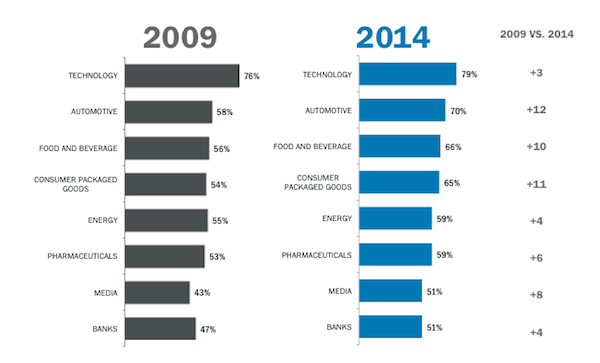
It will be interesting to see if this is maintained once the Internet of Things becomes more prevalent and we move away from the screen as our primary interface into the world of information. Physical technology – washing machines that break etc – is not trusted as much as say our phones. Often the trust is moderated by the experience. For many the use of personal technology such as the Smartphone is driven by our abilities rather than the technology itself. We only use a fraction of the capability.
The headline of this article is very carefully worded. It plays off another headline in a recent article on Re/Code. – We Shouldn’t Have to Give Away Our Identity to Use the Internet.
As we struggle with such concepts as Native Advertising and greater sponsored content as ways to ensure our continued access to “free” information, we will find that trust has moved from the role of understanding and comprehension to one of resigned acceptance.
And that is the crux of the matter. We no longer have control over our identity. Whether we like it or not – we are just part of the giant “meat market”. It may not be our bodies that are being bought and sold. Surely our minds are worth even more? In that case perhaps we have all become unwitting prostitutes in the information age.
• Featured mage credit (Free): Free-pichet_w/iStock