The Chinese believe red is a lucky colour and it seems to be working in RedDoorz’ favour, although it’s also taken a lot of hard work to get to where it is.
The startup that pivoted from a B2B tech player focused on India to becoming a new generation budget hotel chain focused on Indonesia is certainly having a lot of doors open for it in 2017.
It now claims to be the leading hotel chain in Indonesia with 500 hotels (3,000 rooms) in its inventory, and has raised a second round of funding to conquer more cities in Indonesia.
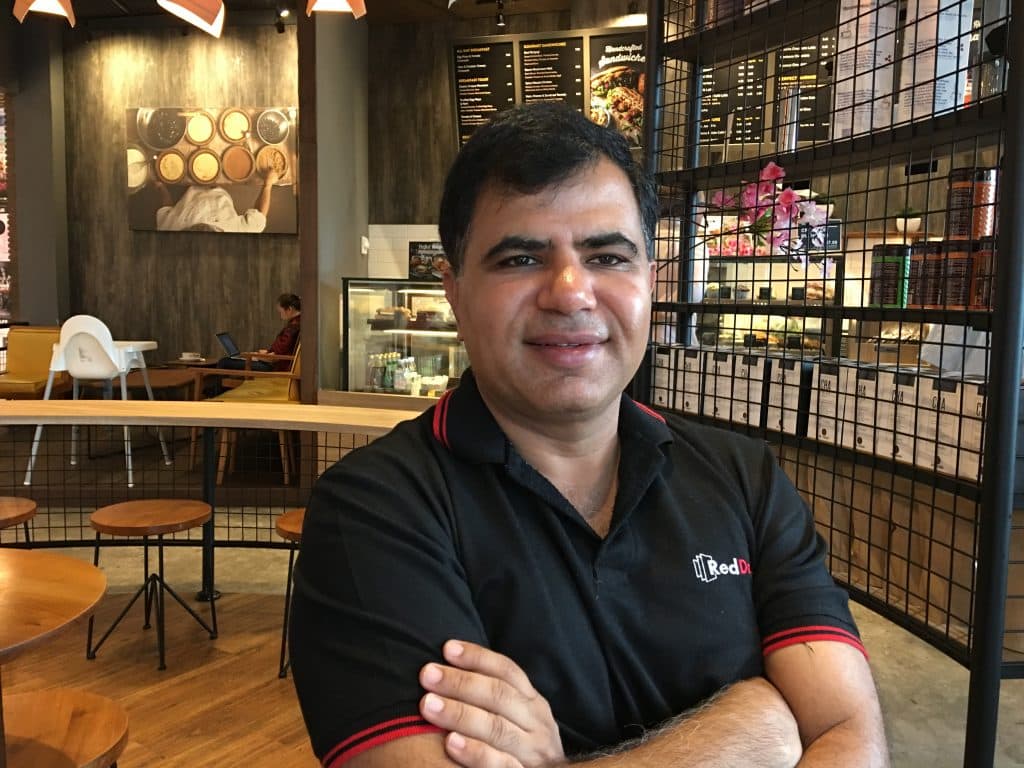
Amit Saberwal: “We are confident of the playbook and we’re confident of Indonesia.”
Co-founder Amit Saberwal, formerly from MakeMyTrip, declined to disclose the Series A amount raised last year but said this would allow them to go deeper into their first three cities – Jakarta, Bali and Bandung – and expand to Yogjakarta and Medan.
Its first round of funding came from investors such as Jungle Ventures and that first US$1 million has gone a long way towards building a sustainable, scalable model.
“What we did was pitch investors profitability by city. It was a logical way for us to raise investment. We said we would focus on three cities first and if we can crack the model in those three, then we could expand to more cities, and then later South-east Asia,” said Saberwal.
“We are confident of the playbook we’ve created and we are so confident of Indonesia as an economy. We want to spend time focusing Indonesia before going elsewhere. People are so social, so dynamic, so last minute, so mobile-driven, so spontaneous – it fits into our profile.”
Inspired by OYO, the missing element was the brand
The RedDoorz model was essentially inspired by OYO Rooms. “We had the tech distribution piece but what was missing was the brand and when OYO put on their brand, that was the moment when we realized that was what we were missing.”
And he believes the budget hotel market in Asia is fragmented and big enough that it’s not a winner-takes-all scenario. “This is not an Uber vs Lyft story – look at all the hotel chains around, Accor, Marriott, Hilton. The difference is we are tech-enabled.”
The decision to get out of India was also prompted by the “crazy discounting” in the market. “Hotels were being subsidized by the OTAs by up to 30-40% of costs – it’s not a sane market”.
And because Saberwal was based in Singapore, he saw the potential of Indonesia and South-east Asia.
RedDoorz works with smaller, independent properties – a notch below the Ibis and Holiday inn Express – and standardizes the stay experience. It either flags the property or rooms depending on the deal. Currently, it has 3,000 rooms available. It offers 24-hours customer service and loyalty points called Red Cash, which seem to be working with repeat rates in the high 40s.
“A block and tackle business”
Building the business has not been easy. “This is a block and tackle business, not aggregation. You have to build up property by property and keep working your way through that location until you build enough inventory that’s in pace with demand.
“It’s about building critical mass in different neighbourhoods. It’s about deep relationships. You have to be meaningful to partners and get their full buy-in.”
RedDoorz has a team of 110 people in its Jakarta office, the majority of whom worked in hotel operations. “Our team is made up of young aspirational people who want to be in hospitality but are looking for fast growth.
“I used to be a hotelier and it can be slow getting anywhere up the ranks. That’s why I switched to MakeMyTrip.”
The majority of its customers are Indonesians, 24-29 years old, 50% male and are last minute decision-makers. The average transaction is about US$35-$38.
He’s been lucky that he’s not spent a lot on customer acquisition. “We look on our business as a hotel business and built the brand organically.
Asked why a hotel owner world work with RedDoorz versus a traditional hotel brand, he said, “With a hotel brand, it often requires major structural change. Our customer base just wants a base quality of room, location and wifi.
Its model is evolving with some owners wanting to work with management fees. “The critical thing is, the pricing decision has to be with us.”
A business of cities, not countries
Saberwal believes that once RedDoorz has cracked Indonesia, it will be able to use the same playbook in Vietnam, Thailand and the Philippines. “This is a business of cities, not countries.”
He also sees a lot of similarities between india and Indonesia. However he said Indonesians were more ahead in mobile engagement than the indian consumer.
Saberwal was never under any illusion that building a tech startup would be easy. “That illusion went away because of my experience at MakeMyTrip. I was completely prepared for the fact that business is not built on the portal but on the ground.”
On lessons he’s learnt since leaving MMT in 2014 to start RedDoorz, he recounted, “Keep focused on what you are doing, don’t forget the basics – buy at right price, sell at right price and keep the money in between. You have to protect your margin.
“Be prepared for a lot of rejection. Everyone knew MMT and would take my call. When you are starting up, you’re nobody – you have to be prepared for it mentally.
“Plan your family and financial life accordingly – know that for 18 months at least, you cannot be going through any domestic mess at home.”