The interview with Muzzammil Ahussain, CEO of Almosafer, at WiT Phocuswright Middle East started with a provocation. Saudi Arabia is reportedly projecting a $44 billion deficit for 2026. Construction contract awards fell 72% year-on-year. NEOM wasn’t even mentioned in the national budget. So: is the Saudi boom running out of steam?
Ahussain responded, “I would say it’s being more rationalised, more strategic, a lot more focused.”
But he noted, if you’re on a train doing 1,000 miles per hour and you slow to 500, you’re still doing 500 miles per hour. “Rationalisation is not bad. It’s okay. It’s good.”
The committed, unmovable markers of Saudi ambition remain intact, he pointed out – the Expo and the World Cup. Tourism – with new airline launches, the Red Sea project now open, Qiddiyah’s entertainment assets coming online – is, he said, “still very, very positive.”
Domestic: Not displacement, additional wallet share
Saudi Arabia’s domestic travel surge is the headline grab, but Ahussain was careful about how it’s framed. It’s not a COVID repeat, where domestic was the only option. The difference now is product: the Red Sea, AlUla, theme parks, luxury leisure assets that didn’t exist at the same level before.
“It’s both demand and supply-driven growth,” he said, adding, “We don’t see domestic as a cannibalization, rather as additional wallet share.”
In 2025, before the current conflict, both domestic and international travel grew simultaneously. The Saudi consumer, he argued, has enough appetite for both.
Luxury: It’s about experience, not bling
On the shape of Saudi’s luxury travel demand, Ahussain offered a corrective to the popular caricature. “Bling, not just for show.” Saudi luxury travellers, he said, are willing to pay a 30% premium for quality but what they’re paying for is genuinely good service, food, spas, and comfort.
“You’re going on a trip to enjoy your destination, take a break. You don’t want the hassle of an uncomfortable bed.”
The Almosafer numbers back this up: 75 to 80% of Saudi travellers book four or five-star and above.
Religious travel: The segment that held
Religious travel, Ahussain confirmed, proved the most resilient segment of all. April domestically was the best month Almosafer has ever recorded, better even than Ramadan. International inbound Umrah was disrupted by flight cancellations in the early weeks of the conflict, but has since restarted, with visas flowing and no visible slowdown in demand.
What’s often misunderstood about religious tourism, he said, is both its scale composition and its economics. The assumption that it’s a mass, low-budget segment misses a significant and growing VIP tier, fully customized, high-end Umrah experiences for travellers willing to pay for them. “Both have very different economics. It’s not only a numbers game.”
He also noted that the primary demand driver for Almosafer’s religious services is domestic Saudi travellers, not inbound international visitors.
Activities: 440% growth and the consolidation issue
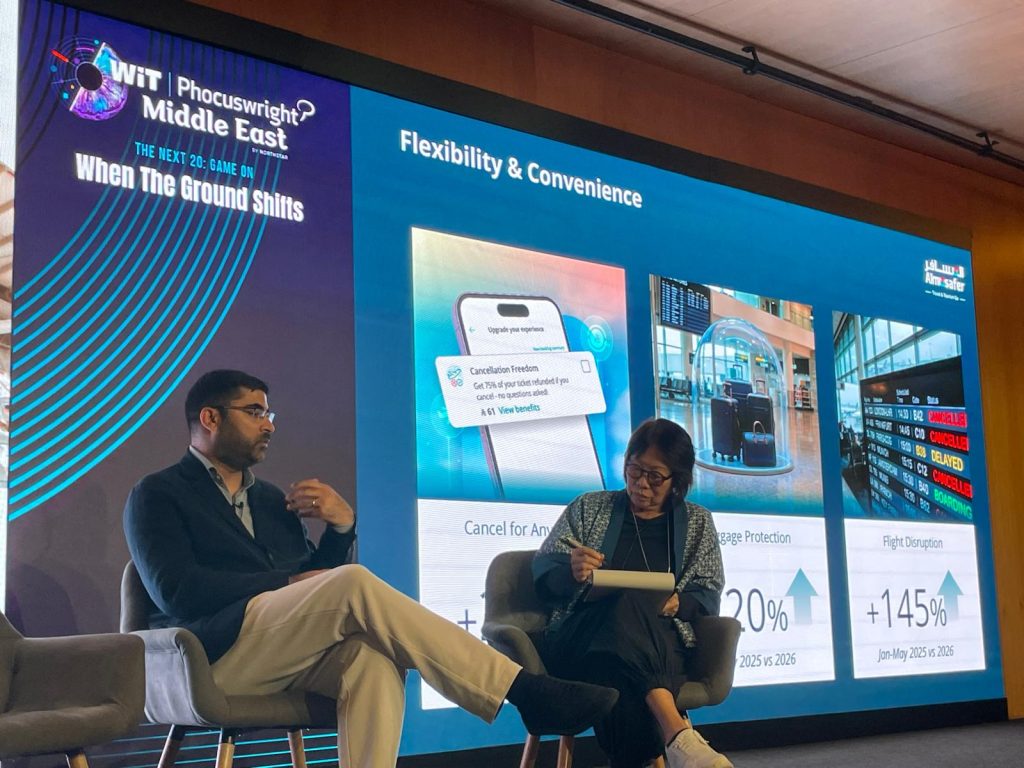
He also shared a 440% growth figure in the activities and entertainment category. Giving it context, he said, some of that is genuinely new demand, but a significant portion is the digitisation of previously offline, fragmented supply.
“Before, there was no organisational company where you could buy things from. It was all small mom-and-pop shops.”
He spoke about Almosafer’s joint venture with Klook as not a simple distribution deal, but a technology partnership to consolidate supply across Saudi’s activity ecosystem into a single platform.
“We saw a gap: there was no centralisation of supply. Once we have the supply, we distribute.”
The westward shift and new routing patterns
On Saudi outbound travel, he said Saudi travellers are moving west rather than east. Dubai, Doha, Bahrain, and traditional South-east Asian destinations like Thailand and the Maldives have all seen significant drops. Turkey, Egypt, Morocco, Spain, France, and the UK are growing strongly.
The reason is partly about comfort with proximity to conflict, but also about routing. Travellers who previously connected through Gulf hubs – Emirates, Qatar, Etihad – are now routing through Turkish Airlines or direct Saudi carriers, to avoid the anxiety of transiting through the region during uncertainty.
New direct routes are opening to reflect this: direct to Madrid has just launched. Direct to Manchester is coming. Once Saudis find a destination they like, Ahussain added, they tend to return repeatedly. “It’s not trending for one year. It’s continuous visits.”
Technology: WhatsApp rules
On AI, Ahussain was measured. Almosafer was the first Saudi app integrated into ChatGPT –good PR, genuine learning ground, but still “very, very minuscule” as a traffic driver. The real focus now is GEO (Generative Engine Optimisation): ensuring the platform surfaces well in AI-generated responses.
But the technology investment that matters most is WhatsApp. Almosafer now handles over 50% of its after-sales interactions through WhatsApp. End-to-end bookings via WhatsApp are in the mid-single digits and growing. AI is being embedded into the WhatsApp journey to make conversations feel less robotic and more authentic. “
The 35 physical stores, meanwhile, are staying. Positioned at key airports and cities, he said they serve a specific and durable purpose: in times of crisis, people want to stand in front of a human being. “That creates brand value and brand trust.”
The only certain bet
On the outlook for the region, Ahussain was honest about the inbound gap: European travellers book six to 12 months out, and for many of them, the tail end of 2026 is already written off for Middle East travel. “The last leg of this year is gone.”
But he sees the downtime being used productively – hotels reinvesting, infrastructure being upgraded, foundations being strengthened for when demand returns.
On certainty: the unknown, he said, is what hurts most. Companies paralysed by “should we invest, should we hold” are damaged not by the conflict itself but by the absence of resolution. “Certainty is the most important thing.”
His certain bet for the next five years is uncomplicated. “The Saudi consumer. We’re betting on them. Whatever happens, that is not going to go away. They might shift their patterns, shift their behaviours. But the Saudi consumer is robust, strong, has heavily disposable income, and loves to travel.”