Millions of data points tell a single, actionable story for hotels and restaurants, says founder
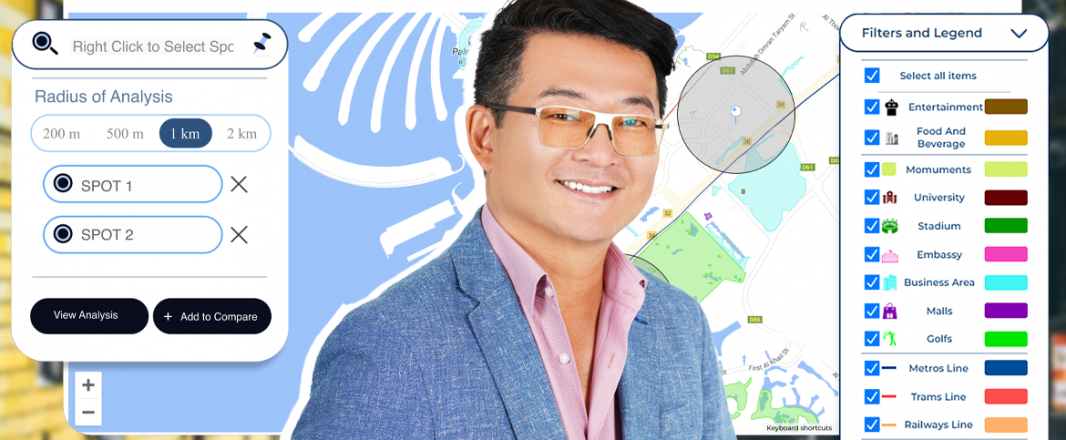
In a world where data drives decision-making, the travel industry has long grappled with the challenge of harnessing location-based insights effectively. Hannes Bos, the CEO and Founder of SpotQuest, aims to address the divide in the data translation and adoption process by providing comprehensive location intelligence through his platform. A SaaS tool, SpotQuest digests location data of a particular restaurant or hotel and turns it into intelligence – proximity to competitors, potential risks, footfall, and other influential factors to performance.
In a recent virtual sit-down with WiT, Bos shared his vision and thoughts on SpotQuest’s journey, the challenges faced by the travel tech industry, and the future of location intelligence.
Navigating the world of location intelligence
Bos says SpotQuest is a unique platform, crafted by travel experts for the travel industry. Its mission is to “provide us the deepest insight into every single location worldwide.” With 20 years of industry experience under his belt, Bos recognised the need for a solution to streamline location assessments. He explained, “It was always a very manual exercise, so we created a fully automated SaaS product on a global level to compare any location with any location.”
SpotQuest goes beyond raw data, enabling users to compare actual performance metrics and the abundance of restaurants or hotels in a vicinity. Moreover, it offers qualitative profiles of every location worldwide. Bos emphasised that SpotQuest is about the “quest for the right spot in the world, hence SpotQuest”.
Challenges in the travel tech space
In the rapidly evolving travel tech landscape, Bos pinpointed two major challenges faced by the industry at large.
“At the moment, it’s the lack of people on the ground, especially in the hotels and restaurants industry. And that has worsened post-pandemic with many hotel and restaurant staff not returning to employment,” explained Bos.
He added, “Secondly, qualified people – people who have market or industry experience – even though you can come up with the best technology solutions, when you don’t have people to adopt them, that becomes an extra big challenge.”
This basically impedes the adoption of these innovations. Bos stated, “These tech solutions tend to automate and solve problems in hospitality, but if you don’t have anyone to receive, or if they don’t have the capacity to value or recognise it, it becomes very hard.”
The operational nature of hotels and restaurants further compounds the issue. Many establishments are resistant to reorganising their workflows with technology. “That’s why we hope to solve these problems and allow hotels and restaurants to adopt it without experience,” said Bos.
Tackling market gaps with location insights
Bos emphasised the need for actionable market and location insights, particularly in the Asia-Pacific region. “Having worked in APAC in the last 20 years, we really lack a lot of relevant, actionable market and location insights to make better decisions,” he explained. Post-pandemic, the pace of change in markets and demand corridors has accelerated, making it challenging for the industry to keep up. “We’re trying to solve that part as well by really taking the market footprint and providing it in digestible and easy-to-read insights.
“If you digest millions if not billions of data points of a location – which is what we do for one report or assessment – then it is truly impossible for someone to understand that within minutes if not seconds and to make informed decisions,” explained Bos.
“So, we created a custom travel map that really allows us to tell that story. We used billions of data points to come to a conclusion but really only showed 1% – the golden data – on the map. Our clients are impressed by that.
“They may not really understand nor have the time, at the C-levels, to read through hundreds of pages of reports but that single picture of the map tells them within seconds why it makes no sense or makes most sense to invest in a location,” Bos stated. “People appreciate the visualisation. They may not be data nerds like me, but people like visualisations.”
Bos has no problem admitting that the newness of a platform like SpotQuest could act as a double-edged sword. The novelty behind the technology’s speed is alluring for sure, but the hospitality scene isn’t particularly known for its keenness to try new ways of doing this. “We’re an industry that’s used to working with a few typical players in intelligence, and the industry hasn’t evolved to a point of adopting different types of intelligence tools,” echoed Bos.
“One of the key clients for us are developers and asset managers who want to review current locations or new locations. What I quickly realised is that they run these feasibility studies in-house and it takes about 3-4 weeks to run a report. Once you show them a report that can be done at a click, they’re in awe.”
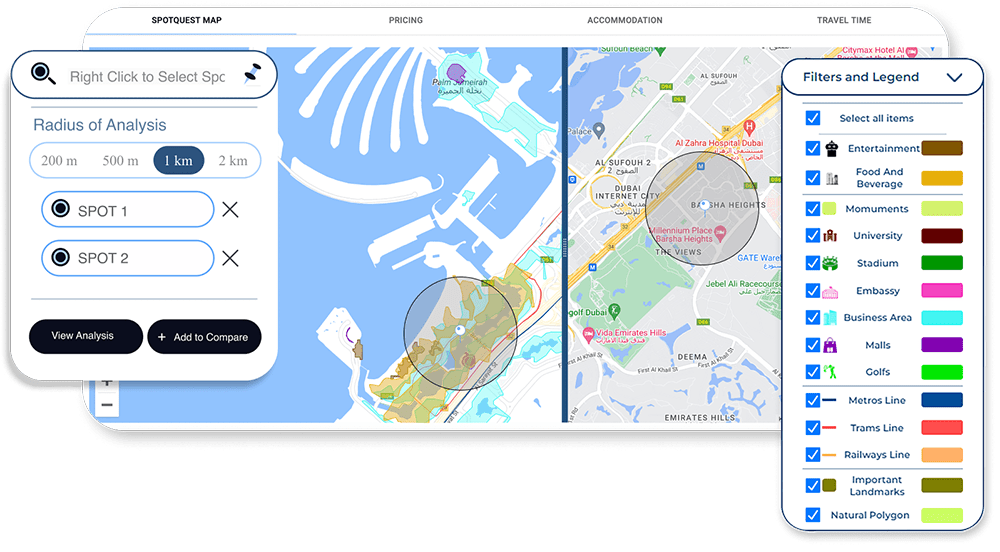
The SpotQuest dashboard
AI in the world of location intelligence
While AI has made significant strides in improving operational efficiencies, SpotQuest’s focus is on turning intelligence into actionable insights that drive profits. Bos noted that there is room for AI to fill gaps but highlighted the importance of context.
“ChatGPT helps us to fast-track the interpretation of these vast amounts of data. It also converts the intent of our queries faster but it’s not the silver bullet that takes away anything in intelligence, at least in my view,” admits Bos.
“There’s a significant amount of curation required to make it relevant and actionable – the context required – that’s what ChatGPT is missing in travel at the moment. Most answers are one-dimensional but the questions we get need more than one-dimensional answers.
“ChatGPT can tell you how many hotels are in a vicinity, but it doesn’t take into account your competitors and what that means to you – that’s the context I was talking about. Is it a relevant competitor at a relevant price point?” Bos questioned, illustrating the need for nuanced insights that go beyond one-dimensional answers.
“AI adoption tends to be more on service delivery and operations, so maybe hospitality staff can be repurposed to ensure a great experience and not be so focused on administration and the like. AI chatbots are getting very sharp and they get better and better but they’re very much solving operational efficiencies.”
Future expansion plans
Looking ahead, SpotQuest has ambitious expansion plans. Bos aims to enhance the platform further by absorbing even more data points, making it relevant for tier 3 and tier 4 markets in China and India. Additionally, the platform intends to serve travel recommendation platforms in the B2C space, offering a first-of-its-kind travel map for natural searches. Furthermore, Bos envisions expanding into other industries, such as FMCG, by the incredible amounts of data that are collected and churned by the platform.
Bos revealed, “One of our first clients asked for insights in a little town in the mountains in Austria. They wanted to buy a hotel there. I need to be ready for those kinds of locations as well.
“At the end of the day, while we started with travel, our platform can expand easily by adding more real-estate data and footfall data to serve the FMCG industry and other industries in the near future, too.”