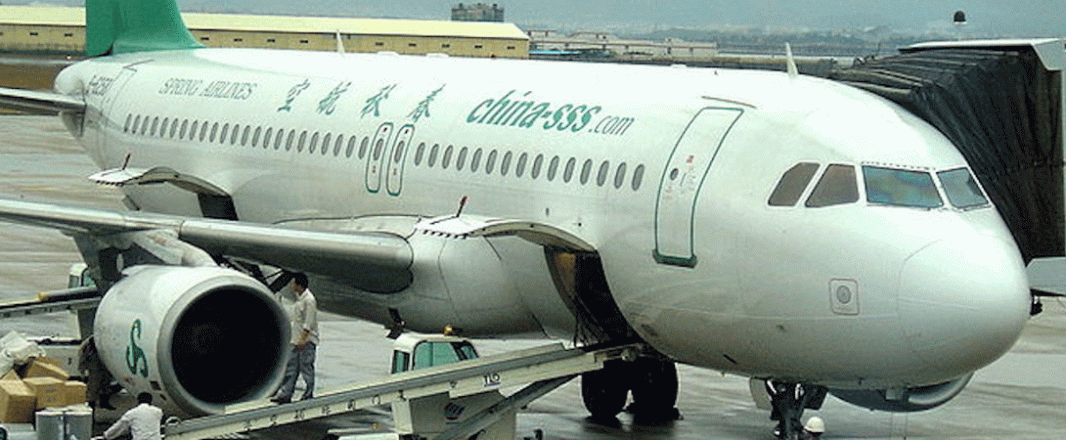

China is on the verge of a low cost revolution and Spring Airlines, the country’s first privately-owned low cost airline, is preparing itself for a future of increased competition by adopting an aggressive IT and digital strategy.
Speaking at the CAPA World Aviation Summit in Amsterdam, Jonathan Hutt, deputy GM strategy/international brand manager, revealed numbers that made other airline executives sit up – in the last 12 months, it has seen sales through its mobile channel jump from eight percent to 50% and it is expecting this number to inch up to 80% by the end of 2014 – proof once again that in China, mobile is a completely different game from other markets.
Hutt told WIT, “The CEO said we had to take the lead and so we set up a separate mobile sales division and the uptake has been fantastic. I think what’s worked for us is that we allow payment on the app and we offer all the payment options, so it makes customers comfortable with booking on it.”
The mobile app was designed inhouse. A new version was launched in August featuring voice-activated flight search function, which allows users to search for flights by speaking the cities they’re traveling from and to, as well as the date of travel.
A report quoting a Spring spokesperson said, “We hope the new version of Spring AirlinesApp could free passenger’s fingers.”
The voice activation requires origins, destinations and dates to launch the search. The new App also supports fuzzy search. For instance, for passengers who are in Shanghai, they only need to speak “to Tianjian tomorrow” or “to Shenzhen the day after tomorrow”, and the voice system will automatically search flights from Shanghai to Tianjin tomorrow, or from Shanghai to Shenzhen the day after tomorrow.
Currently, 85% of sales comes direct through its website and for Spring, social has got to be a business beyond being a promotion and advertising channel.
The airline’s active Weibo channel supports seat selection. It started using WeChat for flight enquiries but is now looking to convert it into a sales channel by offering exclusive deals.
“As a low cost carrier which is obsessive about costs, we have to convert every channel to sales,” said Hutt. “WeChat is also good for crisis management and has taken over some of the call centre functions and so has allowed us to downsize a bit.”
It has also an active Facebook presence despite the social network not being allowed in China. Its biggest number of fans come from Thailand, followed by Cambodia, Taiwan and Hong Kong.
With the new government policy announced last month to liberalise the low cost sector, Hutt predicted that five to eight new LCCs would launch in China in coming years.
He expects there to be a LCC at Guangzhou and Beijing. Shanghai-based Juneyao Airlines has announced its LCC subsidiary, Jiu Yuan Airlines, will be based at Guangzhou.
Competition is also coming in from Asia’s low cost carriers expanding into China and the most intense competition is coming in from South-east Asia, said Hutt, citing AirAsia as a worthy competitor. “AirAsia has had success and is now penetrating deeper via its shorthaul and longhaul operations.”
 Spring has also been expanding its route network, flying to destinations such as Japan, Thailand, Cambodia and Taiwan. It recently ordered an additional 30 A320 jets and expects to have 100 aircraft by 2020.
“Competition is good,” said Hutt. “Till now, there’s only been us educating consumers about the low cost model and now we have airlines like AirAsia doing the same.
“Our competitive edge is our profitability – we work hard to keep controllable costs below industry average – and our team – we pay above average for our talent.
“Traditional airlines tend to depend on traditional distribution – they will have to build a strong online presence and we are ahead in that space.”
“It remains to be seen whether newcomers will be able to compete. Spring’s goal is to become the first low-cost mega-carrier in the north Asia region,” he said.