What’s your disability? Because as far as clinical psychologist Nicky Abdinor, born without arms and shortened legs, is concerned, “everyone has a disability, it’s just that you can see mine”.
And perhaps disabilities you can see versus those that aren’t visible may be easier to deal with, especially if you are born with a fighting spirit like Abdinor who hails from South Africa.
Quoting Sir Ken Robinson, she said, “Every person (without exception) has special needs. It’s just in some cases we can see what they are.”
At the end of her talk titled “If you have the drive, the destination is up to you”, which received a standing ovation at Travelport Live in Muscat early this month, she said, “The great thing about having a disability is that you are focused on problem solving.”
Which means you don’t worry about future-oriented things as most of us are wont to do.,
Answering the question, “what do you do when your mother is not around” – her mother had accompanied her to Muscat for the conference – she said, “I’m here, am I not?”
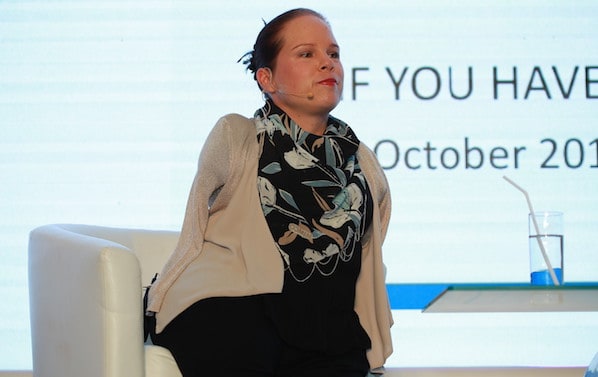
Nicky Abdinor: “Every person (without exception) has special needs.”
Throughout her life, she’s focused on solving the problems that come with her disability. She learnt to walk on her shortened legs, she types with her toes and she sends text messages with her tongue.
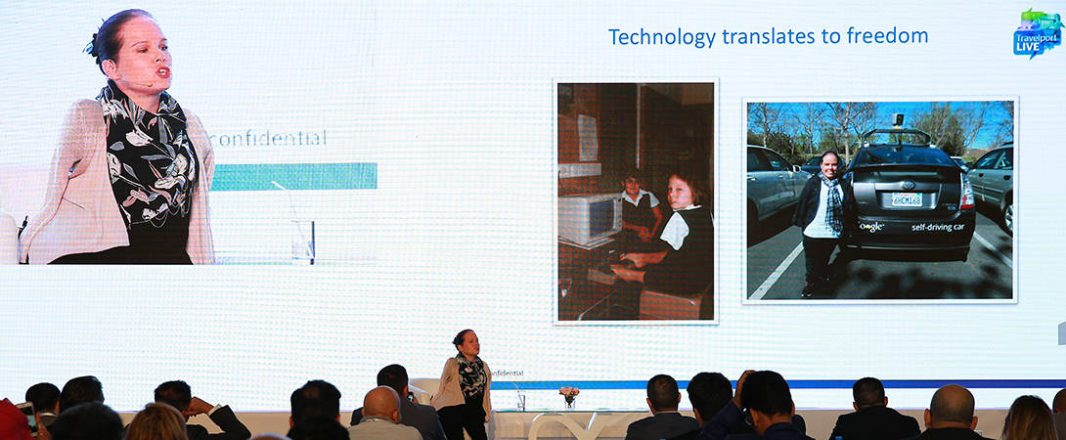
She drives, and showed a video of her driving from Dubai to Muscat, with a car re-engineered for her. She’s set up a non-profit organisation called Nicky’s Drive, which aims to fund car adaptations for people with disabilities in South Africa.
Being on the speaking circuit – she’s a regular TEDx speaker – she has to travel a lot and technology has given her a lot of freedom. But one thing she wishes the travel industry could solve for her is “recognition of my needs” whichever airline she flies with, whichever hotel she stays at.
“It’s not that my needs change with every trip, they are always the same so why can’t someone come up with the technology to recognise that.”
As for the technology she wishes for, she said “voice recognition” that would enable her to send messages she didn’t have to text and which weren’t garbled.
Abdinor’s lessons were simple reminders – believe in yourself, focus on what you can do, learn to tolerate uncertainty, be grateful – but timely for an audience of mainly traditional travel agents and suppliers that are facing change in an age of digital, mobile and AI, and whose customers are clearly ahead of the curve.
One lesson that resonated awith me was in the area of decision-making. Her simple rule is, once you clarify your values, decision-making becomes easy. So values first, decisions second.
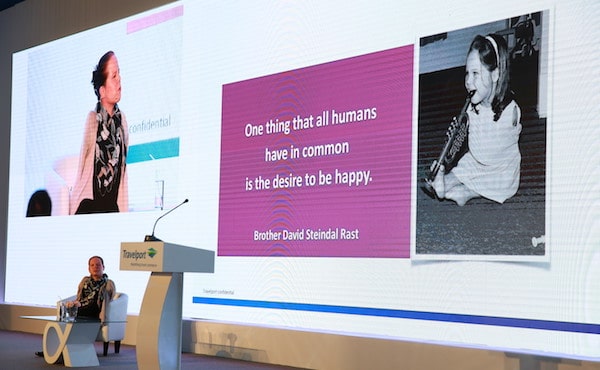
Nicky Abdinor is focused on solving the problems that come with her disability.
It is clear that Abdinor is grateful for the support she got – from her family and from her teacher when she first entered primary school. Two days before she was due to join her class, her teacher asked the kids to paint with their toes and to walk on their knees so that by the time she appeared, “I was a hero.”
It’s a good way to introduce difference, to celebrate it rather than be ashamed of it.
It was interesting that right after I listened to Abdinor at a Travelport event that Amadeus released a report on accessible travel. According to the study, an estimated 1 billion people globally or 15% of worldwide population lives with some form of disability. The number is expected to reach 1.2 billion by 2020 due to various factors that include population ageing and poor working conditions. The World Health Organisation estimates that by 2050, 21.5% of the global population will be aged over 65.
It’s by no means a new topic but one that needs constant reiteration in an age where we seem to lurch from one headline-catching event to another that we hardly know how to feel.
I recall speaking at an accessible travel conference in Singapore a few years ago, the day right after I tore my calf muscle and had to be on crutches. Everyone thought I was faking it – I mean, really? – but those few weeks in cast and crutches made me aware of how unfriendly society and travel facilities are towards physical disability, let alone invisible disabilities.
At the WIT Bootcamp on October 23, among the 12 semi-finalists is a startup focused on accessible travel. It’s not the first time Amuse Travel is taking part in our competitions. I recall them from a couple of years ago. They say with startups, it’s all about timing. Well, perhaps for Amuse Travel, the timing may have arrived. We’ll see – this year’s competition is tough, to say the least.
But it was certainly good to be reminded by Abdinor of my disabilities of which there are many, but which I haven’t worried about because I have been focused on what I can do and am grateful for and my wish is, as we get close to opening WIT Conference 2017 next Monday, that technology will indeed make “Better Travel” for everyone, those with disabilities we can see and those we cannot.