
Hotel chiefs speaking at the HICAP Update in Singapore this week expressed concern over whether “too much attention to technology” could dehumanise the industry.
In his opening, Robert Hecker, managing director, Pacific Asia, Horwath HTL asked that with all the talk about the Internet of things, “are we focused on the right thing?”
Asking for a show of hand as to who’s ever left an item behind in a hotel and if a hotel had ever called to say “you’ve left an item behind” before you’ve even realised it” – to which very few put up their hands – Hecker said, “I don’t think robots or AI will ever be able to do that. Are we focusing on the right thing – the Internet of things or the hotel experience?”

From left, Jonas Ogren, director, Howarth HTL, moderating; Nicholas Clayton, Capella, Thorstein Kirschke, Carlson Rezidor and Barry Robinson, Wyndham.
Thorsten Kirschke, president Asia Pacific, Carlson Rezidor Hotel Group, when speaking about “the coolest new thing” and “keyless entry and automated check-in” and “robots delivering room service” were mentioned, said, “I wouldn’t pay so much attention to one feature. I am a romantic, I prefer my hotels to be more personal.”
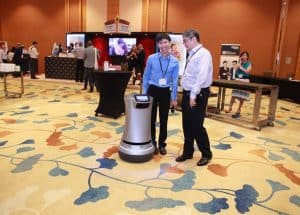
Aura, the Savioke Relay Robot, deployed at M Social, Singapore, made an appearance at WIT 2016, serving coffee to delegates
He added, “We have to be very careful – between the sweetness of efficiency and the shining new thing on the block. It’s a dangerous path. Just because we can doesn’t mean we should. We have to find the right means of applying technology in a way that doesn’t dehumanise the industry.”
Nicholas Clayton, CEO, Capella Hotel Group Asia, said technology could play a bit part in the luxury segment. “The higher your premium pricing, the more labour intensive you can be, and with problems attracting the best talent, cost becomes an issue and we have to find increasing efficiencies.
“AI could be part of the CRM strategy, it could be used in certain support functions – financial, procurement, inventory systems – to reduce cost of back of house support. If we can work on services that are not apparent to the customer – where it’s binary, right or wrong – it could play a big role in streamlining costs so it doesn’t affect the user engagement piece.”
For Barry Robinson, president & managing director, Wyndham Hotel Group, “everything revolves around the smart phone and data is the big play”.
Of course, there are also current earthly matters that trouble hoteliers at this time. Airbnb got first mention at the opening when Hecker spoke about the new regulations in Singapore banning short-term rentals, and branded budget hotel players such as OYO Rooms, Nida Rooms, RedDoorz, Airyrooms and ZuzuHotels got passing mention as new disruptors.
A few years ago, Airbnb would not even have gotten a mention at a hotel investors and developers conference but how things have changed. There is growing awareness among those who invest and build that there’s another huge space that’s emerged in alternative, private and shared accommodation.
And with Airbnb getting into corporate travel, Robinson said they are definitely more threat than opportunity. A breakout session on alternative accommodation hailed Airbnb as the future, although one might contend that the future is already here.
Asked to name new concepts, the three hotel chiefs on the panel picked “glamping, experiential hotels and 100% ecofriendly hotel”.
However Clayton said the game-changer in building environmentally-sustainable hotels will happen when governments regulate, and compliance will then follow. “When you legislate, you change behavior, otherwise we will just fiddle with it.”
He added, “If you design a hotel with sustainability in mind, it always comes to some savings – ultimately you get operational savings.”

Delegates to WIT 2016 last October experiencing Virtual Reality
Asked what they hoped to be talking about 13 years from now, their answers ranged from “space and water”, “mergers & acquisitions – what will it look like then?” and “how travel can solve problems like water, poverty and social unrest”.
Robinson said, “Virtual Reality. We won’t be sitting here anymore.”
Now that would be dehumanising the conference experience, wouldn’t it?