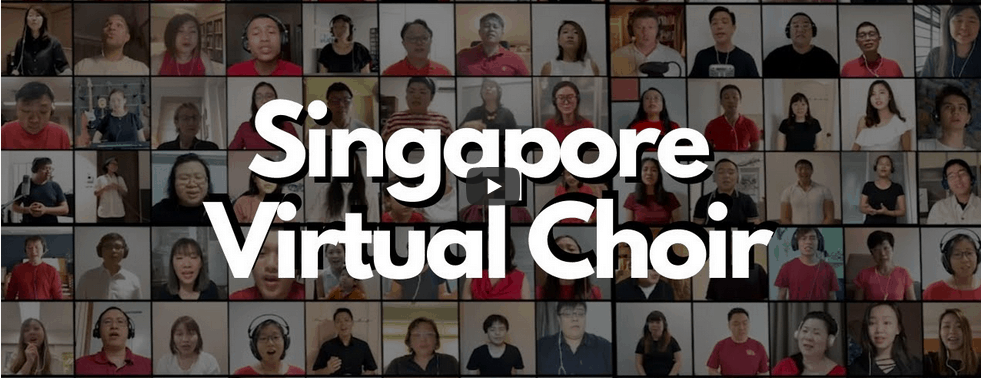
How the Singapore Tourism Board came together with Voices of Singapore to make beautiful music together
When Voices of Singapore (VOS), a not-for-profit choral organisation, found their festival cancelled and realised that they would not be able to hold physical events for the forseeable future, they brainstormed for ways in which they could still make music together.
On the other side of Singapore (okay, it is a small country but still), the Singapore Tourism Board (STB) was brainstorming on how they could use music to support the government’s efforts to get Singaporeans to stay home during the Circuit Breaker phase and yet position Singapore in a global light.
Coincidentally, both had the same idea – to use the song “Home” written by local composer Dick Lee for National Day in 1998. Well, maybe it wasn’t such a coincidence, because with its patriotic lyrics, it was really the right song for the right time.
VOS wanted a song that would unite its choral community, both at home and abroad, and make people yearn for home, while the STB wanted to support the government’s Circuit Breaker directive to get people to stay at home.
Both were also coming at it from different angles. VOS wanted it to be community-led and ground-up while the STB wanted to use celebrities and show them singing at home.
Recalled Lynette Pang, assistant chief executive (marketing), STB, “We were brainstorming around how we could use music to support Singapore at this time and the original idea was to film the song in the homes of celebrities.”
“Our goal was to help them get bigger, better and faster”
There were initial reservations expressed as to whether this was the right song – “so many people were doing it” – but Pang persisted and after a couple of calls made to the composer Dick Lee, she was told the VOS was also planning something and a connection was made.
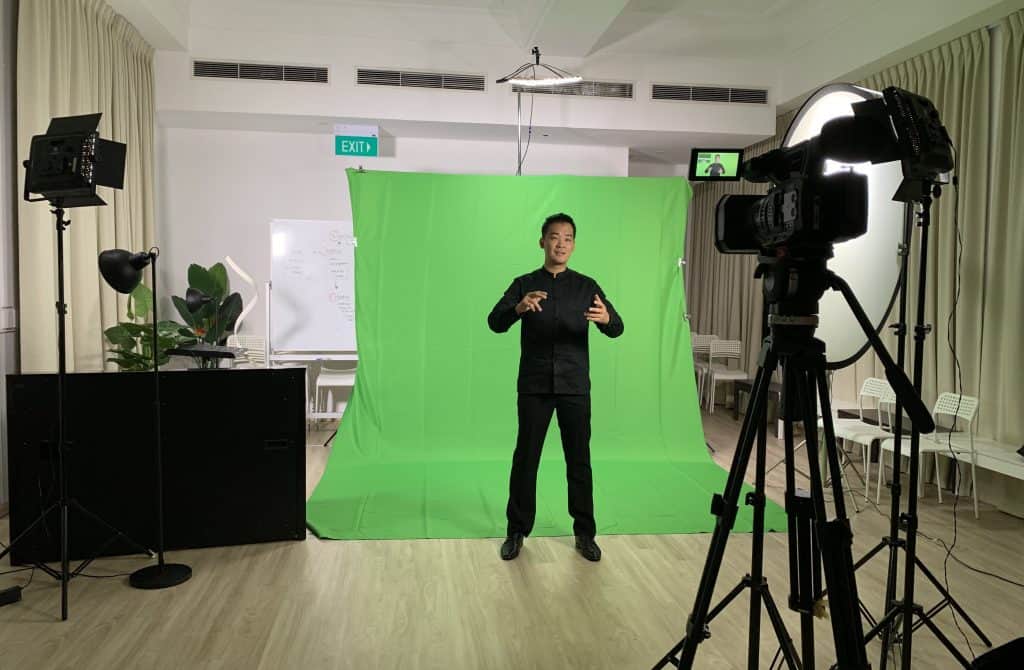
At the VOS, artistic director Darius Lim, who found a love for singing as well as the piano, from five years of age, had been struggling with what to do since not only its festival was cancelled but one of its choir members had also been quarantined.
“We foresaw a longterm challenge and we wanted to continue celebrating music through our mission of being a place to build Sing Singapore. How then could we involve people from all walks of life to celebrate music? Then, in the first week of March, a couple of friends who were stuck overseas could not return, so we asked how do we engage these Singaporeans overseas?”
He said that while the idea of a virtual choir is not new, Singapore had never done it before “properly”. “The more we talked about it, the more excited we got about it – it’s a huge initiative in solidarity and our three key words that we embrace at VOS are unity, strength and hope. Whatever decisions we make, we abide by these three words.”
It called for auditions on March 22 and by March 29, the deadline, it had gathered 2, 475 names. On March 30, it released its training videos to train people to sing at home.
It was at this point that the STB approach came. “Their stand was for Singaporeans to stay at home and to also promote a global Singapore through scenes of Singapore. That resonated with us,” said Lim.
There had been initial reservations that the song “Home” could be over-done – almost everyone was picking it as the song for the times – “but because it is one of the very few songs that Singaporeans would know and we didn’t want to teach them a new song, the immediate choice was Home,” said Lim.
He said the collaboration with STB was “nothing short of fantastic”. “What they gave us was trust. They gave us a lot of autonomy in the artistic planning. All they required was their personalities to be featured – we aligned because we did want some celebrities to boost the video. We told them, we wanted it to be a ground-up thing, not a celebrity-commercial thing, and they agreed with us.”
In the end, out of the more than 900 singers, under 10 were celebrities and by the way, STB’s chief executive Keith Tan is also among the choir. (Try and spot him in the video).
Lim said the most valuable input from STB came in the last two days of final edits. “They contributed to the artistic feel, to improve the video.”
STB’s Pang said, “What we wanted was just to help them make it better, bigger and faster. It was important for us to work with a local community group to help them and at the same time – it’s our mantra that content needs to be authentic – which Voices of Singapore clearly was.”
The tourism board paid for the production costs to ensure it would be a high quality production. More importantly, it is lending its marketing weight to ensure the video reaches a bigger audience.
As of April 20, the video, “Stay Home, For Your Home”, which aired April 14, has garnered more than 147,000 views and unleashed an outpouring of patriotism among people at home. (This is an account from a choir member).
New frontiers open “but virtual can never be like the real thing”
Lim said, “It was a very complex process, there were six steps involved. First, the videos were submitted (924 in total) and we had to extract each file for audio and video. That was the most difficult job.”
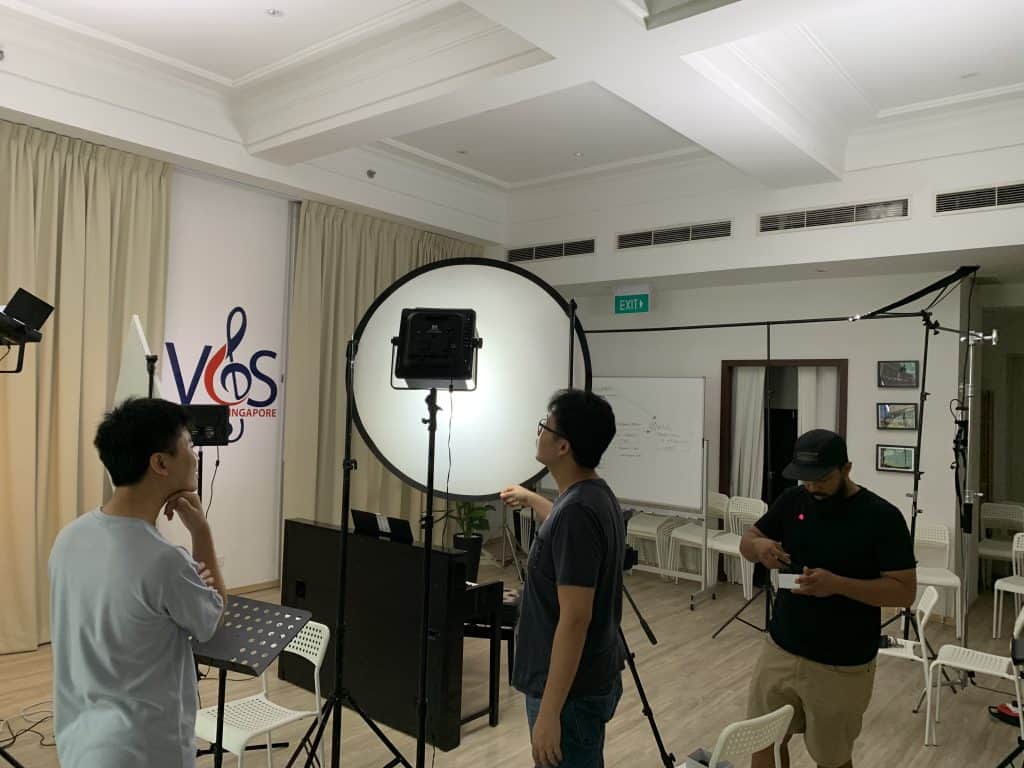
“I think most didn’t watch the training videos,” he said, laughing. “So some were singing to the wrong rhythm, wrong pitch, some were not in tune. We used a lot of gadgets to mix the audio.”
Thankfully, Lim, when he had been a student at NAFA (Nanyang Academy of Fine Arts), had taken a course in composition with music technology. “I used my audio engineering skills, which I haven’t used in years,” he laughed. “The bulk of the work was done by George Leong and his team.”
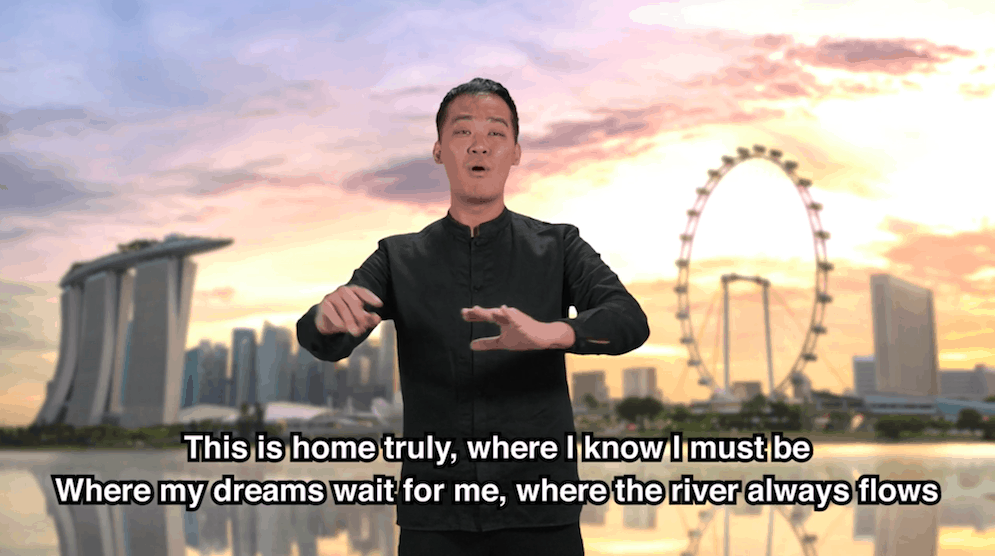
Then the video work began, to get the animation right, to add in more footage of Singapore. In all, four teams worked over two weeks on the project – three from VOS and one from STB.
Lim is clearly pleased with the global reception and sees a new opportunity for the not-for-profit organisation to create a new revenue stream. Currently, its only source of income is its education arm in which it teaches about 200 children, and it receives donations from foundation sponsors. It is also starting a new Extraordinary Voice arm for those with special needs.
“It does open up new frontiers for us – almost anything is possible on screen nowadays. We are now talking about new projects to engage Singaporeans and people around the world and how to give people an experience that is real, and not like in the movies.”
However, he doesn’t believe that virtual choirs are going to replace live performances anytime. “It is different. The live element of singing, the voice, the natural human resonance of body and vocal chords, cannot be replicated even on the best speakers. The magic and feel of the real voice, that can only be experienced live.
“It’s like travel, virtual can never be like the real thing,” said Lim, who made a total of 39 trips last year to adjudicate at choral competitions around the world. “Being there is very important, it invigorates all your senses. I remember being in Wadi Rum (Jordan) and Cape Town – these experiences cannot be replicated virtually.”
Just as he misses the physicality of travel, he also misses that of live choirs. “It is literally impossible to sing together virtually – whether on Zoom or Skype.”
Lim’s background is also interesting in this context. For most of his life, he wanted to be a concert pianist. But when it came time to choose a career path, he picked the choral track.
“It was a difficult decision. With the piano, I could express individuality and I didn’t have to focus on anyone but myself. But because I am a people person, I found it hard to spend six to eight hours alone a day training. The importance of social connection in choirs made me feel I was doing something better for society. It’s like it gave me a purpose to live life better.”