


New book, new AI-native app, new home – ixigo’s Rajnish Kumar on the next fire trial for travel
Rajnish Kumar didn’t want to write a book. In fact, for eight years, he actively resisted one, he told me when we met over coffee in Singapore, his new home after moving here from Malaga. (We’ll get to that part later)
The co-founder and Group Co-CEO of ixigo recounted the story behind the making of the book.
“I don’t need to write a book,” he kept telling Aashish Chopra, the ixigo colleague who wouldn’t let it go. Chopra, a college dropout who had talked his way into a job at ixigo with a viral video, and who went on to become one of the sharpest content marketers in the region, had been sitting in ixigo’s town halls for years, listening to Kumar think out loud. Nothing Kumar said in those rooms ever left the room and Chopra thought that was a waste.
“You need to write a book,” he’d say. Kumar would wave it off. “Do it for others,” Chopra pushed back, “not for yourself.” Kumar kept dodging – until two years ago, when Chopra stopped asking and started manifesting. He showed up at a coffee shop with a printout: a mocked-up book cover, Kumar’s name on it, and a title – “Innovate or Die”. He slid it across the table and said: it’s ready when you are.
That same weekend, coincidentally, a young founder cornered Kumar for advice. Something clicked. “If this one guy can benefit from my one-on-one,” Kumar thought, “maybe I can’t do a one-on-one with 500,000 people but maybe I can do this.” He called Chopra back. “Let’s do it. But I don’t have time.”
So they worked around the constraint: one hour, every Saturday, 8 to 9am — before Kumar’s kids woke up – for a year and a half. Roughly a hundred hours of video calls, transcribed, then compressed over six months into something that wouldn’t run to a thousand pages. The book that emerged, retitled, is called “Made In Fire – Hard-Won Lessons For Believers, Builders and Future Founders”.
“It was very painful,” Kumar admits. “In the beginning I almost despised it.”
It felt more like relief than triumph when it finally came out – “a big weight off my chest”, says Kumar.
I quipped, so you could say the book itself was “made in fire”. He laughed.
Some fires you can’t skip, others you should not have to walk through
Kumar doesn’t buy that resilience, judgement, or gut instinct can be simply downloaded — you earn them by going through the fire, whether that’s a brush with irrelevance, a founder’s version of near-death, or a truly bad call that costs you sleep. But neither does he believe that you need to go through every fire.
“You don’t have to poison your culture to learn that a bad hire ruins it. You don’t have to breach a customer’s trust to learn that trust compounds slowly and dies in an instant.” Some lessons, in other words, can be borrowed.

“You don’t have to poison your culture to learn that a bad hire ruins it. You don’t have to breach a customer’s trust to learn that trust compounds slowly and dies in an instant.”
In other words, you don’t need to put your own finger in the flame to know it burns – that’s what founders, like parents, are supposed to do for the people coming up behind them.
For ixigo, the fires that couldn’t be avoided were the 2008 financial crisis and COVID. ixigo survived both – and how it did is told at length in the book, which I highly recommend you read. It is a book for the times we have gone through and the times we are about to go through.
And as for the next fire to come, the book has exactly one chapter on it.
“Only one?” I teased. “Only one,” he laughed.
AI, the next fire and the lessons from mobile
He likens the arrival of AI with that of mobile in how it disrupted travel.
“There’s really a big test right now for most companies,” Kumar says, reaching for the moment when mobile came, adding that mobile was the disruption nobody in travel fully understood. “We didn’t know what apps were, why we needed them, or what apps we’d even build. But we knew something was coming that could kill us.”
His conclusion, arrived at then and repeated now: at every technology inflection point, a small team of smart outsiders can pick up the new tool, build from zero, and eat an incumbent’s business before the incumbent even notices it’s under attack.
His belief – the only real defence is to become that startup yourself, except you can’t, not really, because everything that built your success (the legacy systems, the org inertia) is now working against you. So you cheat. You build a new startup “inside” the old company. Isolate it completely, fund it properly and let it race the outside threat to the same finish line: killing the mothership.
“If the outside company gets there first, you’re disrupted. If your own startup gets there first, you’ve disrupted yourself.”
Kumar believes the inside team has the unfair advantage – your data, your domain knowledge, your capital – if you’re willing to actually build it like a startup and not a committee.
In 2014, the outside threat to ixigo had a name: ConfirmTkt, the train ticketing and confirmation prediction platform. Kumar’s answer was to lock himself in a room with three engineers – four people total – for 90 days and build ixigo’s train app from scratch. It outgrew ConfirmTkt. In 2021, ixigo acquired the company it had once been racing. “If I hadn’t gone into that room, ixigo wouldn’t exist today.”

“If the outside company gets there first, you’re disrupted. If your own startup gets there first, you’ve disrupted yourself.”
Newco vs Oldco: Doing it all again on purpose
A year ago, Kumar did it again, deliberately, and at scale. AI wasn’t a feature to bolt onto ixigo’s app, he believed, it was a second mobile moment, and he went back to that first instinct: build the inside disruptor before someone outside does it to you.
He carved out roughly 10% of the company – the same ratio as 2013, scaled up: about 50 people out of a workforce then around 550 (ixigo is 650-strong today). He put them on a different floor. He cut their Slack access, their calendars, their email threads to the rest of the company. And he told them that anyone caught talking to “Oldco” would be fired from the new team on the spot.
“I was quite draconian. People were shit-scared,” he says, without apology. “You have to create a sense of urgency. I think the real difference between companies that survive disruption and companies that get flattened by it is whether the founder can convert what they’re seeing in the future into paranoia and act on it now. At the time, it looks like lunacy. In hindsight, it’s the only way to channel resources hard enough in one direction.”
As he sees it, “Product velocity depends on organisation velocity. You can have the right vision for a product, but if your factory can’t build fast, you can’t build it. You don’t just rebuild the product – you rebuild the company.”
Unlike 2013, when things could happen in private, this reinvention happened in the open given ixigo’s public listing. Kumar had been signalling “Newco” on ixigo’s earnings calls for three quarters before it shipped. As a listed company now answering to outside shareholders rather than just himself, he opted for transparency instead of secrecy about the fact of disruption, even while the work itself stayed locked down.
“I had no fear of competition. It’s so hard, nobody can copy it easily. And if someone can – good for them,” he says confidently.
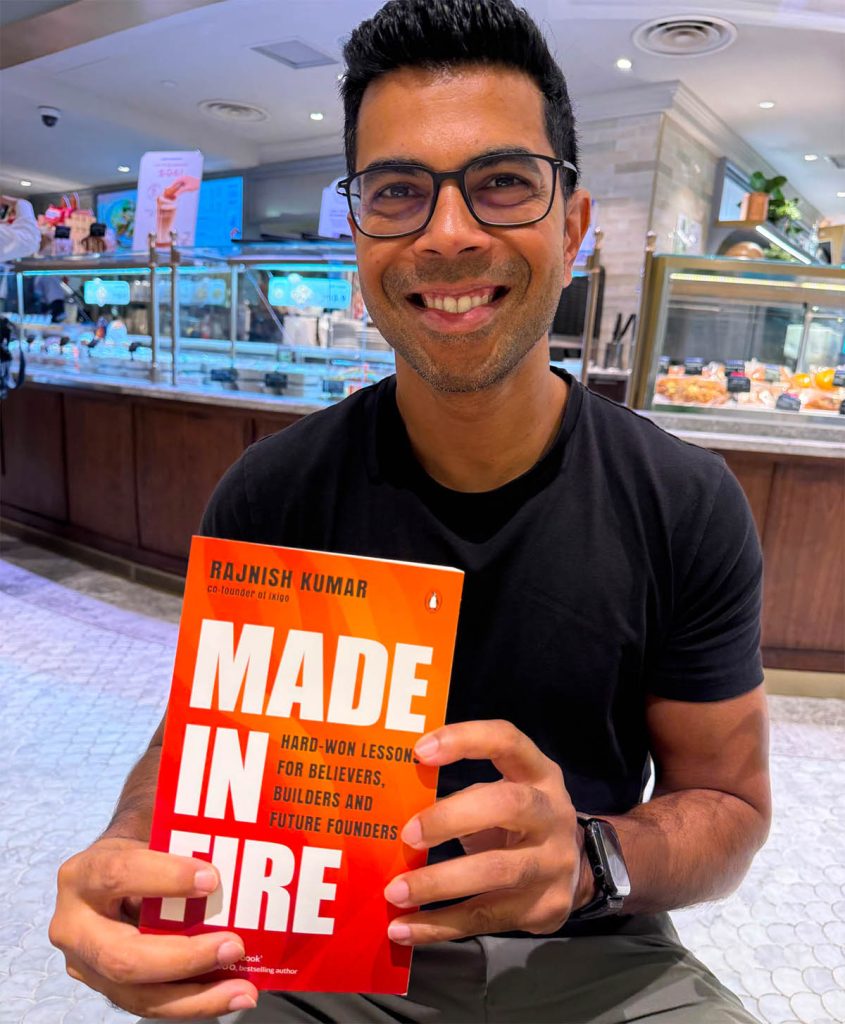
Rajnish Kumar and the book he got off his chest: “Product velocity depends on organisation velocity. You can have the right vision for a product, but if your factory can’t build fast, you can’t build it. You don’t just rebuild the product – you rebuild the company.”
What came out of the room: ixigo NEXT, “the travel app of the future”
The product, ixigo NEXT, launched two months ago. Kumar’s thesis is that the point-and-click interface people have spent two decades learning to use isn’t going anywhere – travel is too visual, too decision-heavy for pure conversation to replace it. But it’s also hit its ceiling: “Look at booking.com’s filter menu. It’s so intimidating you need a search bar to search the filters. The scroll is longer than the results.”
His fix is architectural: keep the existing app as “Layer Zero,” then lay a fully conversational “Layer of Intelligence” on top of it – one that understands every screen below it, what each screen can do, and can navigate, highlight, or explain any of it on command.
“I believe that we have demonstrated a new way of building a new user interface – everyone should copy it. I think every travel app in the future will look like this. It’s a bold claim. But I’m telling you – that’s how they’ll all look.”
Inside the app sits what Kumar calls the “agentic view” – a visible feed of AI agents working on a traveller’s behalf: one that auto-checks a flyer in and drops the boarding pass into their wallet the moment it’s available; one that phones an Indian hotel ahead of a guest’s arrival to reconfirm the room and any special requests; one that chases an airline for a refund.
None of it is hidden – users can watch the agents work. “This wasn’t possible before. Doing this with people would have needed hundreds of hires I couldn’t afford on our GMV.”
Two months in, Kumar says conversions and NPS are both up, and ixigo hasn’t marketed it yet in earnest. “Everyone I’ve shown it to says they’ve never seen a travel app do this. If we ever go out and make noise about it, I think that’s where the incremental users come from.”
What the AI fire means for founders
Kumar’s advice to founders sitting where he sat a year ago isn’t really about AI tooling – it’s about judgement. “Give two people the same task, the same AI tools, infinite tokens. The one with better taste, better judgement, more ambition, more patience wins because building is now commoditised. The only ceiling left is imagination.”
He borrows from Michelangelo to reiterate his point: “The greatest danger for most of us is not that our aim is too high and we miss it, but that it is too low and we reach it.”
Personally, he has an internal decision test – before any hard call, ask: will I sleep peacefully tonight with this decision in my head? If not, don’t take it.
He applies the same discipline to health and family, and he’s watched what happens when founders don’t. “I know three friends, all of them extremely passionate, all of them built something big, sold it, made real money. The next thing I knew, they were seeing psychiatrists. The moment they sold, they lost their identity because what they thought was driving them was success and money, but it was actually purpose. When the purpose disappeared, everything they’d been chasing turned out to be fake.”
ixigo had his own brush with that fork in 2013, when a partial exit and secondaries put real money on the table. He and co-founder Aloke Bajpai turned it down. “We were disillusioned – like, now what? We’d have gone home and lost the thing that got us excited to walk into the office.”
His current answer to “why he’s doing this” is simple: ixigo touches half a billion users. That, to him, is impact. But the internal purpose that drives him is to use his capabilities “to create something bigger than myself”.

“We want to travel and see this part of the world. And it’s no coincidence that I run a travel company.”
From Malaga to Singapore
On the move to Singapore: Kumar’s family – his Spanish wife, their two kids – had settled in Malaga, a small town where, by his own account, life had gotten too comfortable for his children. “There was no competitiveness in the schools. No fire, basically.”
The move to Singapore is partly personal: proximity to India (monthly trips now, instead of once every two months), a harder academic environment for his children among Indian and Chinese peers, and – in his words – the conviction that travel itself is the best gift he can give them.
“We want to travel and see this part of the world. And it’s no coincidence that I run a travel company,” he grins.
It’s also practical: several of ixigo’s largest investors, including GIC, sit in Singapore.
The bigger bet: Can India build a global consumer company?
Beyond the personal, Singapore also raises the question of where ixigo is headed next.
Ixigo has cracked transportation – flights, trains and buses are the strongest part of the business – and is now working on hotels, the piece he concedes remains unsolved, though he believes AI will allow ixigo to skip two decades of the “grunt work” other OTAs went through to get there.
Asked if ixigo would go beyond India to be a global player – given he believes ixigo NEXT is a model for the future – he is somewhat hesitant at the moment. “You don’t want to lose the home ground advantage,” he says, yet adding in the same breath, “the world is changing so fast. We do have a shot at building a global product. AI has changed the pace,” he says, again reiterating, “the only limit is your imagination.”
In any case, he admits to another more personal goal. “There’s a dogma that large, game-changing global companies don’t come out of India. We want to change that.”
Explaining, he says, “We’ve had global giants come out of India – Infosys – in consulting because probably no one in India would pay for their services so they had to go outside. Ditto with Indian SaaS companies – there are no buyers in India, so they had to go out. But B2C product companies – that hasn’t happened.
“This decade, I think it can happen – because AI is accelerating everything, and it might be the opening we need.”
On whether Asia, which led the mobile revolution in travel, will lead the next wave of AI commerce, Kumar is candid.
“The uncomfortable truth is I’m still not seeing frontier AI labs or models emerging from anywhere outside the US and China. There are slivers – a sovereign voice model out of India. Sarvam AI – but we need many, many more stories like that.”
He points to Sweden’s quiet rise as Europe’s new startup hub, driven by founders who exited in Silicon Valley and moved home, and wonders aloud whether Asia is undercapitalised, or simply not yet willing to back big enough bets on local teams.
It’s a question he’s putting some of his own money behind. Invited back to IIT Kanpur, his alma mater, as guest of honour at a recent convocation, Kumar used the platform to announce a personal fund for graduating students – reasoning that the gap between success and failure is often just one early believer.
“For me it was my university, or an early investor. I want to be that for some of these kids. And eventually, I want them to pay it forward.”
Rajnish Kumar will be speaking at WiT Singapore, September 30-October 2, themed “21: A New Beginning”. Get your tickets now.


