
In the news: SITA Baggage Report 2016, native mobile advertising solutions from Wego, HRS’ and Concur’s expanded partnership
Airlines report lowest mishandling of baggage in 2015

Airlines improve baggage management last year. (Image credit: Pilin_Petunyia/iStock)
Airlines’ focus on improving baggage management seems to have paid off, as last year saw the lowest level of baggage mishandling by the industry, revealed SITA in its Baggage Report 2016.
According to data from the recently released report, the rate of mishandled bags was 6.5 bags per thousand passengers last year, down 10.5% from the previous year. This was less than half the rate in 2003 and the lowest ever recorded.
This improvement comes despite an 85% rise in passenger numbers since 2003.
“Increasing passenger volumes put pressure on the industry’s infrastructure, resources and baggage handling systems.” said SITA.
Last year more than 3.5 billion passengers travelled, and with no sign that this growth will slow down the industry is making step-changes to how it handles baggage.
The International Air Transport Association (IATA) is leading the way with its call for airlines to track each bag throughout its entire journey. IATA Resolution 753, to be implemented by airlines by June 2018, will mean that bags will be tracked at every point of the journey.
“Over the next three years bag tracking will be in the spotlight as airlines ready themselves to implement IATA’s Resolution 753. This increase in visibility will provide more control and drive further improvements in bag handling,” said Francesco Violante, CEO if SITA.
“It also means that passengers will be able track their bag, just like a parcel, which will reduce anxiety and allow them to take fast action if flights are disrupted and their bags are delayed.”
The SITA report also identified the growth of self-service bag services as another area of change.
Around 40% of airlines and airports now provide self-bag-tag printing at kiosks, and more than three quarters are expected to do so by 2018. Almost a third of passengers expect to be using bag-drop – either a dedicated staffed station or fully self-service – in 2016.
According to SITA how bags are tagged for their journey is also evolving. Over the past year there has been progress across the industry on permanent electronic tags, which offer passengers independence and can reduce waiting times.
Airlines are now trialling these tags which passengers update with their flight information for each journey via a mobile phone app. Home-printed bag tags, which offer passengers similar benefits, are a lower cost option being used by several airlines today.
Violante said that despite the encouraging statistics for 2015, mishandled bags still cost the industry US$2.3 billion last year.
“While this is a 3.75% reduction from 2014 it is clear that this must remain an area of focus for the industry. Passenger experience is paramount and improving baggage handling will deliver improvements for passengers along with cost savings.The technology is available to support increased tracking and improved tracing and SITA is working across the air transport community to deliver efficiencies.”
Download the SITA Baggage Report 2016 here.
Wego launches native mobile advertising solutions
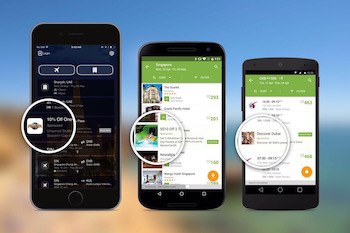
Wego’s native mobile advertising solutions.
Travel search site Wego has launched native advertising solutions for mobile, making it one of the first companies in the region to do so.
“Mobile is the new frontier for advertisers. Nothing connects advertisers with, or gets closer to travellers, than creative and relevant mobile messaging,” said Craig Hewett, co-founder and chief advertising officer at Wego.
“Traditionally ads were considered intrusive, and wasteful due to accidental clicks that return no value to the advertiser. Wego’s Mobile Native Ads have changed all that,”
Hewett explained Wego’s mobile native ads are embedded inside travel search results, returning relevant and highly personalised communications that have proved to be successful.
“Travellers are proving increasingly responsive providing positive feedback to the ads, and early advertisers are receiving eight to ten times higher CTRs than industry standards.”
He added that “Wego’s strength in these growing mobile regions places us in the unique position to test what works best for both travellers and advertisers.”
Google studies state that 79% of smartphone owners use their device to purchase goods and services, and on average, consumers check their mobile devices around 150 times per day.
Click here for more information on Wego’s advertising solutions or watch the video.
HRS and Concur expand strategic partnership

Benefits for corporate clients from HRS’ and Concur’s expanded partnership.
HRS, the global hotel solutions provider, and Concur, a leading provider of integrated travel and expense management solutions, have expanded their partnership to offer joint corporate clients optimised content.
The clients will also benefit from streamlined processes and higher transparency through seamless data synchronisation.
This includes optimised display of HRS content in Concur Travel and integration with Concur TripLink enabling travel managers to track, view, and manage all bookings made directly on HRS.
In addition, the implementation of HRS payment solutions will be available in Concur Travel and the partners will conduct joint sales activities.
“Our expanded partnership with HRS will allow us to deliver high quality content within Concur Travel along with fully integrated direct booking via Concur TripLink, enabling greater visibility and efficiencies, improved compliance and reduced direct and indirect costs,” said Tim MacDonald, executive vice president of travel for Concur.
Tobias Ragge, CEO of HRS, added that working with Concur since 2009 has been a win-win for their mutual customers worldwide.
“With the new strategic dimension of our cooperation, we aim to provide our content and services to corporates through all channels to take their travel management to the next level. Corporates will benefit from substantial cost savings and improved processes,” he added.
Both partners will jointly support customers in boosting their hotel adoption rate and provide their travellers with a fully integrated booking and payment solution. Travel managers get a better overview of travel expenses, enabling improved controlling and the identification of further cost savings potentials.