THE Wrap is a round-up of news in the travel and technology industries, and an update on how businesses in these sectors are adapting and resetting as they prepare for post-pandemic travel.
IATA, UNWTO launch online destination tracker to prepare for the return of international travel
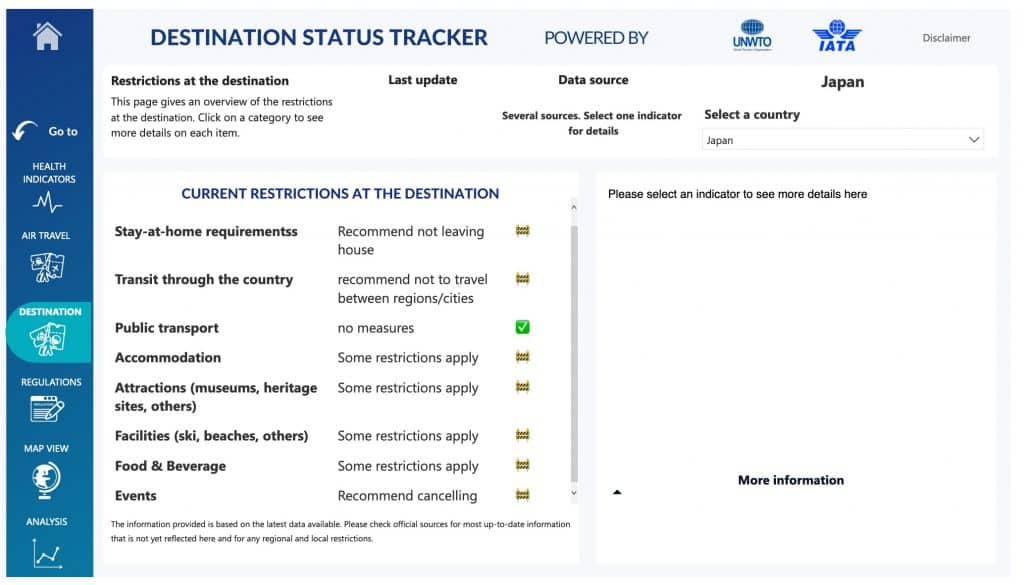
The International Air Transport Association (IATA) and the World Tourism Organisation (UNWTO) have developed the Destination Tracker, a free online tool to drive the restart of tourism.
The two organisations said the tool, available through their websites, is for governments to provide information on Covid-19 requirements for travel and the measures in place at the destinations.
The tool provides information on Covid indicators such as infection rates, positivity rates and vaccination roll out by destination/country, in addition to air travel regulations including test and quarantine requirements provided by IATA’s Timatic solution. It also monitors destination measures including general health and safety requirements such as use of masks, transit through a country, curfew, or regulations related to restaurants and attractions provided by national tourism organisations.
Governments can use the Destination Tracker to post Covid travel information to keep travellers updated on what to expect at their destination. When fully populated with updated destination information travel stakeholders, including destination management organisations and travel agencies, will be able to obtain the latest information to enable to make informed decisions when borders reopen and travel resumes.
According to IATA and UNWTO, the development of the Tracker framework is completed. Up-to-date information on Covid indicators and air travel regulations is available and systematically updated. Destination information is being progressively uploaded, expanded and updated with official sources as the situation evolves
“Travellers and companies will be able to check requirements in place for air travel, as well as what measures will be in place at the visited destination. We trust this tool is also critical for governments to track existing travel restrictions and support the safe restart of our sector,” commented UNWTO secretary general Zurab Pololikashvili on the tracker’s functions.
Willie Walsh, IATA’s director general, said it has been more than a year of no travel with borders closed. “When governments have the confidence to reopen borders people will be eager to travel. And they will need accurate information to guide them. With the support of national tourism organizations, the UNWTO-IATA Destination Tracker will help travellers and travel companies obtain the latest information for travel planning.”
The creation of the Destination Tracker builds on the existing partnership between the two parties, which started in October last year when they signed a memorandum of understanding to work together to restore confidence in international air travel. The agreement will also see the two agencies partner to foster innovation to drive the restart of tourism.
Passenger traffic of APAC airlines remains weak a year into the Covid-19 pandemic
The opening of the Australia-New Zealand travel bubble, the launch of quarantine-free travel between Singapore and Hong Kong on May 26, and talks of more travel bubbles sparks hope for a gradual restart of international air travel this year.
Despite such encouraging developments airlines in Asia Pacific are still experiencing dismal traffic, although cargo demand remains high.
The March traffic results released by the Association of Asia Pacific Airlines (AAPA) showed that international passenger markets remained weak with unabating border restrictions, particularly in the Asia Pacific region.
The aviation trade association added the dismal situation has been exacerbated by the uneven progress in vaccination rollouts and rapid resurgence in Covid transmissions in some countries, particularly India.
Only 1.1 million international passengers flew on the region’s carriers in March – 13.2% of passenger volumes in the same month last year when travel was already in sharp decline. Available seat capacity averaged 27% of the previous year’s volumes, as the majority of the region’s commercial passenger fleets remained grounded. The international passenger load factor fell by 29.4 percentage points to average 23.8% for the month.
Healthy air cargo demand, fuelled by overall rising business confidence and e-commerce growth, provides some relief for the airlines. Congestion at shipping ports also spurs a shift to the speedier transportation of goods by air.
International air cargo demand, as measured in freight tonne kilometres (FTK), grew by 16.1% year-on-year in the month of March, which has been the best performing month since December 2019. Offered freight capacity rose by a comparatively slower 12.7% year-on-year – a 2.2 percentage point increase in the average international freight load factor to 74.3% for the month.
“March marks a full year since the World Health Organisation declared Covid-19 a pandemic. Asian airlines have been faced with major challenges over the past 12 months and have evolved their strategies to stay afloat by adapting to changing demand patterns and diversifying their revenue base, whilst undertaking significant cost cutting measures,” remarked Subhas Menon, AAPA director general, on the results.
He again reiterated the call for more government support to help the industry survive. “It is apparent that we will need to learn to live with Covid-19. As such, it is imperative that governments across the world embrace harmonised risk-based measures that safely reopen air travel. This includes digitalisation of travel health certificates, as well as the implementation of contactless and seamless travel measures in accordance with ICAO and WHO guidelines, to support travel recovery.
Menon reaffirmed the association’s commitment in working with governments to aid the resumption of air travel in a “smart, safe and sustainable way.”
Hotelbeds extends benefits to travel professionals in partnership with IATA

Bedbank Hotelbeds has formed a partnership with the International Air Transport Association (IATA) to deliver new hotel benefits for IATA/IATAN ID Card holders.
Travel professionals with these cards have access to IATA’s AgentExperience platform where they can enjoy benefits such as special offers for flights, hotels, car rentals, sightseeing, ground transportation, familiarisation trips and IATA training courses.
The new partnership will see 180,000 hotels in 140 countries worldwide added to the portfolio on the platform. This is made possible through Hotelbeds’ TravelStack technology powering IATA’s AgentExperience platform.
According to Hotelbeds, this technology provides industry partners with a full service white label booking platform integrated with its global product portfolio.
“Offering our IATA/IATAN ID Card Holders a wide range of travel experiences in order to expand and enhance their product knowledge has been a hallmark of our AgentExperience platform. Partnering with Hotelbeds will significantly improve the booking options for travel professionals across the globe,” said Harsha Krishnan, head of travel & tourism at IATA.
• Featured image credit: Juan Carlos Hernández Hernández/Getty Images