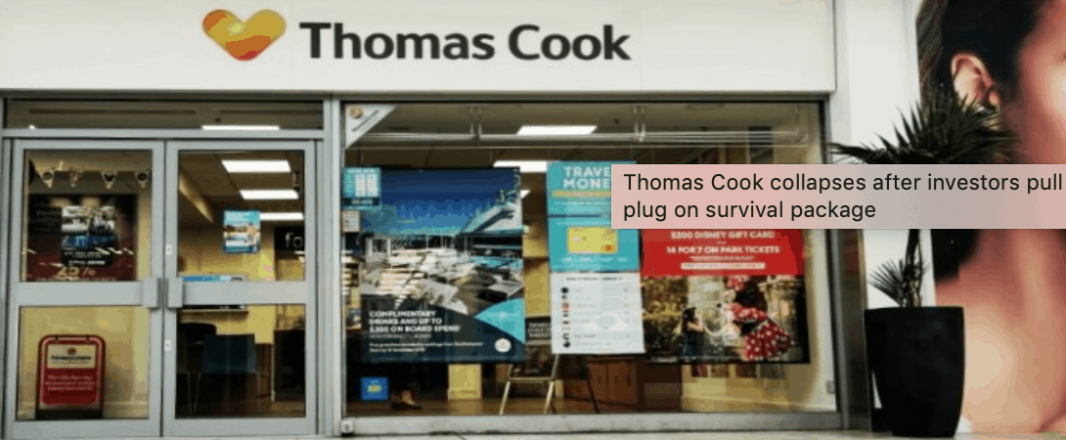
Thomas Cook, one of the most well-known brands in the history of the travel industry, has collapsed after a financial rescue failed to materialise.
The U.K. and Germany-listed public company needed a £200 million bailout to secure survival following a previous investment of £900 million in July this year was deemed too small to put it back on firmer ground.
It applied for “compulsory liquidation” with immediate effect in the early hours of September 23, putting the company in the hands of external officials to wind down business operations.
Some 600,000 travellers are currently in-destination on trips provided by its range of tour operating brands or on flight-only deals on its airline.
They will be automatically repatriated under the terms of ATOL package trip bonding regulations.
The financial crisis that engulfed the company ahead of its collapse this week was blamed on political problems in destinations such as Tunisia and Turkey, travellers taking domestic holidays due to unseasonably warm weather in Northern Europe in 2017 and unease around the U.K.’s ongoing Brexit saga.
It has 34 aircraft and a 22,000 headcount worldwide, including those in call centres, retail travel agencies and support staff in hundreds of resorts.
The current incarnation of Thomas Cook goes back to 2007 when it merged with fellow tour operating brand MyTravel – the same year that arch-rival TUI (then Thomson) joined forces with First Choice.
But its roots stretch further to 1841 when a cabinet maker with the name Thomas Cook organised rail-based tours around the U.K. Within 25 years, it was sending travellers around Europe and to the U.S.
Despite sales of around £9 billion a year, Thomas Cook has faced a string of problems ever since the merger with MyTravel, such as a financial bailout in 2011 and a number of poor management decisions, including those covering IT and digital strategy.
A £100 million project given to IBM in 2006, ahead of the merger, became a poisoned chalice over the course of the next half a decade due to the size of the task to unify and integrate each of the tour operating brands onto a single reservation and customer management platform, running both online and in its retail travel agencies.
BlueSky Technologies, one of the vendors tasked with implementing much of the Globe project, collapsed in 2009 and relations between Thomas Cook and IBM also became strained.
Thomas Cook eventually axed the project in 2011 amid a £86 million financial write-off, blaming a change in requirements and the complexity of attempting to connect the myriad of brands.
Perhaps most infamously was then-CEO Manny Fontenla-Novoa’s belief in 2010 that Thomas Cook could challenge Expedia in Europe (strangely, he never mentioned Booking.com) and become the biggest online travel agency in the region within three years.
The project was given its own headquarters in London and ex-Expedia managing director Simon Breakwell was brought in to oversee operations.
Fontenla-Novoa resigned in 2011 and the OTA project barely got a mention by his replacement as CEO, Harriet Green.
The OTA ambitions did get a somewhat ironic final chapter when Thomas Cook announced in 2018 that it would be using Expedia’s white label to power large parts of its accommodation booking site.
Thomas Cook Group’s CEO, Peter Fankhauser, who took over from Green in 2014, says the need to find another £200 million proved “insurmountable.”
He adds: “It is a matter of profound regret to me and the rest of the board that we were not successful. I would like to apologise to our millions of customers, and thousands of employees, suppliers and partners who have supported us for many years.
“Despite huge uncertainty over recent weeks, our teams continued to put customers first, showing why Thomas Cook is one of the best-loved brands in travel.
“Generations of customers entrusted their family holiday to Thomas Cook because our people kept our customers at the heart of the business and maintained our founder’s spirit of innovation.
“This marks a deeply sad day for the company which pioneered package holidays and made travel possible for millions of people around the world.”
Source: PhocusWire
Featured image credit: PhocusWire