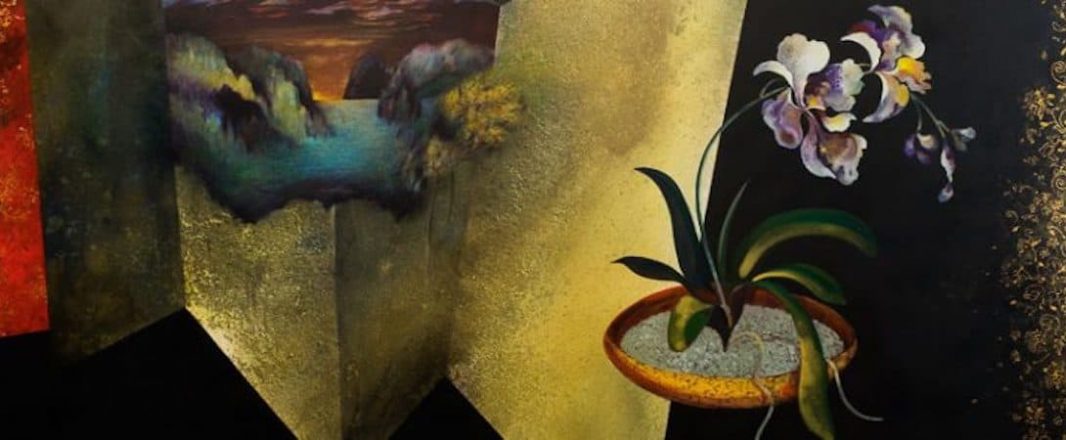
In this first series of articles around our WIT Singapore Conference theme of “Through The Looking Glass”, where we look outside travel in search of different stories and lessons, we feature Singapore-Australian artist Hugh Oliveiro and how his journey, from Singapore to Australia, has influenced his art and his latest collection of Peranakan-inspired creations in “Ambience”.
In many ways, travel is about a search for home, a yearning to return to something familiar. It could be visiting a place where you once lived and remembering moments from that time. Or it could be a search for one’s roots. I remember travelling with a friend who wanted to trace his ancestry to Bohemia and we trampled graveyard after graveyard to find headstones carrying his former family name.
In recent years too, we’ve taken to staying in people’s homes and we want to eat in other people’s homes when we travel. Perhaps it makes us feel at home away from home.
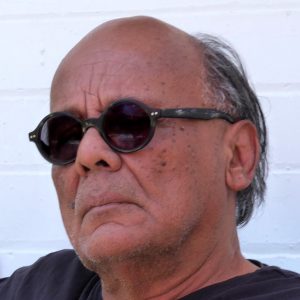
Hugh Oliveiro: “I owe a great deal to my Oriental heritage.
For artists too, there’s something powerful about the call of home. It took a return to his shipbuilding hometown of Wallsend, Tyne and Wear, to break pop artist Sting’s dry creative spell and out of it came his musical, The Last Ship, which premiered in 2014.
Australian-based artist Hugh Oliveiro, known for his “4 Seasons” mural at the Victorian Art Gallery, was driven by the same yearning for home with his latest exhibition, Ambience, which was showcased at the Australian High Commission in Singapore earlier this year. The collection of 10 paintings were inspired by his early memories of Singapore and the Peranakan culture in the Katong neighbourhood where he spent a big part of his childhood before leaving for Australia at the age of 17.
Born in 1938, it’s taken Hugh almost six decades to answer the call of home with his latest paintings. This is a story of a Singapore-born artist who found fame in Australia but whose creativity and imagination are inextricably linked to his roots.
Q: What do you recall of your early years growing up in Singapore?
It was a bit like “Phoenix Rising From The Ashes” – Singapore after the Second World War. I was 5-6 years old and I remember rustic, and horrific scenes, but also an energy of excitement to clear the mess – so typical of the people there. We moved to our beautiful home in Katong and lived there till I left for Australia.
Q: What was your first job? And your fondest memories of it?
After finishing school at St Patrick’s De Lasalle, near to home, I got a job with a neon lighting company – it made animated Street signs in neon – beer, cigarettes, hotels, cinemas were big time clients. I was the sole designer, it was a small company, they wouldn’t let me leave when I had to. I had a few designs in the streets of Singapore. I couldn’t believe it, it was a crazy time, and perhaps that was when the idea of LIGHT stayed with me.
Q: Why did you choose to leave for Sydney, and not London which would be the more conventional choice at that time?
I moved to Shaw Brothers and was given a job in the art department as assistant to the studio manager. It was really a great place. On hearing of my acceptance to study at the Slade, the general manager, Ashley Cooper, an Australian, encouraged me and insisted that Australia was a freer, and more climate-friendly place. Singapore was not art conscious at that time, and being young, there was no strong support to focus on the quality or importance of art. I believe in fate and so I settled for Australia.
Q: What were your feelings the first time you returned to Singapore after you had emigrated to Australia? I understand that your daughter cried when she saw the site of your old house and it was no longer there.
I returned a couple of times during my five-year College days for holidays. My house in Lorong N Telok Kurau Rd was still there but already the area was slowly changing with the new government plans for development, more so in the 70’s when I took my family and stayed for a whole month at the Shangri-La Hotel, it was memorable. But it was nothing like what I just experienced recently when we visited Teluk Kurau when I was in town for the “Ambience” exhibition. I was blown away – so was my house, No 38, Lorong N.

“4 Seasons” mural at the Victorian Art Gallery
Q: What was it like adjusting to a new country back then?
Surprisingly easy actually. Being able to speak the language helps enormously, as it would in any country I guess, and the excitement being in a new place takes over. That said, I did miss the food. I still do. Australians at best are a very relaxed lot, and very casual. I have been so lucky to meet some very dear friends. Going back in time, I remember my family entertaining some of the troops at parties we had at No 38, just after the war. They were really friendly and very entertaining. I helped with the piano of course.
Q: How did you build up your reputation and career as an artist? How hard was it to get that first break? Who made that happen?
Art is all I ever engaged myself in. I didn’t learn to be an artist, as is so often expressed by so many. It can’t be learnt as such, but only nurtured if one is serious, that’s the difference. Dabbling is fun – and there is no harm in doing so but there is no blood, sweat and tears here.
Five years full time at art school, two years part time in fabric design and pottery, more than 10 years in advertising design, lots of sidelining with artistic projects and commissioned works – pushing me towards my true ambition…to create, to paint, to be an artist…
Then two very special friends, themselves creative jewellers, and designers, in one of Sydney’s very fashionable Bohemian lane ways known as Roe St, introduced me to a gallery in Melbourne, The Munster Arms Gallery.
My life changed from then on. Enter into my life, the very zany, stylish, and a quintessentially sentient, “Nicky Austin” that literally, nobody in Melbourne didn’t know. My first exhibition there was a sellout, it was opened by Merriel Forbes, wife of Sir Ralph Richardson who was performing at the Old Vic in Melbourne at the time.
Q: Who/what influences your work?
Experiences in life. Images are paramount in a creative work, no matter what the inspirational source is, it must come from within. I owe a great deal to my Oriental heritage. While there are principles learnt in techniques, I explore, and experiment, with them to achieve an effect, or texture, to express what is in my mind’s eye. There is a sense of theatre in my work, a combination of narrative, and visual effects. Paintings should take you to another place, another level of seeing, and thinking.
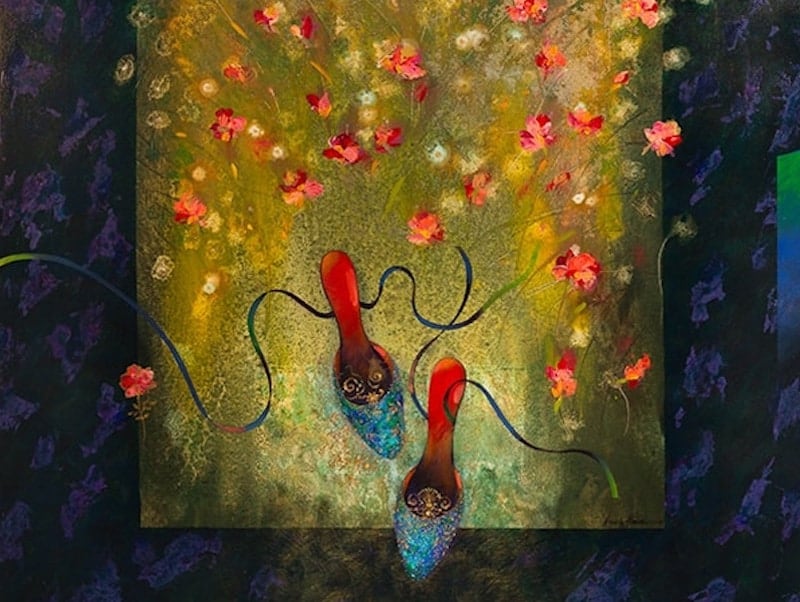
“Beaded shoes” were her skill and destiny depended on it.
Q: Which piece of work are you most proud of and why?
My “4 Seasons” mural 42ft x24ft high at the entrance of the Victorian Arts Centre – 74 panels painted in a technique using several layers of oil paint and glaze. It took one year to paint, in 1983-4. It is the highlight of my career to date. “4 Seasons” depicts the life cycle of the artist using 4 human figures, to display nature’s own perennial splendour, from birth to death, and birth again …In a pantheon backdrop of theatrical fantasy, are symbols, to complement the whole display. I worked with one of Australia’s truly great visionaries, artist and designer, John Truscott. He designed the costumes and sets for the 1967 film Camelot for which he won an Oscar for production design.
Q: In your work in Australia, did your Singapore roots influence you in any way?
Always. All my work has that exotic meld. It is in my blood.
Q: It is said every artist must find his/her voice. How did you find yours? And what do you think is your voice?
Way back in my childhood – as an only child, in a large house, and a beautiful garden, I indulged my creative fantasies. Again, the rich meld of Oriental culture trained my eyes, and mind, I guess, to see critically, and also to explore, beyond a framework, of preconceived ideas when it came to creativity. This attitude very much reflects an echo of that voice… It grew from there.
Q: How do you handle rejection, which is par for the course for any artist?
Rejection is only an opinion. How many have regretted using it, and proved wrong in time… people have this right however. I am my worst critic, I must feel 100% happy with what I do and display. In having this attitude, nothing else matters. Of course everybody wants to be loved, liked, revered, idolized. I have had some unusual responses from my exhibitions in the earlier part of my career – two women literally tugging at a painting in Canberra, each claiming they saw it first. Another in Melbourne standing in the middle of the gallery sobbing, saying, “I have never seen such beauty, and all in one space.” It’s humbling actually, and this money cannot buy…

“The idea grew, to embrace the Peranakan aesthetic because my memories predominantly revolved around it, visually and socially.”
Q: It is said being an artist is a long, lonely thing and to produce one great piece of work, you have to produce many, many pieces of work. In the book “Originals”, Adam Grant wrote that for the past great artists, it was found their most creative work was usually during their most prolific – and so it is about hard work and not that mad burst of inspiration and voila. How do you approach your art?
How true, but it is easier if you are devoted to art, and not just treating it as a hobby. Of course, one’s vision, ideas mature, as one does, and yes, for some there are fecund periods along the way, while many give up altogether. It is said that the best curator an artist can have is ‘TIME’ and here is where I am blessed, being the age I am, and still prolific. A ballet set this year, and another exhibition in 2019… no rest for the wicked…
Q: What gave you the idea to do the Ambience series? What was your objective?
“Ambience” was a very personal journey to have an exhibition, in Singapore. The idea grew, to embrace the Peranakan aesthetic because my memories predominantly revolved around it, visually and socially. I didn’t want to depict Nonya images as such, but rather inject their influences from their most colourful life style, into contemporary works. The Idea interested a friend Glenise Anderson who very generously sponsored the exhibition. The concept of high lighting the Matriarch, fitted in with her business profile in supporting the needs, and importance of women in the workplace today.
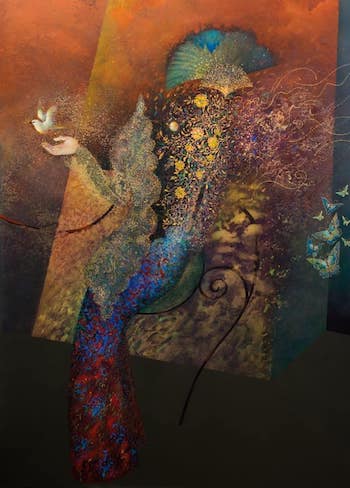
His favourite piece – inspired by the “Kebaya”, the main cloth that traditionally told stories within geometric areas
Q: Tell us about the pieces you created – which one are you most proud of and why?
Collectively, there were 10 works, they had to hold as one. I used the principles of the “Kebaya”, the main cloth that traditionally told stories within geometric areas. By using embroidery patterns, geometric shapes sumptuous textures, and colours, they helped to embellish a dominant image, metaphorically telling a story within a space. “Beaded shoes” were her skill and destiny depended on it. “The Gilded Cage” spoke of a restricted life but not really so, she was more in control. Temple offerings become a still life, a traditional wedding head dress fades into the distance, to reveal a contemporary face, a screen unfolds stories of faraway places and heritage.
My favourite would have to be “Kebaya” as it is the key to the whole concept.
Q: During the exhibition, you spent some time in Singapore, and you had been away for a while. Did you find much changed? What impressed you? What did not impress you?
Singapore has changed so dramatically… and yes, much has changed, all in such a short space of time I believe. 50 or more years? The containing of a confined space given, it being a small island, with architectural wonders in lush manicured greenery is truly remarkable. I was more than impressed, The only worry is, will it be able to sustain the lifestyle it portrays now with the threat of an ever growing population?
Q: People say home is where the heart is – for you perhaps, home is where the art is? How would you define a sense of home?
Home for any one is where their heart is, where they feel safe, and where it gives their lives meaning, and a reason to live… artist live in their minds, I know I do. I have been to places nobody knows, or will ever see.
Q: If you had to do it all over again, what would you differently?
Nothing.
Note: WIT Singapore 2018 will be held Oct 15-17. Tickets on sale here
• All images credit: Hugh Oliveiro