
TNS Connected Life 2016, a recent global study surveying the online behaviours of approximately 70,000 internet users across 57 countries revealed that the use of visual social media platforms, Instagram and Snapchat, has risen sharply across APAC.
It comes as no surprise as APAC sees over a billion smartphone users within the region, with the highest smartphone penetration in densely populated, Singapore.
While a digital-savvy population comes as no surprise, the study also shows that while the majority of online sharing may have traditionally occurred on Facebook, users are now shifting to other popular platforms that specialise in visual content.
The significant rise was most evident in Singapore over the course of the past two years, as Instagram users rose from 51% in 2014 to 63% in 2016. However, it still ranks third in the region, behind Malaysia (73%) and Hong Kong (70%).
Snapchat usage may be markedly lower but its popularity has risen exponentially, almost doubling from 19% to 37% in Singapore within a year. Hong Kong ranks highest with 46% of internet users with the app, followed by New Zealand (39%) and Malaysia (37%).
Many might be quick to assume that the rise in usage is merely a millennial trend; the study actually reveals that 33% of users aged between 55 and 65 are also Instagram users, with 10% on Snapchat.
It consolidates the notion that perhaps millennial behaviour is more about being mobile and digitally savvy than coming from a particular age bracket. Not least, it demonstrates the increasing power of visual storytelling as a means of capturing the attention of its users.
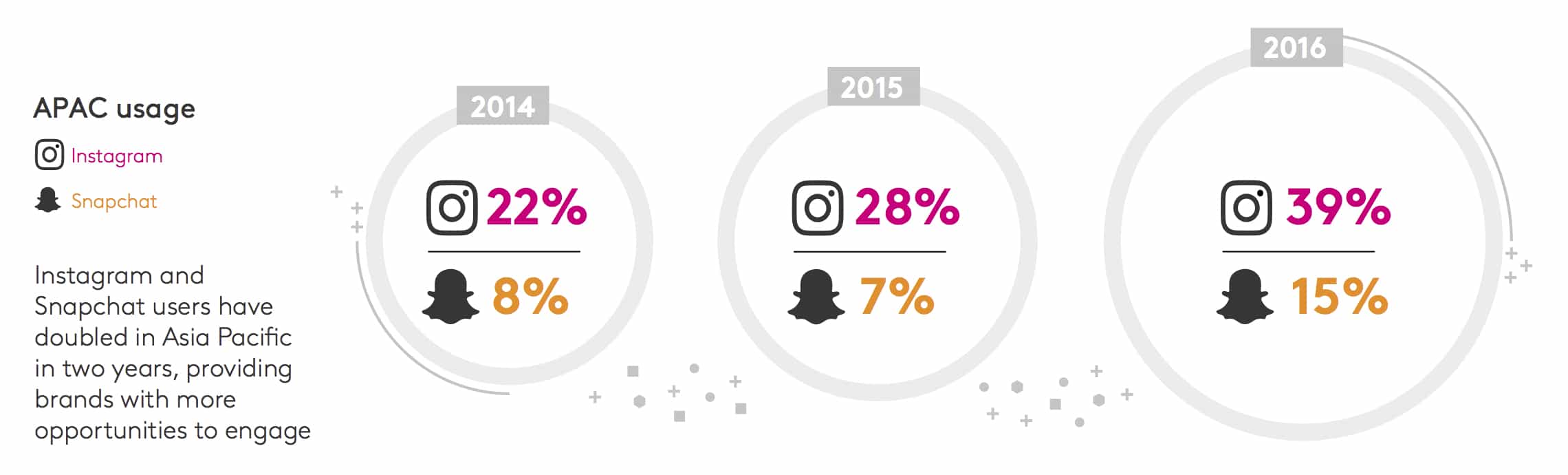
The data presents a clear opportunity for digital marketers to embrace these platforms as a direct way to communicate with an ever-increasing volume of customers. However, direct consumer advertising will no longer suffice as it once did if brands are looking to engage directly with their consumer base.
The study warns that at least 22% of connected Singapore consumers ‘actively ignore’ direct brand advertising on the apps, with 24% feeling constantly followed by online advertising. It reflects the delicate balance between maintaining strong brand presence and coming across as overly disruptive to an individual’s ‘online experience’.
Instead, consumers want content to be integrated seamlessly into the platform, “enhancing rather than interrupting the use of it”, said Zoë Lawrence (digital director at Kantar TNS, APAC).
Thus brands would be well advised to adopt similar behaviour patterns that are typical of the respective apps, e.g. curated photography on Instagram versus more organic and spontaneous content on Snapchat.
With that in mind, the Connected World study also shows that though brands may do well to become active users of the visual social media apps themselves, they may be better off using popular influencers and celebrities to push their message.
40% of 16-24 years olds and even older generations demonstrated a greater tendency to trust ‘influencer networks’ (whether it be through bloggers, peers or family and friends) over ‘official’ sources when it comes to brand recommendations.
If brands are to succeed in the online space, they must find a way to become part of the user’s ecosystem and develop “a more meaningful relationship with the consumer”, according to Subhashish Dasgupta (head of digital, Kantar TNS, Singapore).
Lead photo: Marina Shanina