FCM’s chief for Asia Bertrand Saillet speaks to Yeoh Siew Hoon on how it is blending best of online and offline in Asia by investing in new tech to enhance the traveller experience and taking lessons from its parent company’s retail model.
There was a time in corporate travel that when you asked key executives what their competitive edge was, most would say service first, followed by compliance and safety, but the times, they have changed.
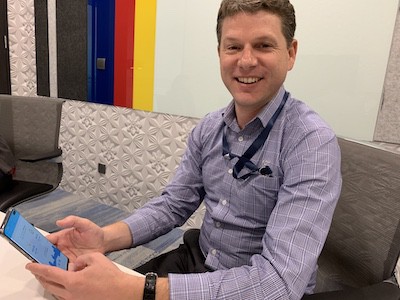
Saillet: Showing off Sam which he says was a game changer for FCM.
When I asked Bertrand Saillet, managing director of FCM Travel Solutions, Asia what the key competitive edge is today, the former Amadeus executive said unequivocally, “Technology.” Of course, he followed up with “service” right after that. “The one who can blend the best of technology and the best of service,” he added.
Saillet, who joined FCM four years ago as general manager for Singapore and has since risen up the ranks to look after the region, said the Flight Centre Travel Group (FCTG) has been investing heavily in tech through its Labs initiative whose aim is to incubate and bring to market emerging travel technologies to its corporate brands.
“The consumerisation of corporate travel is definitely happening. Travellers are telling us, when I travel for leisure, I have amazing tools but when it comes to company trips, I have nothing. FCM is investing in traveller-centric solutions to change the perception of corporate travel and make it exciting again.”
He introduces me to Sam, which he said was the game changer for FCM. Sam, the personal travel assistant launched in 2017, is now in use by FCM Travel Solutions and Corporate Traveller in over 40 markets. It’s an impressive mobile app that allows you to book, chat, send feedback, report expenses, share your location, book rides (it’s integrated with Uber and Lyft), get notifications on flights, traffic and security alerts, tell you restaurants around you, gives you city guides, etc.
It has gamification built in – it will tell you that you’ve flown enough miles to reach the moon or you’ve spent “940 hours flying”,which is equivalent to watching 403.49 Harry Potter films or 46.63 Star Wars sagas – that’s Saillet’s profile by the way.
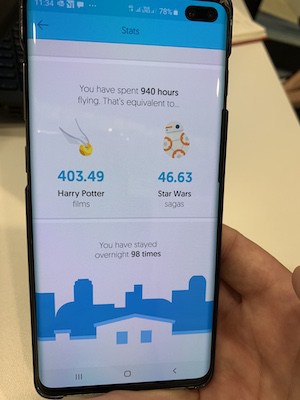
Sam in action – it has gamification built in to help stickiness.
All these features give it the stickiness most travel apps dream of. Saillet said it is looking to add tours & activities as this in-destination piece comes online and it also plans to launch Sam in China, the only problem being that Google does not work in China “so we have to find another way”.
It is also looking to add booking capability in text with the robot “while protecting company policies”, said Saillet.
FCTG first secured a 25% stake in Sam in 2017 when it acquired a holding in FCM’s partner in France, Paris-based 3Mundi. Earlier this year, it fully acquired Sam, becoming the sole owner and licensor of the product.
In addition, Flight Centre has increased its investment in 30SecondsToFly and its Claire AI-booking engine product. FCTG will have exclusive use of Claire for the next two years in the large global travel management company sector, enhancing its AI booking capabilities for corporate clients. The investment increases FCTG’s stake in 30SecondsToFly to approximately 10%.
FCM Travel Solutions started the integration of Sam and Claire late last year and piloted an AI-enhanced self-booking air and lodging capability via Claire on SAM with interested clients. Basically, what happens is that SAM hands travelers who want to book their own flights or hotels to Claire, which will process text-based booking requests with natural language processing and recommend options based on those travelers’ previous bookings, travel policies and preferred suppliers.
Saillet is excited that FCTG Labs now has a development centre in Bangkok, bringing innovation closer to Asia. FCM Labs are now present in Boston, London, Barcelona, Bangkok and Brisbane.
“Claire brings an additional engine to Sam and we want to develop this for the SME segment. We want to own the traveller experience in this segment,” said Saillet.
In Asia, corporate travel, not retail, is the star for Flight Centre
It is interesting to note that FCTG, which employs more than 20,000 people worldwide with over 30 brands in 23 countries and does more than US$20 billion worth of business, only operates two main brands in Asia – FCM Travel Solutions and Flight Centre Retail – but corporate travel forms more than 90% of the US$1.5b worth of business it does in the region.
Is this because leisure was harder to crack in Asia, I asked?
“We decided to move away from retail in Asia because people went to shops looking for cheaper price rather than book,” said Saillet. “Plus, we were extremely successful on the corporate travel side so you could say, leisure decreased because corporate has doubled in the last four years.”
On the retail side, it decided to move away from High Street shops and focus on its niche – high end leisure travel for Asians “which is more profitable. It is not our intention to fight against local tour operators – that is not our segment,” said Saillet.
Being part of FCTG’s umbrella eco-system has an advantage. It has access, for example, to Buffalo Tours in Vietnam, which was acquired by the group’s TEN Destination Network division. “There is a strong link between TEN and Flight Centre – from the moment you sell to the moment you deliver – thus controlling the entire customer experience. In corporate travel, we use Buffalo to do our transfers and in Vietnam, where the hotel content is very fragmented, Buffalo gives us access to a wider range of hotels.
“This unique positioning gives us an upside when it comes to bleisure travel, it gives our customers the opportunity to book and extend their trips.”
The rule of seven in ensuring the best of service
In terms of ensuring it continues to deliver “the best of service”, FCM Travel Solutions also takes a leaf from its parent company’s book in terms of structuring its teams.
“Skroo (Graham Turner, founder of FCTG) believes in Person to Person. For him, people don’t buy from a brand, they buy from an individual. Travel is so personal and emotional, you need to trust that person. So his idea is the family village tribe – a team cannot be bigger than seven people and we have kept this model. Every team has seven people – one team leader, one assistant and five consultants.”
The office is thus organised by teams and the teams get to choose their own names. One team leader told me she chose Sirius because it is the brightest star.
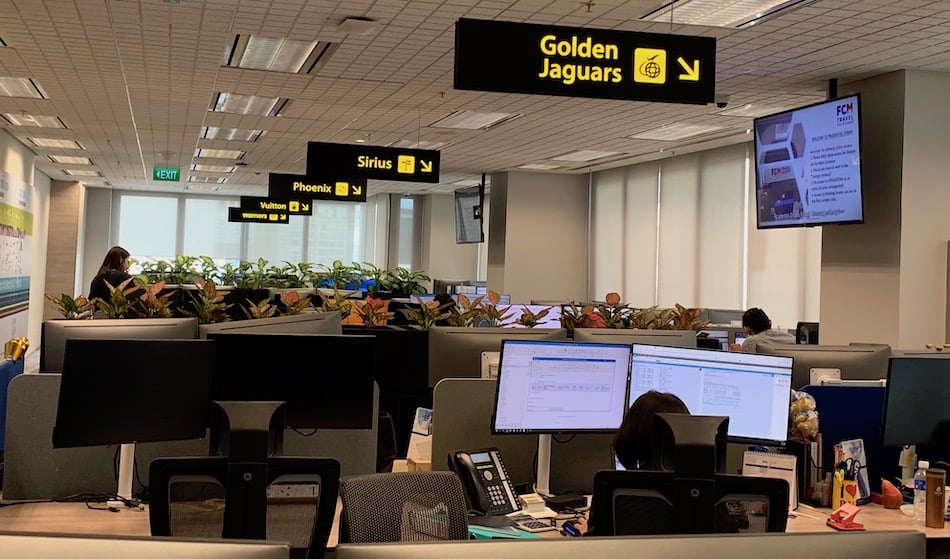
“If people don’t have amazing service, companies will complain. Yes, technology is the edge today but you need to blend the best of tech with the best of service,” said Saillet.
In Singapore, FCM has had success with local businesses such as Singtel and GIC. “We have a strong local commitment while being a global player and we have an opportunity to take local businesses global.”
Having said that, he said corporate travel is still in its infancy in Asia. “In terms of maturity of markets – when it comes to cost savings, compliance and safety – it’s still a work of progress here. It’s interesting that corporate travel is usually top five of any spend of companies yet they pay little attention to it, they don’t even have someone in charge, which is bizarre. But because of the pressure on costs, more companies are now looking at it.”
As a corporate traveller, I do question the need to have TMCs – after all, I can book most of what I need online and there are plenty of apps I can use for trip planning, getting around, booking restaurants etc. “It’s a valid question,” said Saillet. “We need to evolve. If we don’t, we will die. We bring a lot of value on the tech side, we also bring a lot of value on the service side. More than 20% of flights are changed after the ticket, guess who takes care of that?”
And while most travel companies are not as optimistic about this year, Saillet is bullish about the year. To date, it has grown turnover by 16% and for the next financial year, starting July, he expects a 20% growth based on the pipeline.
Growth markets are Malaysia, Singapore, Hong Kong, China and India. “All key markets are growing and are profitable,” said Saillet.
Plus, he has a budget in case he spots potential targets for acquisition. “We’re pretty opportunistic about this – anything that keeps enhancing the traveller experience, that’s our big area of focus.”