
Expedia’s first Traveler Value Index shows consumers “do not want to go back to what it was in 2019”, says Greg Schulze
JUST as the Olympics, which is currently ongoing in Japan, proves that sports can unite humanity, so can travel and Expedia Group’s Greg Schulze believes it won’t be long till travel proves its power again in connecting people to places and cultures.
Speaking to WiT right after the Olympics opening ceremony last Friday the senior vice president and general manager of Strategic Travel Partners said, “It’s something I’ve always looked forward to – every four years, we have counted on this competition and its amazing athletes, bringing the world together. That’s what travel is all about and travel has resumed in many places.”

Sharing the findings of the group’s first Traveler Value Index study, conducted by Wakefield Research, Schulze said one thing stood out – although travel currently is tending to be closer to home, with three quarters of respondents planning such trips, “interestingly, they do not want to go back to what it was in 2019”.
“They want something new, even if it’s their own backyard. They want to explore. For example, half of all people want to take a new mode of transportation. Three quarters want to try new destinations. One quarter say they are planning a once-in-a-lifetime experience.
“All of us, having been confined, have reflected on what’s most important and this elevates travel.”
This first Traveller Value Index, in which Expedia surveyed about 8,000 nationally representative adults ages 18+ in eight markets – US, Canada, Mexico, UK, France, Germany, Japan and Australia between April 16 and May 7, 2021 – is part of the group’s new mission of understanding the values of what drives travellers and “reflects our commitment to really understanding customers beyond transactions”, said Schulze.
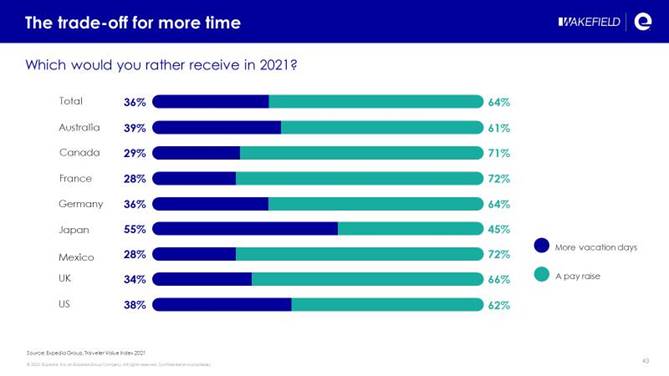
For example, the study found that more than one third of people would trade a pay raise for more vacation days and this was most prevalent in Japan, said Schulze. “Japan had the highest number choosing vacation days. During normal times, we see people not taking their full vacation time. As we move forward and people begin to travel again, I think they will prioritise personal vacation time. A lot has changed during the pandemic including how we work.”
Another value in which Japan scored highest was a preference for contactless technology. “The adoption of tech to ensure smooth travel is really important in Japan and we will highlight this value to our partners,” said Schulze.
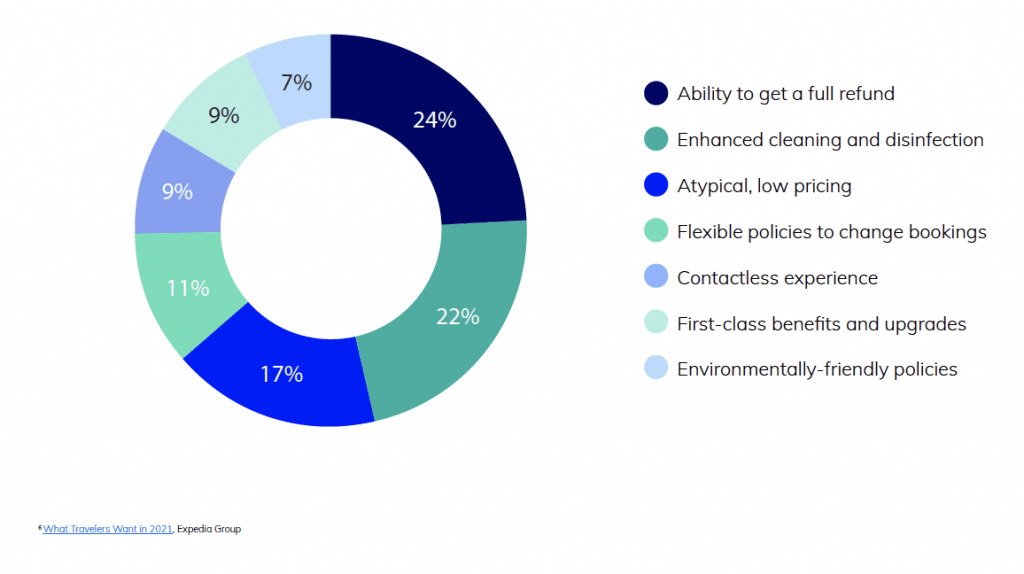
Younger travellers also veered towards contactless travel, but the number one value to travellers is the ability to get a refund on cancelled hotel bookings. However, this value varies across different generational groups. Travellers under the age of 40 in the US and Japan rank enhanced cleaning the most important, while also valuing contactless experiences and premium benefits, indicating that younger groups are less focused on price and refunds.
The good news is, one in five travellers expect travel to be the thing they spend the most on in 2021. More than a third (34%) of travellers have larger travel budgets now compared to 2020. Breaking down the findings, it found that:
• Travel will be the top spending item for Gen Z and Millennials. However, home renovation projects are top for both Gen X and Boomers – by a slim margin.
• Travel will be top for men, but home renovation projects will be the top item for women.
• Australia, UK and Mexico are the countries where travel spending will be the top priority.
As for what travel does for them, 56% say new experiences are the top benefit of travel, 48% cited physical and mental wellness, 51% want to learn about new cultures and communities, and 33% “use travel to become a well-rounded person”.
While two-third overall prefer to drive, half plan to board a plane in the next 12 months. “Australians are the most eager to get on a plane,” said Schulze. They expect to travel by air at nearly the rate as car for their next trip, at 62% and 65% respectively.
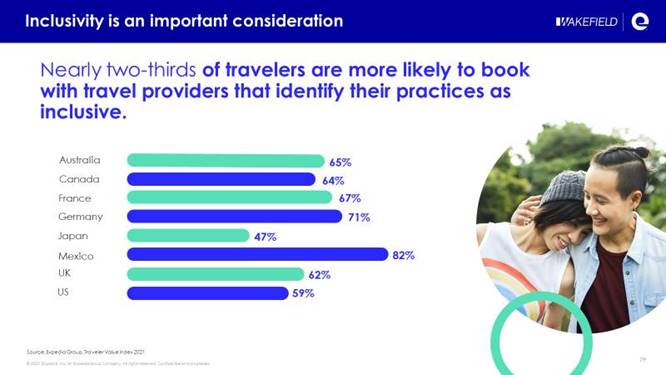
The study also found that three in five are willing to spend extra to make their trip more sustainable, including three quarters of Mexicans. And nearly two third are more likely to book with travel providers that identify their practices as inclusive. This is particularly important to German travelers, where nearly three quarters (71%) are more likely to book accommodation with inclusive policies.
Said Schulze, “There seems to be a sentiment for more authentic travel and experiences most aligned with “who I am” and even though actions may not always match the survey results, we have a responsibility to provide the right information and the right options to allow people to travel more aligned with their values.
“Can we make travel more enjoyable but, at the same time, more inclusive and sustainable? This comes out super clear in the survey. We have an opportunity as an industry to come out of this different. Customers want us to be different, they expect us to move forward.”
Having now made a couple of domestic trips in the US, Schulze said, “I have travelled through a few airports now. There is cleanliness but it is also not nice to spend a long time in queues. You want to move through efficiently and a lot of airlines are investing in that – kiosks – so that people can skip the line. It is an opportunity for travel providers to address some of these anxieties.”
And even though 81% of travellers say they will travel to a remote area, mountain or small town in the next 18 months, it’s not the end for big cities. Searches for major cities are increasing across Expedia’s marketplace: Las Vegas, (+40%), Melbourne (+90%), Paris (+30%) and Sydney (+85%).2
Schulze, who made his first business trip to New York City this month, said, “The city is extraordinarily active and alive, full of people re-emerging into the world. You can feel it. I felt thankful to be walking in the streets and be comfortable bumping into people. You can appreciate the re-emergence of life and travel.”