
Covering these three cities in a span of two weeks, I found interesting parallels in a world being flattened by the globalization of travel and technology.
Here’s Part 1 of the trilogy.
Let’s start with Tokyo. This city has suddenly become very hot. There was a time when it was more the Land of the Setting Sun – stagnant economy, devastation post-tsunami, ageing population. Now the sun is rising again.
In fact, the annual Cities in Motion Index (ICIM)has ranked Tokyo number one, citing “its impressive public management, technology, economy, and the ability to attract talent from all over the world”.
And as one of those global nomads who are always dreaming of the next place to live, for the first time, I find myself seriously thinking of Tokyo. Ten years ago, no. Too foreign. Too strange. Today, a possibility.
TripAdvisor’s second annual World City Survey has also rated Tokyo the best for travel experiences with global travellers ranking the city as #1 for helpfulness of locals, taxi service, local public transportation, and cleanliness of streets.
Anyone who’s been to Tokyo and got lost (which really means everyone) can vouch for the helpfulness of locals and taxi drivers. One even escorted me personally to the doorstep of a hard-to-find restaurant, to make sure I was in the right place.
One of the most repeated comments made by our overseas delegates attending WIT Japan was their surprise at the extent of English used by our speakers. The fact that the president director of Recruit Lifestyle, Yoshihiro Kitamura, chose to deliver his presentation in English (his first at a public event by the way) sends a strong signal of the determination by Japan Inc to change.
Local brands brace for global wave
As the doors open in Japan to foreign companies – brands such as Booking, Skyscanner, Trivago and TripAdvisor (seen here on the WIT Japan stage) are gaining traction in the market – local brands know they too have to change.
The globalization of travel and technology and the emergence of a new generation make that imperative.
Consider the Priceline Group juggernaut, whose market cap (as of May 9, 2014) was $59 billion. In 2013, the group recorded gross bookings of $39.2b, up 37% and in terms of units, sold 271m room nights, 44m rental car days and 8m air tickets. Mobile has also become a growth story for the group – $8 billion achieved on booking.com in 2013, up 160%.
When a group that’s as well-oiled as this comes into your market, you’d better watch out and change. Adrian Currie (second from left), senior vice president, corporate development, for the group, said the aim was to become domestically relevant in Japan and the group would take “small steps” to achieve its goal. It’s seeing good growth in the inbound segment, in parallel with the rise in inbound arrivals to Japan. Agoda’s strength in the South-east Asian market should give it an advantage in Japan.
Certainly online travel is where the growth is happening in Japan – players such as Rakuten, Jalan, iJTB and Ikyu (seen here on the stage at WIT Japan) are still seeing double-digit growth, outstripping the traditional segment. .jpg)
According to data supplied by Takanobu Yamamoto (extreme right), CEO, Rakuten Travel, the division achieved gross transaction volume of 547 billion yen (US$5.38 billion) in 2013, a 15.2% YoY growth.
Domestic hotel bookings totaled 46 million room nights. Mobile accounted for over 30% of bookings as of December 2103. The division achieved revenues of 34.7 billion yen in 2013 on an operating income of 13 billion yen and employs about 600 people directly in charge of the travel business.
While the bulk of packages are still being sold offline, with groups like JTB and HIS holding sway in the market, this segment is also moving online slowly.
Expedia Japan, with its new focus on air+hotel packages, has seen healthy adoption, according to Natsuko Kimura, head of marketing, Expedia North Asia (right).
And Trippiece, with its new social travelling model, is also seeing healthy traction with younger Japanese travellers although CEO & co-founder Ian Ishida (left) said his website was also being used by all generations of Japanese travellers who want something different.
“There is no age barrier, only mental barrier,” said the 20-something whose company has raised US$3 million and expanded its model to South-east Asia.
Start-ups tell the story of changing traveller needs – myRealTrip wins
The range of start-ups who took part in our WIT Japan Bootcamp is also a sign of where travel is going in the region and the pain points that need to be solved – mobile-only plays (same-day hotel bookings), hotel meta-search in Korea, P2P tour guide marketplaces, destination guides and social travel planning. Five start-ups from Japan and three from South Korea all presented in English.
Three finalists were chosen – Japanese travel destination guide, Matcha.com, and two P2P tour guide marketplaces, Triple Lights with Travelience (Japan) and myRealTrip (South Korea). 
The winner was myRealTrip, “an open marketplace for local guides and travelers that offers authentic customized guide service”.
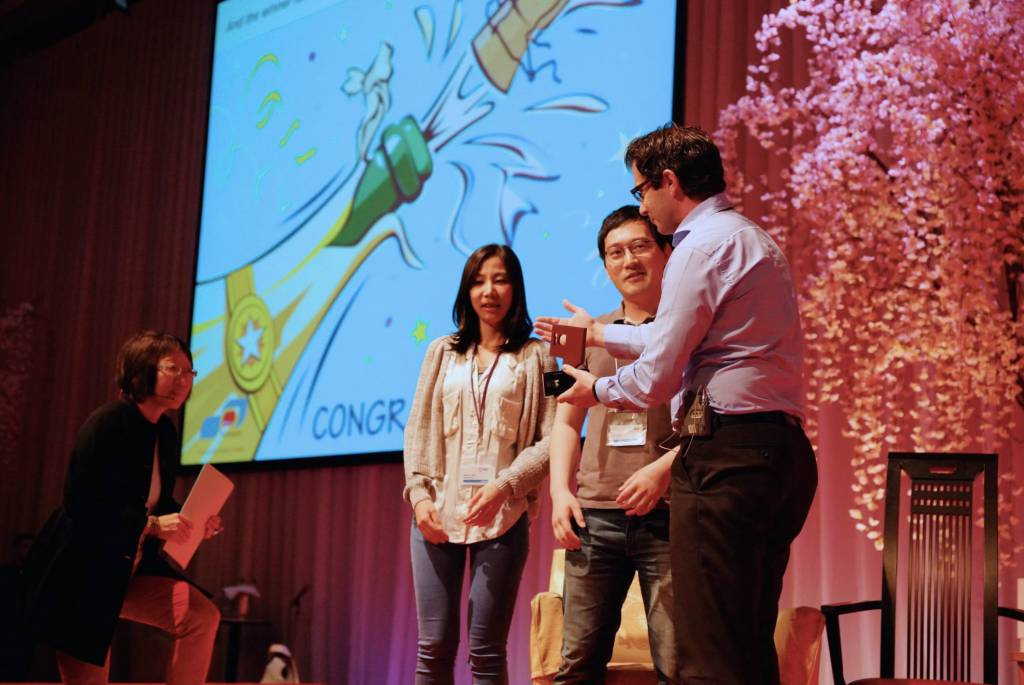
Donggun Lee (centre) winning the Startup of the Year.
The Seoul-based start-up, founded by Donggun Lee, CEO and CSO Minseo Baek, attempts to address the problem of Koreans travelling overseas as the market matures and travellers aspire to different kinds of experiences than those offered by traditional tour packages which typically offer “hectic itinerary, superficial travel experience and coercive shopping/option tours”.
The marketplace, which is receiving 230 reservations a week as of May, links travellers to local guides, allows them to make their own customized tours and travel with “their own group only”. It is backed by two funds, Primer and Bon Angels.
Korea’s another story altogether – price war raging between two giants
Korea is an interesting market – highly connected yet travel remains in the hands of traditional travel brands. But that’s changing slowly. Korea is probably where Japan was three to five years ago, said Min Yoon, CEO of TideSquare, which runs Privia, a private member travel website.
But with mobile, this change could be compressed and accelerated, he said. That Korea is dominated by Samsung and LG makes the market an easier one to crack mobile-wise, say some pundits. Hyuk Park, head of planning for Jeju Air, said the battle seemed to be in the 5-and-a-half inch screen, with Samsung pushing that model aggressively.
Currently the top two players in online travel – Interpark and HANA Tour – are engaged in a price war. Interpark, the “Taobao” of South Korea, has made impressive moves into the travel space. The group, which started the first online shopping mall in Korea in 1996, achieved total revenues of 385 billion won (US$377 million) in 2013 and claims 40% domestic flight market share and 15% domestic hotel reservation market share.
Charlie Park (centre), general manager, HotelFIT for Hana Tour, said the company recognizes the need to go online to protect its business for the future. “The market is definitely changing and we need to build for the next generation of consumers.”
Wang Hee Soon, senior manager of planning division, Interpark (right), made no bones about the fact that both were competing head-on and said hotels was the big opportunity for Interpark.
Min, whose company achieved revenues of 134 billion won in 2013, said that more than 25% of customers who book hotels on his site go on to book flights.
Multi-screen’s the new word
Mobile’s an old story in Japan, yet these days, multi-screen’s the word. Toru Matsunami, industry head for travel, Google (speaking in English), said Japanese consumers now lived in a multi-screen world. More than 50% use smartphones at the beginning and in the middle for product research.
And while travel queries in Japan were growing 20% year on year – Japan is still the number one market in APAC for travel queries – the biggest growth was coming from smartphones, with 57% of queries coming through that channel.
“We have to pay more attention to the importance of smartphone and also the growing importance of multi-screen development,” he said.
Incidentally, did I mention that the Korean panel was also conducted in English? Yes, the times, they are a-changing.
Next week: Dublin