Tripadvisor’s “Covid-19: The Road to Recovery for the Travel Industry” report outlines five key stages of recovery, and offered guidance to hospitality businesses, destinations, brands and advertisers on what actions should be taken at each stage to make sure they emerge as strong as possible.
Said Kanika Soni, chief commercial officer, Tripadvisor, “While travel restrictions remain in place, the short-term focus for many businesses is understandably on finding a way to stay afloat by managing costs and, where possible, finding new, inventive ways to reach and attract customers. Yet there remains a longer-term question, and it is one that leaves many businesses and advertisers in our sector uncertain as to how to plan for the future.”
“A global recovery that will come in five distinct stages: Decline, Plateau, Emerge, Domestic and International. An industry that will need to adapt in order to prosper, as new travel norms emerge. A future that can only be achieved through collective responsibility and thoughtful action.”
The five stages identified are:
- Decline – the early stages of social distancing and sharp travel decline
- Plateau – all potential travellers ‘stay inside’ to flatten the curve
- Emerge – the easing of lockdown restrictions and the re-opening of local businesses
- Domestic – growing confidence in travel, but mainly limited to within home countries
- International – the final stage, people feel comfortable travelling abroad
The Decline Stage
Travel companies are already starkly aware of the sharp decline in travel bookings and cancellations that occurred in the early stages of the Covid-19 pandemic. However, Tripadvisor data identified that 34% of consumers surveyed in late March reported rescheduling their trip instead of cancelling it. 40% of those who rescheduled said they did not do so out of choice, but because of imposed travel restrictions. Over a quarter (27%) of those who cancelled trips indicated intent to reschedule at a later date. Overall, it inferred “resilience in the way consumers were thinking about travel. Even in the face of a new and sudden crisis, many of us were still dreaming of our next trip.”
The Plateau Stage
As mandated limits on both travel and domestic movement were imposed, a decline and plateau in travel bookings naturally followed. Nevertheless, Tripadvisor reported that 68% of consumers were still thinking about travel and where they wanted to go next in April. 32% reported watching destination videos for inspiration and 18% reported watching travel shows or documentaries. Searches for domestic travel more than 90 days away increased in markets like USA, Germany, Australia and Japan. “All of this points to one key underlying trend: there remains significant pent-up consumer demand for travel.”
The Emerge Stage
With this pent-up intent in mind, Tripadvisor stated it was critical to consider how travel restrictions will affect consumer mindsets long-term, even once they are lifted. For example, will the fear of a second wave make social-distancing practices a new norm? And how likely are people to resume once-normal activities like dining in a busy restaurant?
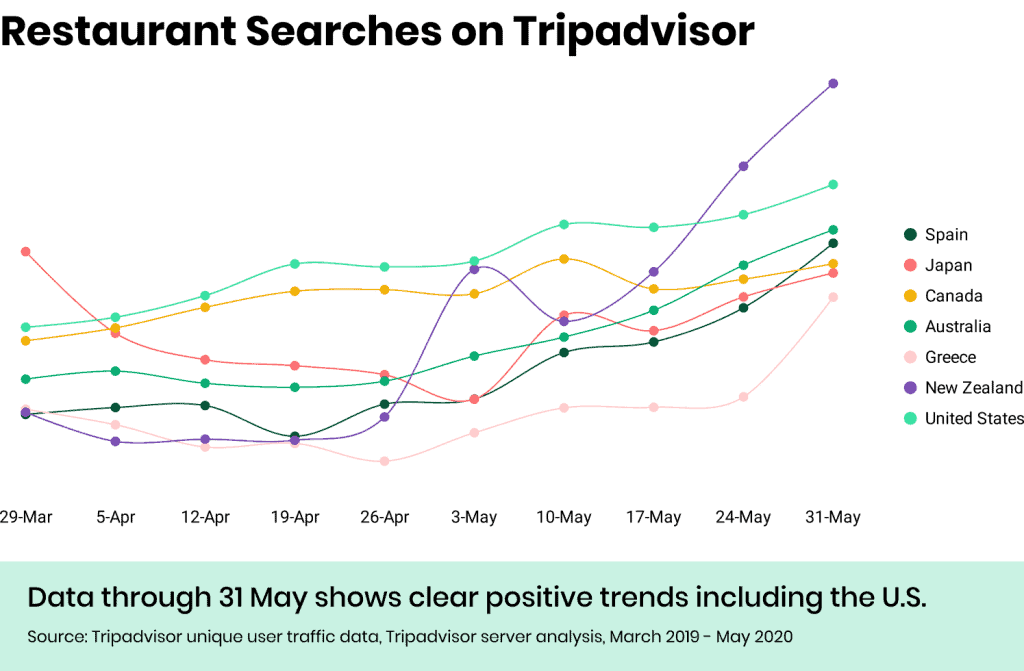
The report identified the dining sector as cause for optimism. Traffic to restaurant pages in New Zealand showed strong recovery, followed by Germany, Switzerland and Spain as local travel restrictions are eased.
However, a major caveat is the shift in attitudes towards cleanliness and safety, which will temper consumer confidence. Less than half (42%) of consumers say they will dine-in at restaurants as they did before. More than a third of consumers (35%) said they will choose restaurants that make a point of keeping customers safe. 16% will avoid dine-in experiences altogether.
This is also generally mirrored in hospitality and experiences. 86% of consumers marked cleanliness as an important factor when choosing accommodation. 82% stated frequent disinfection of “high-contact” surfaces will be important when booking tours, activities and attractions.
While businesses that address these consumer demands will likely have a head start in recovery, the report said the “Emerge” stage will last a significant period of time. This is also because of changes in spending power, given the pandemic’s economic repercussions.
Two in five (40%) consumers report their household will be worse off financially in the next 12 months, around the same number (43%) expect their financial position to be about the same as it is now, while only one in six (17%) expect to be better off.
Two thirds of consumers (59%) are likely to take fewer trips in the next twelve months than in the year previous, around two in five (41%) are optimistic that they will take the same or more trips than last year.
The Domestic Stage
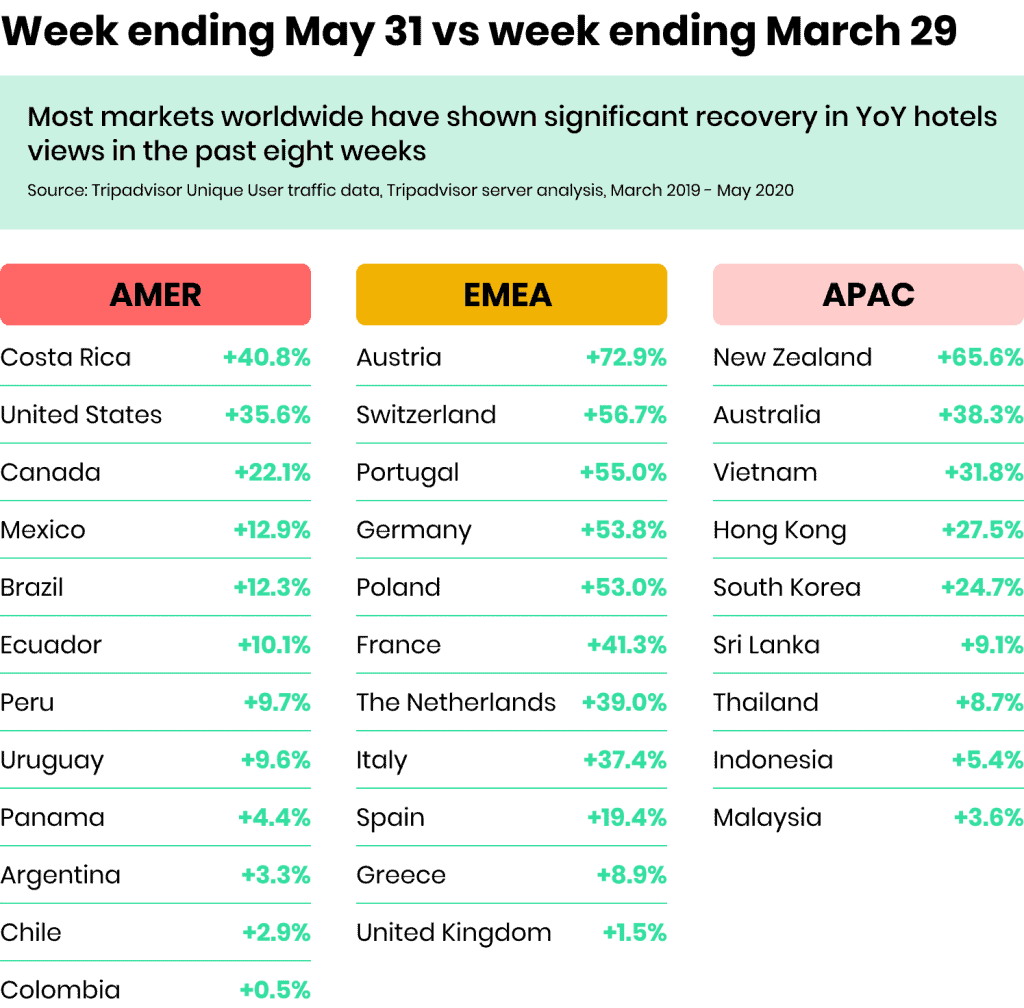
The report illustrated that most international markets have shown significant YoY recovery in the past eight weeks, with New Zealand, Australia, Vietnam, Hong Kong and South Korea being the top five rebounding markets in APAC.
Looking at domestic travel trends more closely, nearly half (44%) of consumers said they are more likely to take a road trip, and two thirds (61%) are most comfortable taking a road trip for three to five days.
The report also predicted that there will be a growing preference for emerging destinatins that tend to draw smaller crowds. “Consumers are 218% more likely to want to take a trip where they can relax compared to before the pandemic, and nearly two thirds (59%) report they would prefer to go somewhere off the beaten path versus a popular destination post COVID-19.” Beach and nature destinations will benefit the most in this regard, as they are considered environments most conducive to social distancing.
The International Stage
Nearly half (43%) consumers believe their next trip internationally will be more than a year from today, compared to only a quarter (26%) who expect it to be within six months and 31% who believe it will be somewhere between seven to twelve months. Short-haul trips will likely be the first to recovery, with 28% of respondents wanting to take a short international flight (three to four hours).
Overall, international travel’s recovery will take significantly longer to reach normality, as different countries deal with their own set of individual circumstances that will impact both inbound and outbound markets.
“There are many different factors that will determine how quickly outbound and inbound international travel recovers in each market, and the two may not always go hand in hand. Many destinations will face a delicate balancing act to protect the quality of the inbound tourist experience while also ensuring that travellers regard it as a safe place to visit.”
41% consumers reported the lifting of stay-at-home orders and lifting travel restrictions as the biggest sign of the return to normal, but 20% saw school and office reopenings as major indicators too.
What the five stages mean for: destinations and DMOs
- Focus efforts on domestic – “Destinations should be employing upper-funnel strategies, specifically in drive markets, to ensure they’re poised to capture pent-up consumer demand.”
- Promote attractions capable of social distancing – Outdoor attractions and cultural sites that tend to draw less crowds or densely-populated areas will tend to fare best as the majority of consumers report wanting to visit “off-the-beaten-path” destinations.
- Confidence in cleanliness – Cleanliness is critical to rebuilding consumer confidence. 84% of consumers regard sanitisation certificates as important. 79% reported that public displays of compliance to government safety standards would also help ease their minds.
- Help consumers relax – Boosting attractions and activities that can reduce consumer anxiety will fare well, as travellers want to leave the stress of the pandemic behind and seek out travel as a form of mental escape.
What the five stages mean for: accommodation providers
- Focus on safety, flexibility and transparency – Accommodation providers must rebuild trust and confidence with their consumers, if they are to encourage them to click ‘book’. Implementing flexible cancellation policies while travel remains unsteady can help ease their minds in this regard. Guest feedback can also be key, as travellers look to others’ experiences, to get a sense of how effectively and well post-pandemic measures are being handled.
- Reset and prepare – Re-evaluate your online presence and marketing channels to see where improvements can be made. Ensure all information is up to date and consider strengthening your digital strategy.
- Differentiate your brand – Understand what consumers are looking for and see how your brand can cater to those needs. “Consider different ways you can offer real added value that stands out from the competition — and focus on showcasing it to the right target markets… Once you’ve identified those areas of value, build a cross-platform marketing plan that promotes them to travelers across your website, social channels and planning platforms, so that the unique aspects of your offering really stand out.”
- Throw out old data, focus on current information – Pre-pandemic data will be difficult to apply in a post-pandemic world, given we now live in a wholly new environment. When building a new marketing strategy, adopt a test-and-learn approach so that you can adapt messaging quickly and easily, should circumstances change.
What the five stages mean for: tours and activities
- Publish protocols – 53% of consumers stated they will do more research when trip-planning post-COVID-19. Consumers are actively seeking health and safety information right now… Make this information clear, accessible and digestible for travelers to provide reassurance and encourage bookings.”
- Offer private and small group options – “As consumers consider traveling again, three in five (62%) have said private tours are most appealing… As more travellers take trips in smaller groups, consider small group tours and private tours as alternatives.”
- Flexible booking and cancellation policies – 76% of respondents say that flexible cancellation policies extremely important when booking, because of perceived risks around travel. Catering to that demand will give consumers ease of mind, and industry recovery continues.
What the five stages mean for: F&B
- Focus on marketing – Approach reopening your restaurant as you would if you were launching a new one. “Focus on high-impact places diners see when they search for your business or food in your local market, including your website, social media channels and planning platforms.”
- Stay ahead of business updates – If operation hours or service levels may change, update the various places where they may seek out information about your business to avoid miscommunication.
- Diversify your business – “Takeout and delivery, as well as catering and gift cards, should remain an important part of your strategy moving forward. Be sure you’re promoting those services on both your website and social channels to ensure you’re appealing to diners who may want to experience your business in these new ways — or to those who may not be comfortable returning for dine-in service just yet.”
- Share your story – Fresh content and reviews can help other customers get an idea of what a dining experience is like at your establishment. Encourage customers to leave feedback online – whether they are dining in or ordering delivery.
What the five stages mean for: brands
- Creative messaging must be current – “95% of consumers say brands should focus more on positive communications during this time, and 81% say they want to hear more heartfelt language used in these communications.” Focusing on optimism will encourage consumers to build positive connections with your band.
- Focus on value – In light of economic uncertainty, value will be critically important for customers. Focus on offering as much as you can in your proposition.
- Make a positive impact, beyond your brand – 81% of respondents said how well a brand responds during this crisis will impact on their likelihood to buy that brand in the future. Brands that can build a strong sense of community – e.g. through non-profit initiatives – will have a deeper connection with its customer base. “This is an opportunity for brands to engage consumers in a non-transactional capacity and introduce themselves to a new community of brand loyalists.”