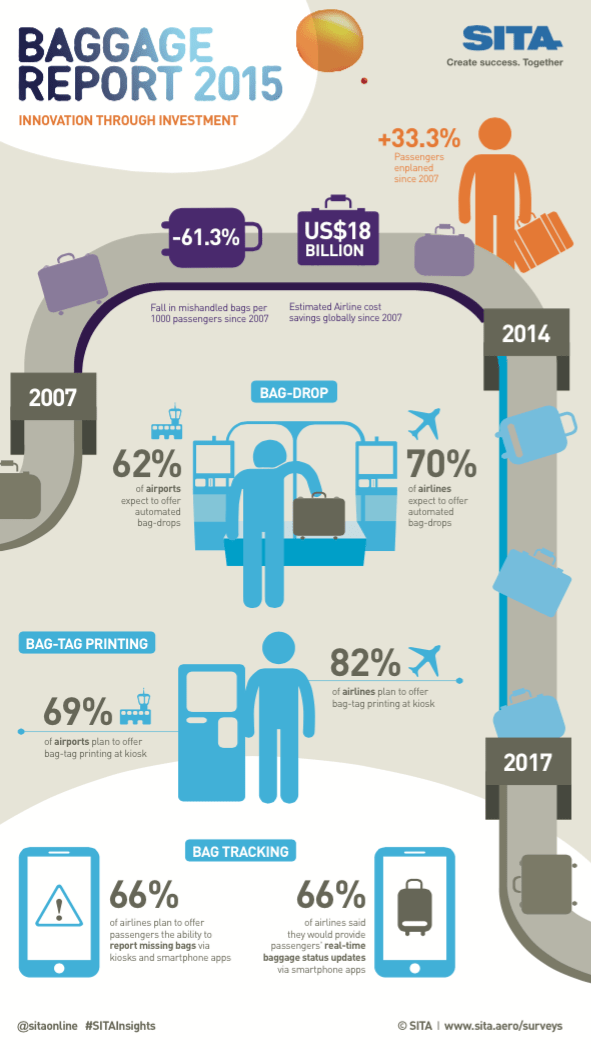
Technology invesment has led to a fall in mishandled bag rate by 61.3% in the past seven years leading to a US$18 billion in estimated cost saving for the air transport industry, according to air transport IT specialist SITA.
The SITA 2015 Baggage Report (see infographic below), which was released last week, showed that the rate of mishandled bags in 2014 was 7.3 bags per thousand passengers, down from a peak of 18.88 bags per thousand passengers in 2007.
This decline comes despite a significant rise in passenger numbers over the same time period, peaking at 3.3 billion passengers in 2014, said SITA that regards a mishandled bag as checked baggage that is delayed, damaged, pilfered, lost or stolen.
According to the report, global passenger numbers rose 5.5% and aircraft load factors increased globally to 79.7% from 2013 to 2014. This increased pressure on existing systems nudged the rate of bag mishandling up in 2014 to 7.3 bags per thousand passengers, from its all-time low of 6.96 the previous year.
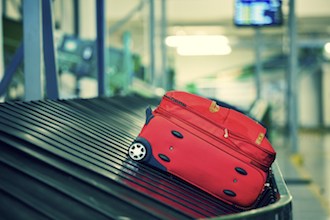
Last year transfers between connecting flights was the main cause of delayed baggage. (Image credit: Chalabala/iStock)
More than 80% of the mishandled bags in 2014 were delayed, with transfers between connecting flights the leading cause of late delivery. In the same year, mishandled transfer bags accounted for 49% of all delayed bags or 11.81 million bags. However, the majority of bags were reunited with passengers within one to two days.
In its 2014 Airport IT Trends Survey, SITA listed baggage processing and management as among airports’ top investment priorities, with investments in self-service processes such as kiosk and bag-drop technology leading the way.
Over the next three years 59% of airports said they would invest in major self-service programmes, as passengers increasingly express a desire to have more control over their journeys, including their baggage.
By 2017 around 69% of airlines said they would provide passengers with real-time updates on the location of their bags, with 66% looking to provide these updates via smartphone apps.
In addition, both airlines and airports are looking for new ways to enable passengers to file missing bag reports themselves. Around 18% of airlines already offer passengers the ability to report missing bags via self-service kiosks and 10% via smartphone apps; by 2017, nearly two-thirds of airlines expect to offer these services.
Baggage tracking is set to improve further in coming years as a result of IATA Resolution 753: Baggage Tracking. The resolution, which goes into effect in 2018, requires IATA members to “maintain an accurate inventory of baggage by monitoring the acquisition and delivery of baggage.”
For example, BagJourney, SITA’s end-to-end baggage tracking solution for the air transport community, provides a cost-efficient and accurate method of tracking passengers’ bags anywhere along their journey from check-in to the destination airport. It can also enable passengers to access information on the location of their bags at any time when the airline provides this service and passengers subscribe to it.
SITA’s proprietary BagMessage system delivers more than 2.5 billion messages between airline departure control systems and automated baggage systems annually. And more than 2,800 airport locations use WorldTracer, SITA’s system which traces mishandled bags globally.
Francesco Violante, CEO of SITA, said the improvement in baggage handling over the past seven years was largely due to strong technology investment and innovation in baggage systems automation and processes.
“However, rising passenger numbers will continue to place pressure on baggage infrastructure and processes, so the industry cannot afford to become complacent. With IATA forecasting continued passenger growth of around 7% in 2015, all industry partners will need to continue to invest, collaborate and focus on baggage management,” he added.
• Download the full SITA 2015 Baggage Report here.